
14-08-2016 23:15
 Alex Akulov
Dear friendsCan you help me to find the descriptio

05-06-2026 11:02
Thomas Læssøehttps://svampe.databasen.org/observations/10596691
04-06-2026 11:36
Gernot FriebesHi,found on Vaccinium myrtillus.Asci: IKI –, 8-s
05-06-2026 12:10
 François Freléchoux
Capitotricha sp. sur Lonicea caerulea Caractères
19-05-2026 10:27
Patrice TANCHAUDBonjour, récolte récente sur terre retournée i
04-06-2026 18:39
Gernot FriebesHi,I collected this species in two different locat
22-05-2026 13:29
Gernot FriebesHi,I am curious to hear your opinion on this mater
 • Macro and habitat suggest Rutstroemia, and possibly R. firma.
• Seems to be confirmed by spores etc.
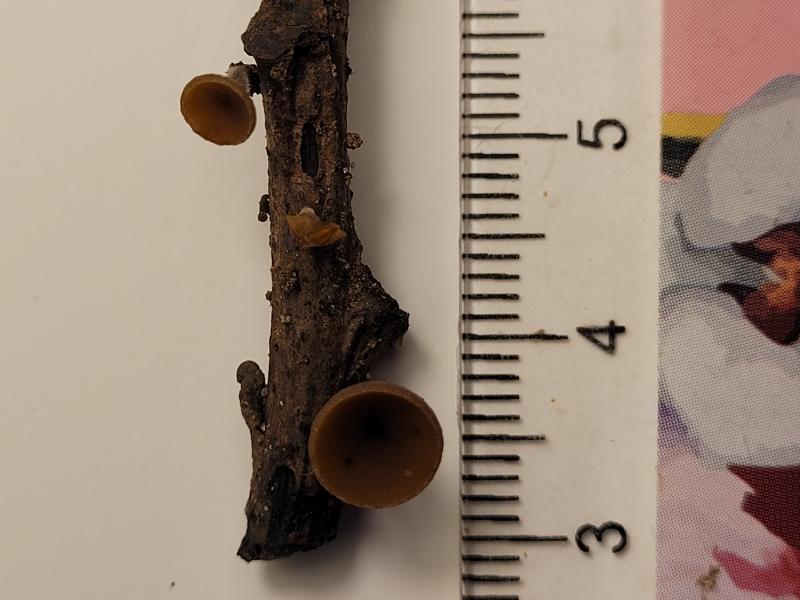
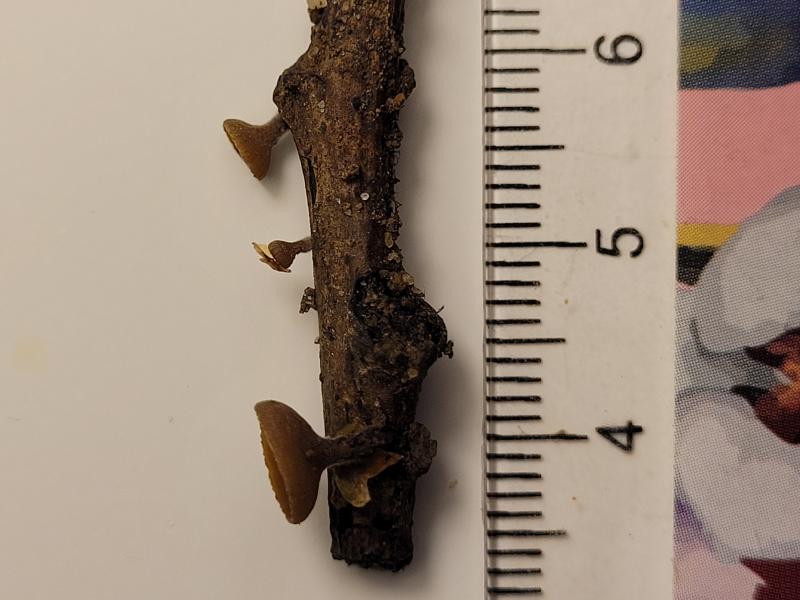
Habitat: On a short twig, looks like Quercus, apparently on the ground (not observed in situ), damp and muddy area, by a large pond, mixed deciduous woodland, Low Weald, England, late-September, after rain.
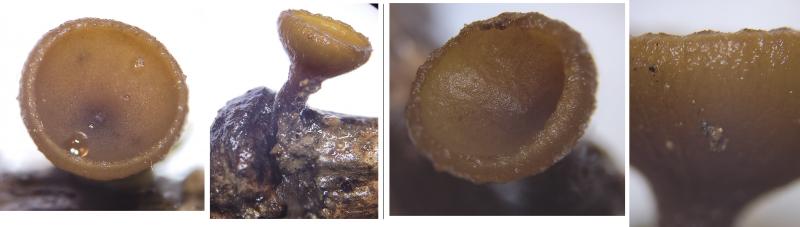
Apothecia: Medium-size Rutstroemia-like, four counted on the twig, loosely grouped, varying stages of maturity, diameter < ~6.5 mm, stipe < ~4 mm (relatively short), orangish-brown, cupulate, receptacle with uneven appearance, covered by a network of darker hyphae, margin distinct, round, bumpy or uneven appearance due to glassy exudate (around marginal hairs), remaining slightly raised above the disc, stipe mostly blackened from the base, covered with short whitish hairs (long hyaline hyphae) under low magnification, disc concave but becoming more plane, shallow, opaque, dull and slightly darker appearance, but lighter and grainy appearance with darker flecks (paraphyses) under low magnification, some localised blackening around the base.
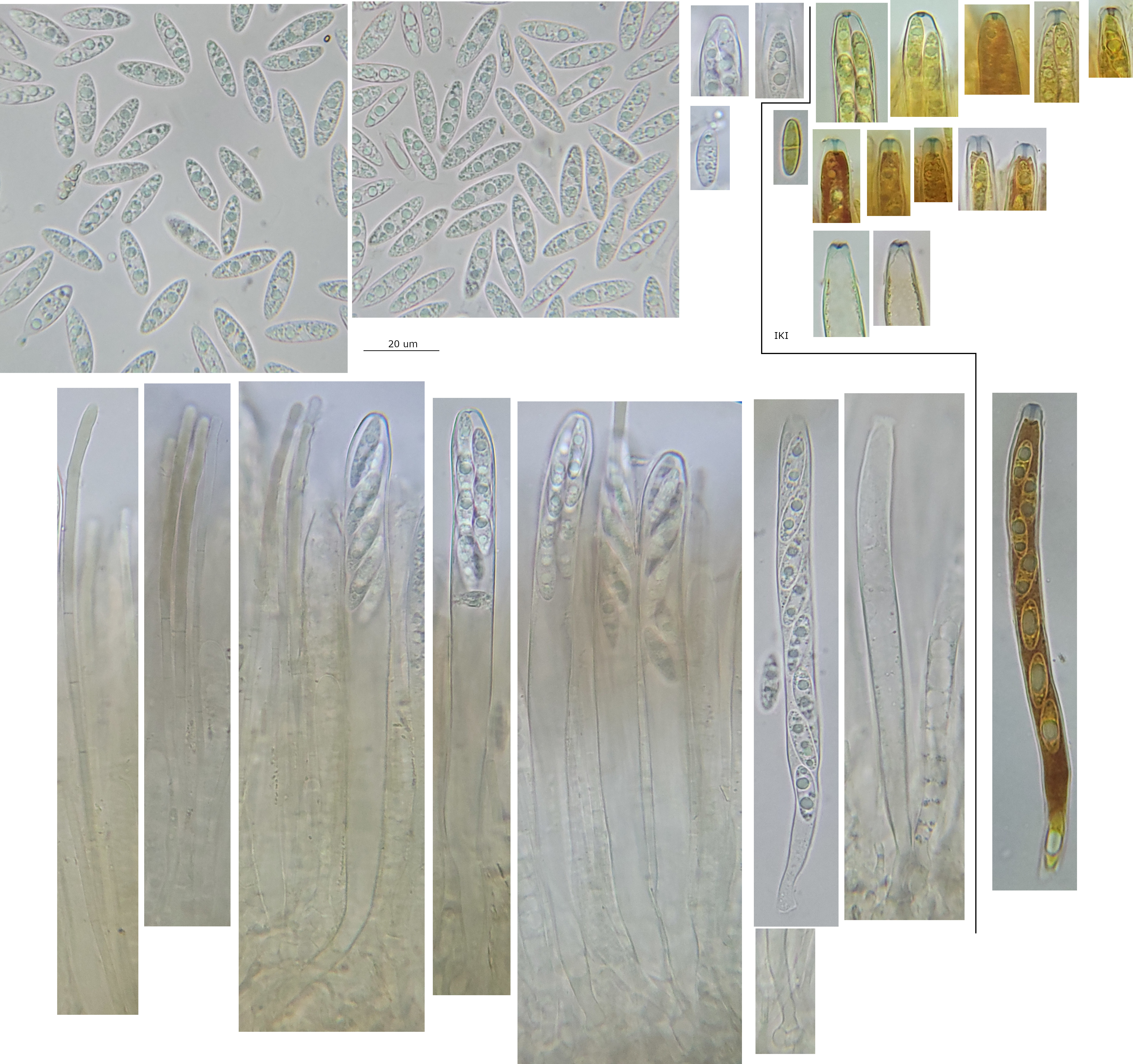
Asci: Narrowly cylindrical-clavate, croziers, rings mostly bb but occasionally more dirty rb, form seems typical Rutstroemia, apex rounded-conical when turgid and more acute-truncate when flaccid, more hemispherical when immature, thickening substantial when immature or flacid, obtusely biseriate when turgid, not inverting post discharge, after some time many asci discharging in water mount.
Spores: Ellipsoid, homopolar, poles rounded-acute, length varies considerably, usually two large and conspicuous LBs and a smaller one towards each pole (smaller more extreme), and many much smaller ones, free spores occasionally with 1-3 (5?) septa, each cell with a predominant LB (larger towards the centre), some budding from the poles (not seen in asci), ascoconidia < ~ 4 x 3 um with one relatively large LB, budding spores shorter and wider with less or smaller LBs (some moving to ascoconidia).
Free spores in water (not budding): (15) 15.8 - 18.9 (19.3) × (4.3) 4.8 - 5.8 (6.0) µm, Q = (2.9) 3.0 - 3.7 (3.9), n = 30, mean = 17.6 × 5.4 µm, Q mean = 3.3.
Paraphyses: Cylindrical, width ~ 2.5-3.5 (4) um, multi-septate (some with at least 5), apical cell usually longer (< 3.5x), this with cylindrical VBs, strongly pigmented dirty-yellow, more reddish en masse, apex usually slightly inflated and occasionally irregular, no branching observed close to the apex.
Excipulum etc. looks typical for Rutstroemia.
 Hymenium-0014.jpeg
 Excipulum-0007.jpeg
Your idea about the spore shapes is interesting, and some examples in the Quercus folder look quite different to these ones. Boudier's drawing is difficult to categorise on curvature but some of the spores have the more heteropolar shape. Do you know of a type specimen? The older descriptions have no microscopic details and the lectotype details on IF seem strange.
I can mail a sample to Pablo for ITS, but then we need a sequence from the other phenotype to test the hypothesis.