
02-06-2026 14:33
 Nicolas VAN VOOREN
Hello.I'm searching for a PDF copy of the followin
02-06-2026 17:58
Louis DENYBonjour forum, Sur feuille de Populus tremula, en

28-07-2011 18:31
 Alex Akulov
Dear FriendsToday I made the pdf file of Velenovsk
11-09-2025 16:57
 Jason Karakehian
Our revision of Marthamycetales (Leotiomycetes) is
12-11-2019 10:32
 Miguel Ángel Ribes
Hi againExactly at the same place than my previous
25-12-2019 17:54
Valencia Lopez Francisco JavierHola a todos/asEstas supuestas pezizas estaban en
12-07-2015 00:05
 Nedim Jukic
This one from the same locality as the previous on

30-05-2026 21:12
Philippe PELLICIERSur branche de mélèze (Larix) près de la neige,
 Hi to everybody
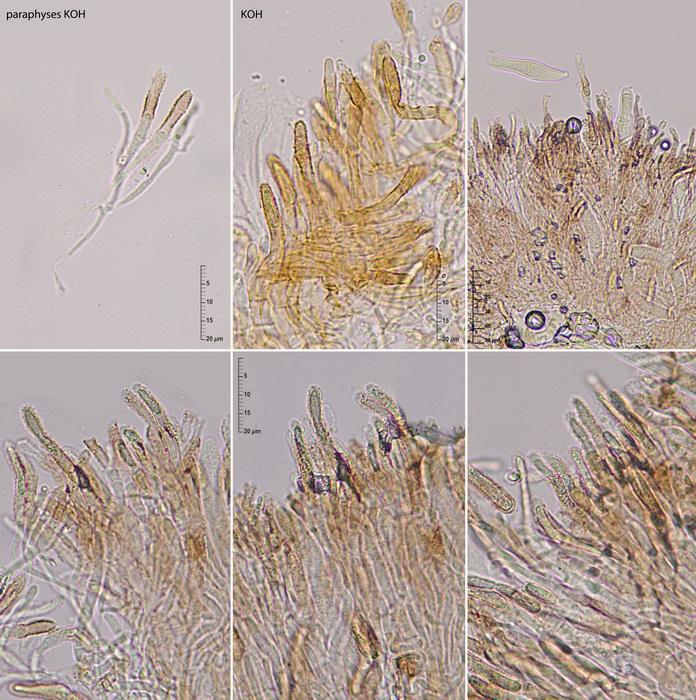
Some time ago my friend M. Tapia, from Navarra (NE of Spain) sent me this strange, gregarious, turbinate, 0.2-0.5 mm in diam., pale grayish-brownish with brownish pruinose hymenium surface by the existence of a brownish, verruculose, granulate, matter that not dissolves in KOH, growing on old leaves of Cornus sanguinea.
The apothecia seems to be glabrous, and many leaves have hyaline or translucent gelatinous conidiomata perhaps belonging to his asexual morph.
The asci are IKI negative, with no croziers and the ascospores do not turn darker. I could see that some paraphyses have VBs that stain in cresyl blue. Excipulum made by prismatical to roundish cells.
Some idea will be wellcome
Thanks again




I have nothing in my database on Cornus leaves with such spore size.
Only the anamorph reminds me of a Pilidium.
Thanks again
PD. If you want, I could send you the images at higher resolution

Hi Enrique,
yes - as Zotto said a very interesting fungus. It reminds me of a Trochila or something like this, but if Zotto is quiet about the genus, I should be quiet, too ....
Could you add the finding-date? It could be interesting for other people to look for this fungus - as Cornus sanguinea is a very widespread host.
Thanks and best regards from Lothar
P.S. Rehm (1896) describes a Naevia carneopallida (Rob.) growing on Cornus sanguinea-leaves. Unfortunately, the data do not fit at all ...

The paraphyses reminded me of a Coronellaria species but I think that ENrique you tried CRB and that it does not produce the same reaction .
Bravo anyway (again)
Amitiés
Michel
Coronellaria is a nice idea, but I am used to see multiguttulate contents in that genus.
Zotto
Coronellaria is a nice idea, but the paraphyses are not multiguttulate and lacks an hemiamyloid apical apparatus in the asci. The collection was made on novemebre 17 2016. This collection should be sequenzad, but my study was made with somewhat old specimens. Maybe on next year Mikel will be able to collect newly this fungus.
Thanks to all.