
06-05-2026 11:25
 Castillo Joseba
Me mandan el material seco de Galicia (España) re
06-05-2026 17:23
Thomas Læssøehttps://svampe.databasen.org/observations/10594257
28-04-2026 20:07
 Lothar Krieglsteiner
... on twig in the air at standing Ceratonia siliq
05-05-2026 22:40
Gernot FriebesHi,I believe this is a Plagiostoma growing on a Sa
04-05-2026 18:13
 Stephen Martin Mifsud
ID request for what seems to be a true aquatic fun
04-05-2026 16:39
Stephen Martin Mifsud
ID request: This specimen was collected in Malta o
28-07-2011 18:31
 Alex Akulov
Dear FriendsToday I made the pdf file of Velenovsk
04-05-2026 09:50
Castillo Joseba
Me mandan el material seco de Galicia,(España) re
02-05-2026 12:42
Alain BRISSARDBonjour à tousJeuidi 30 avril dernier on m'a remi
Otidea leporina ? Pale Brownish Buff Fruit Body
Peter Thompson,
27-11-2014 10:28
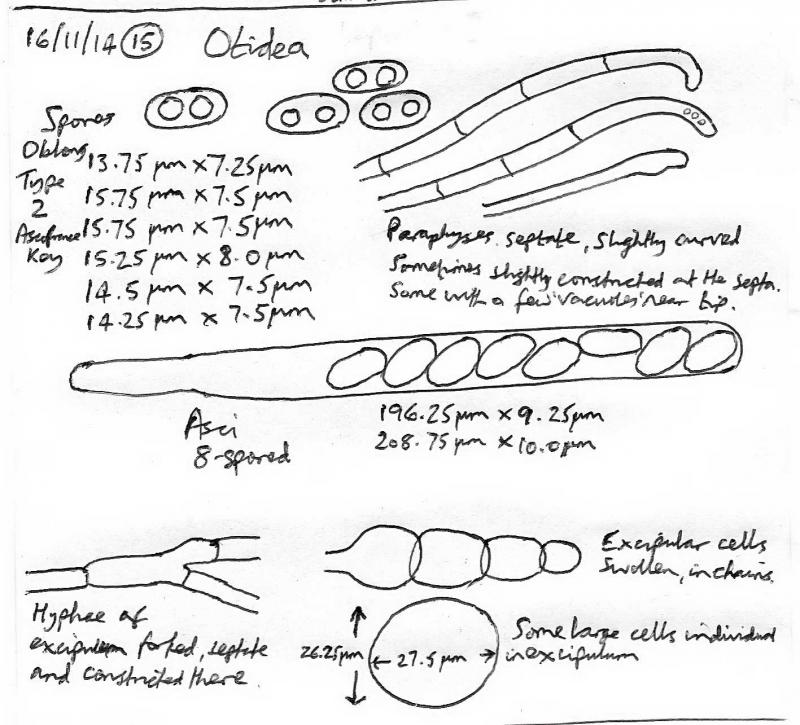
I recently collected a fruitbody of a pale brownish buff Otidea, with evenly coloured hymenium and exterior. It was about 45mm high, ear shaped, split down one side and adjacent to the photographed group.
The fruit body has some tousled white fibres near the base.
The photo is well compressed and some yellow and pink tints have resulted. These were not seen on the actual fruit bodies.
Using Nicolas Van Vooren's Otidea key, I arrive at O. leporina as the closest species.
The photo of the fruit bodies and a sketch of the microscopy are attached.
I wonder if I have correctly identified it?
Thank you,
With Best Wishes,
Peter.

Nicolas VAN VOOREN,
01-12-2014 08:01

Re : Otidea leporina ? Pale Brownish Buff Fruit Body
Difficult to be affirmative with your data and photograph, but if the spore shape is really oblong, so your collection enters in the Otidea alutacea complex.
O. leporina has more ellipsoid spores.
O. leporina has more ellipsoid spores.