
06-05-2026 17:23
Thomas Læssøehttps://svampe.databasen.org/observations/10594257
06-05-2026 11:25
 Castillo Joseba
Me mandan el material seco de Galicia (España) re
28-04-2026 20:07
 Lothar Krieglsteiner
... on twig in the air at standing Ceratonia siliq
05-05-2026 22:40
Gernot FriebesHi,I believe this is a Plagiostoma growing on a Sa
04-05-2026 18:13
 Stephen Martin Mifsud
ID request for what seems to be a true aquatic fun
04-05-2026 16:39
Stephen Martin Mifsud
ID request: This specimen was collected in Malta o
28-07-2011 18:31
 Alex Akulov
Dear FriendsToday I made the pdf file of Velenovsk
04-05-2026 09:50
Castillo Joseba
Me mandan el material seco de Galicia,(España) re
02-05-2026 12:42
Alain BRISSARDBonjour à tousJeuidi 30 avril dernier on m'a remi
Scutellinia
Dieter Slos,
27-10-2013 19:03
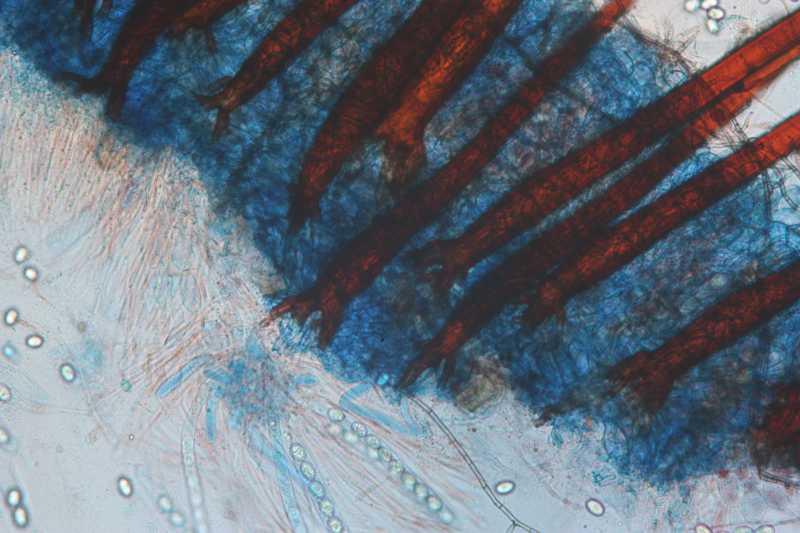
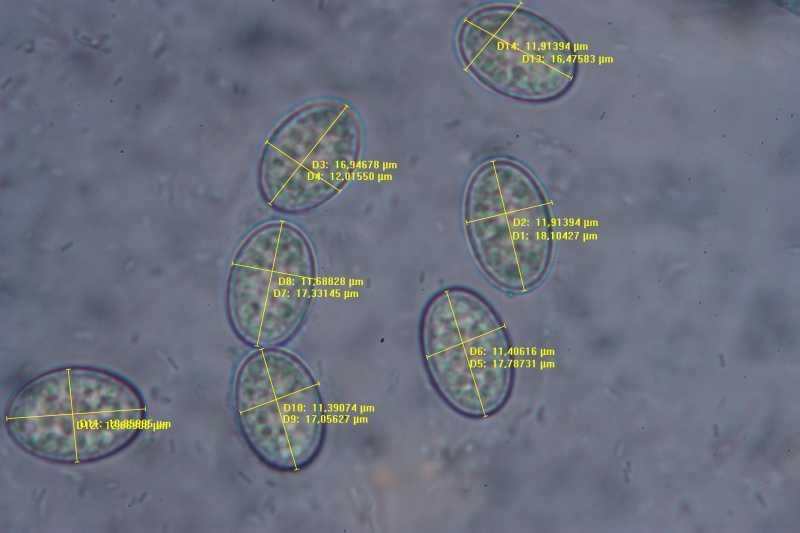
Nicolas VAN VOOREN,
27-10-2013 20:17

Re : Scutellinia
What is the spore ornamentation? Without this information, it is impossible to help you...
Dieter Slos,
27-10-2013 20:20
Re : Scutellinia
It appears smooth to me. Pictures are in cotton blue. The only thing I see is as in the picture that the edges are not perfectly smooth. I can put them under a DIC microscope tomorrow.
Beñat Jeannerot,
28-10-2013 08:38

Re : Scutellinia
Adio Dieter,
It's very important to give us more data. No help is possible without some things like :
- Where ? Country is important. For example, here, if the collection is european, it's probably S. crinita.
- Sporal ornementation in BC as Nico said. It's VERY important in this genus. Sometimes, ornementation of S. crinita is difficult to see because composed by minutely warts...For example, a lot of herbarium specimens which are determined S. setosa are crinita in reality, misidentified because "apparently" smooth.
- hairs measurements : measure of base of hairs, average of length...
Here, I suspect (at 99%), S. crinita, if this collection is european. In europe, there isn't a lot of species on wood with long hairs and this form of spores...
Beñat
It's very important to give us more data. No help is possible without some things like :
- Where ? Country is important. For example, here, if the collection is european, it's probably S. crinita.
- Sporal ornementation in BC as Nico said. It's VERY important in this genus. Sometimes, ornementation of S. crinita is difficult to see because composed by minutely warts...For example, a lot of herbarium specimens which are determined S. setosa are crinita in reality, misidentified because "apparently" smooth.
- hairs measurements : measure of base of hairs, average of length...
Here, I suspect (at 99%), S. crinita, if this collection is european. In europe, there isn't a lot of species on wood with long hairs and this form of spores...
Beñat
Dieter Slos,
28-10-2013 09:17
Re : Scutellinia
Location is Belgium, the rest of the data I will provide you tonight.
Thanks for the help so far! :)
Thanks for the help so far! :)
Dieter Slos,
29-10-2013 10:59
Re : Scutellinia
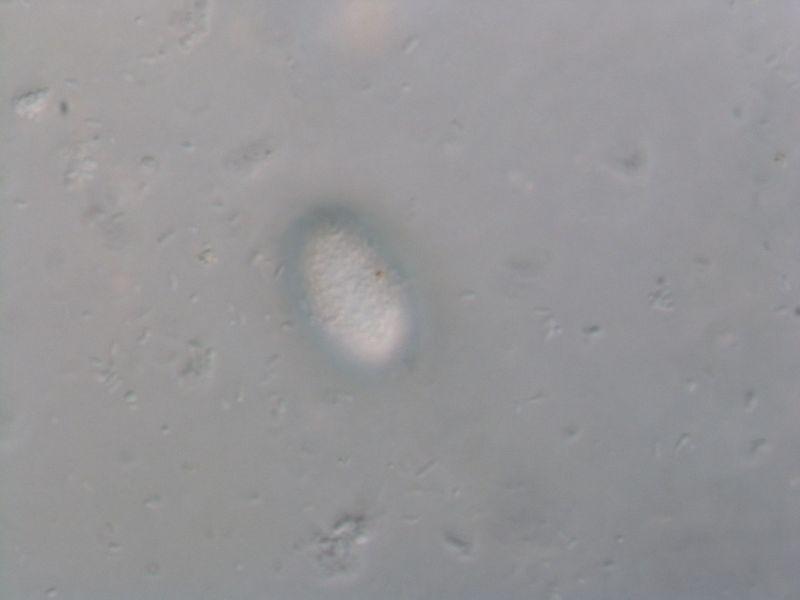
Measurements of the hairs on average 666.8 µm. Maximum 1350 µm. Ornamentation as in picture. With base of hairs you mean the diameter of the hairs at the base?
Dieter
Dieter
Beñat Jeannerot,
29-10-2013 13:16
Re : Scutellinia
Adio Dieter,
It's important to have sporal ornementation in blue cotton. I see you have this chemical product on your first photo. You can make a photo of ornementation with BC, in the asci or with a sporogram (spores ejected naturally on a coverslip put on apothecium).
Hairs base measures, yes it is the diameter near the base, where this diameter is the much higher.
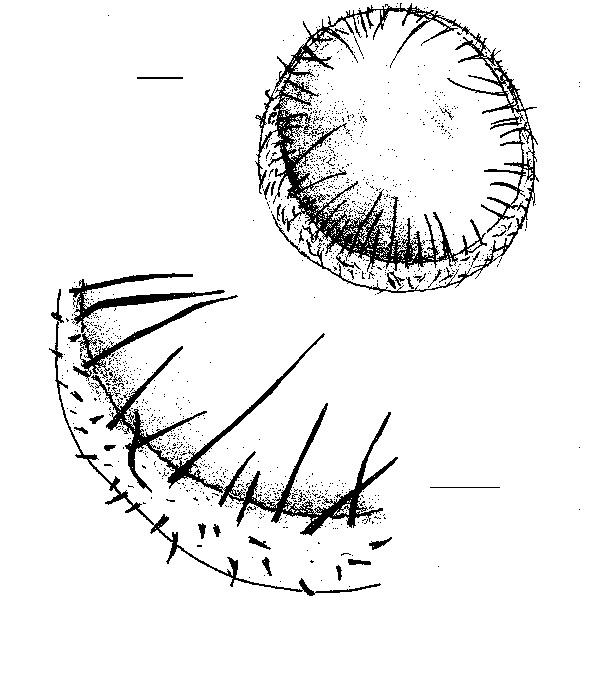
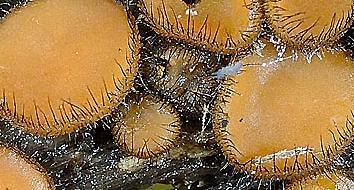
Around hairs, another thing about S. crinita is the alternance of one long hair (>1000) and one medium hair (500-800) like you can see on this drawing and photo.
Beñat
It's important to have sporal ornementation in blue cotton. I see you have this chemical product on your first photo. You can make a photo of ornementation with BC, in the asci or with a sporogram (spores ejected naturally on a coverslip put on apothecium).
Hairs base measures, yes it is the diameter near the base, where this diameter is the much higher.
Around hairs, another thing about S. crinita is the alternance of one long hair (>1000) and one medium hair (500-800) like you can see on this drawing and photo.
Beñat
Dieter Slos,
29-10-2013 13:30
Re : Scutellinia
Aha, this is the case. One long hair and one smaller hair next to it. You can see small wrats on the previous picture. No need for cotton blue because I was using DIC. So I think this confirms S. crinita. Thx :)