
09-06-2026 18:32
Camille MertensSur morceau de roseau immergé 0,5 - 0,7 mm de dia
08-06-2026 10:16
 Spooren Marco
I don`t have a clou about this fungus,it is not in
08-06-2026 17:00
François BartholomeeusenGood day everyone, On June 5 2026, I collected de
07-06-2026 15:10
 William Slosse
Hello everyone,On 05-06-26, I found following asco
05-06-2026 11:02
Thomas Læssøehttps://svampe.databasen.org/observations/10596691
07-06-2026 12:09
 François Freléchoux
Bonjour, Voici une brève description de ce qui m
07-06-2026 12:43
Steve ClementsBojour. This was a strange find on a stick on my
12-07-2015 00:05
 Nedim Jukic
This one from the same locality as the previous on
06-06-2026 17:44
Steve ClementsBonjour, This disco was on planed wood 3 x 1.5 cm
White peculiarity on mosses
Marja Pennanen,
27-08-2010 11:04
is spite of unstudied old specimen, I went and picked some more last evening.
On the bottom of a dry ditch was a twig with something on.
So I pulled it off and after noticing, that it was Bisporella, put it back.
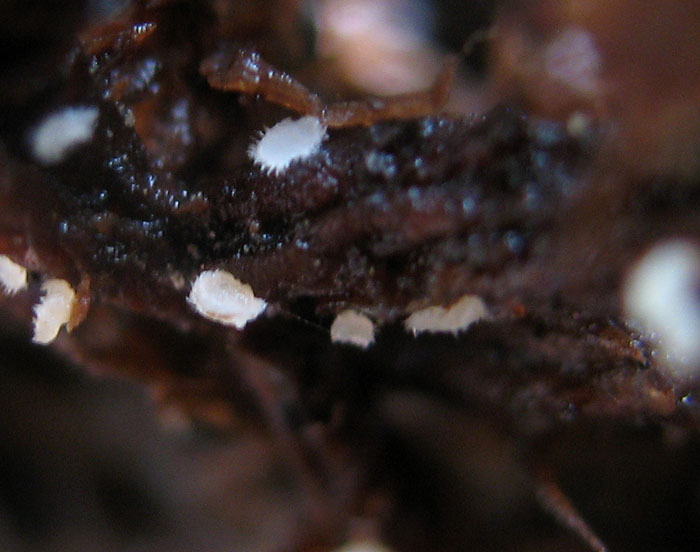
Some mosses were ripped off and covered with white spots.
Having some ealier experience of happenings like this, I studied them and there grow something hairy:
Marja Pennanen,
27-08-2010 11:10
Re:White peculiarity on mosses
Home I studied them at once.
They are about 0,5-1mm wide and very short stipate.
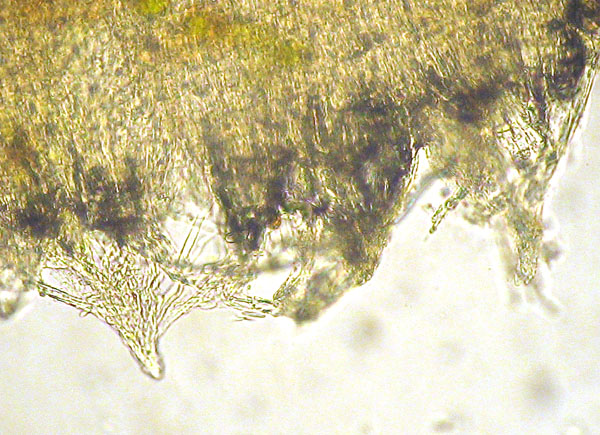
Microscope views reminded Echinula with hairs being clued together.
They are about 0,5-1mm wide and very short stipate.
Microscope views reminded Echinula with hairs being clued together.
Marja Pennanen,
27-08-2010 11:20
Re:White peculiarity on mosses
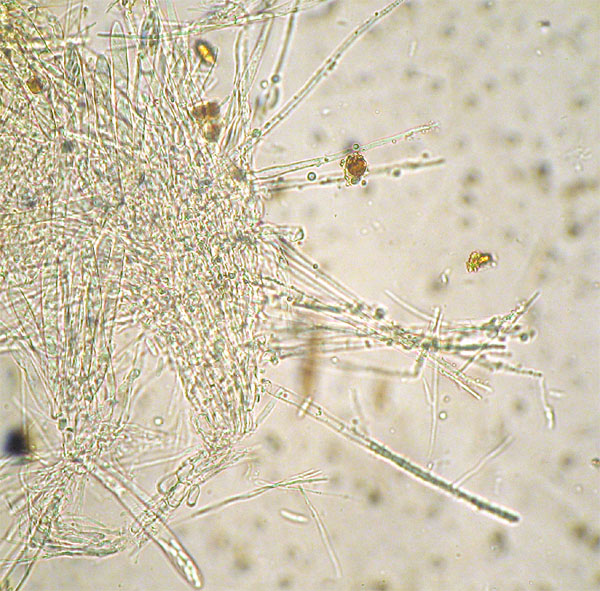
But the hairs were tapering, sometimes septate and had some crumbs on them (resinous matter?), size about 75-120x3-4,
Spores were 8-10x2-2,5 and asci 45-70x5-6, IKI+.
Now I'm wondering, which genus do they represent.
Hyaloscypha may ne one possibility, but no species is like this and at least I've never met a species with this kind of hair behavior.
Alternatives? Marja
Addition: there were some end cells or something like that (short hairs?), some of whisc can be seen at the bottom of the photo.
Spores were 8-10x2-2,5 and asci 45-70x5-6, IKI+.
Now I'm wondering, which genus do they represent.
Hyaloscypha may ne one possibility, but no species is like this and at least I've never met a species with this kind of hair behavior.
Alternatives? Marja
Addition: there were some end cells or something like that (short hairs?), some of whisc can be seen at the bottom of the photo.
Hans-Otto Baral,
27-08-2010 11:30

Re:White peculiarity on mosses
Maybe Hyaloscypha leuconica?
Marja Pennanen,
27-08-2010 12:16
Re:White peculiarity on mosses
Hello Otto,
I naturally checked that possibility, because it was the only one, that came to my mind.
This has got too big asci for H. leuconica.
Besides the septas are rare with them. These could have 0-2 septas as far as I saw.
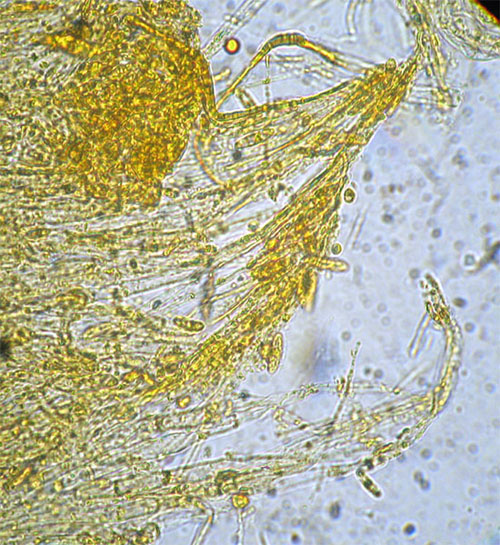
The resinous matter should dissolve in Meltzer (which I don't have).
But in Lugol it was stable.
So, let's seek for another option, or what? Marja
Maybe I'll still check that...
I naturally checked that possibility, because it was the only one, that came to my mind.
This has got too big asci for H. leuconica.
Besides the septas are rare with them. These could have 0-2 septas as far as I saw.
The resinous matter should dissolve in Meltzer (which I don't have).
But in Lugol it was stable.
So, let's seek for another option, or what? Marja
Maybe I'll still check that...
Hans-Otto Baral,
27-08-2010 12:31
Re:White peculiarity on mosses
Ascus length is not so different, I see on a photo by Enrique 36-57 x 6-7 (probably alive).
Zotto
Zotto
Marja Pennanen,
27-08-2010 13:47
Re:White peculiarity on mosses
Hello,
I think you may be right. I only use fresh specimen and Seppo must have had dried ones.
I didn't test again in Lugol, because there is nothing, where the resins could dissolve.
I tested lactophenol instead. Now hairs were clean, straight and about 60-120x4-6, 0-1 septate (I must have imagined the second septa).
I saw no trace of croziers as usually and the ascus bases were plain.
H. leucnica var leuconica maybe.
Hopefully I finally learn to know the tricks of this species ;)
It seems to grow anywhere...
Thankfully: Marja
I think you may be right. I only use fresh specimen and Seppo must have had dried ones.
I didn't test again in Lugol, because there is nothing, where the resins could dissolve.
I tested lactophenol instead. Now hairs were clean, straight and about 60-120x4-6, 0-1 septate (I must have imagined the second septa).
I saw no trace of croziers as usually and the ascus bases were plain.
H. leucnica var leuconica maybe.
Hopefully I finally learn to know the tricks of this species ;)
It seems to grow anywhere...
Thankfully: Marja