
27-04-2026 20:52
 Lothar Krieglsteiner
Found on hanging tiwg of Olea europaea in dried-ou
27-04-2026 18:48
Tony MoverleyCollected 23rd April 2026, Norfolk, EnglandSwarms
27-04-2026 17:41
Lothar Krieglsteiner
.. Algarve, same leaf than the last post. The con
27-04-2026 18:05
Lothar Krieglsteiner
... still attached at standing tree. The green con
27-04-2026 17:16
Lothar Krieglsteiner
.. Algarve, moist lying.The conidiomata look like
27-04-2026 12:54
Steve ClementsBonjour. Ce petit champignon blanc résupiné et
27-04-2026 09:59
Pauline. PennaBonjour Can anyone advise me on these pycnidia fo

22-04-2026 20:54
 Enrique Rubio
Hi to everybody.This Pyrenopeziza grew in moist le
Stictis...
Martin Bemmann,
31-10-2009 18:13
 Hello all,
today I found some Ostropales on old Zea mays (maize) stem. Looks like a Stictis.
I know it's hopeless for an amateur like me, but I certainly want to document it.
Can somebody provide Sherwood's article in Mycotaxon 5 as a whole? It is so annoying to click through the file page by page at cybertruffles....
Thanks in advance!
Martin
Martin Bemmann,
31-10-2009 18:30
Re:Stictis...
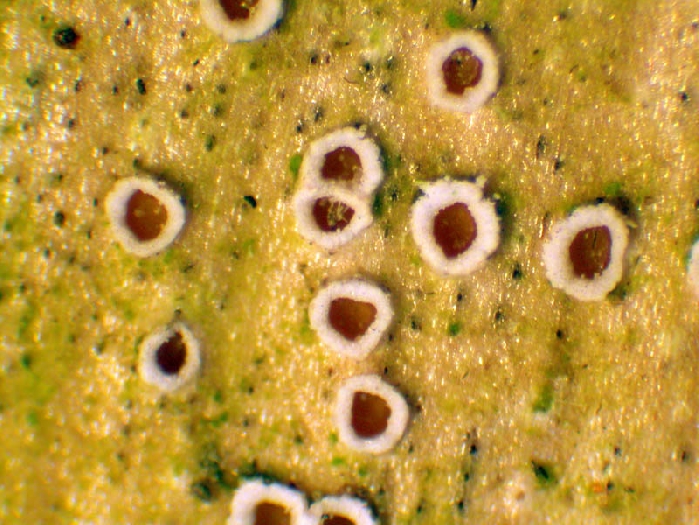
And yes, here is a fist impression of it:
Martin Bemmann,
31-10-2009 22:06
Re:Stictis...
Hi again,
this is what I have achieved so far:
Date: 31.10.2009
Location: Kleingemünd (near Heidelberg, Germany)
Host: old (last years?) moistly lying stem of Zea mays (maize)
Ascomata have a dm of c. 0,3 mm., Hymenium ist of orange colour with a white border (you will tell me the right word for this part of the fungus, will you?)
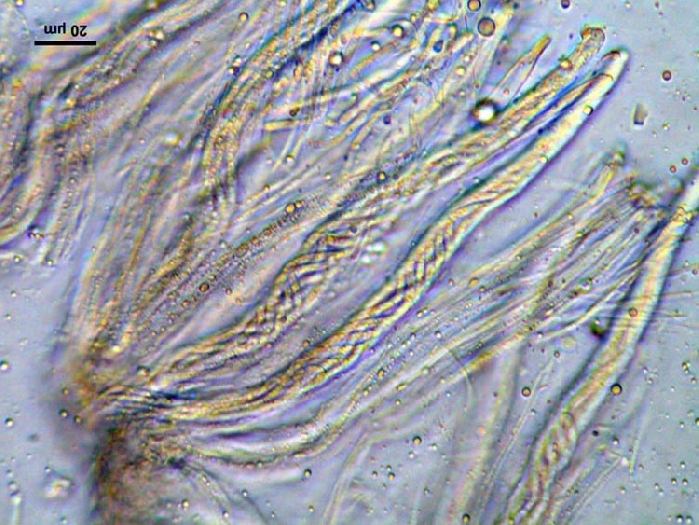
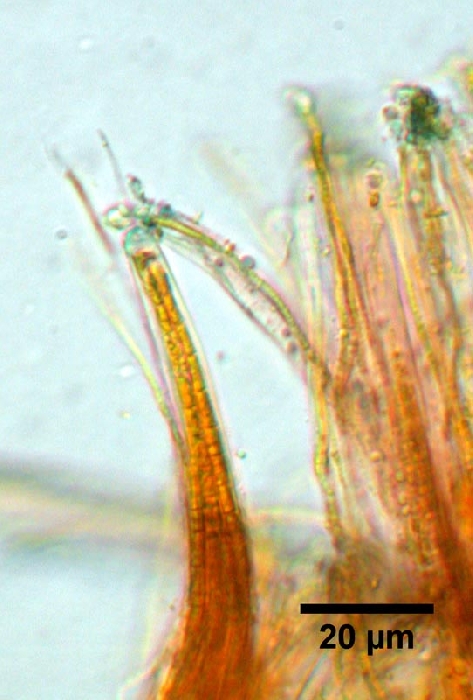
The Asci I measured are 201-203 x 12-16µm by size, their tips are turning slightly blue with IKI (see picture below).
Paraphyses are filiforme with slightly clavate tips. They bear a crystaline crust that turns blue in IKI as well.
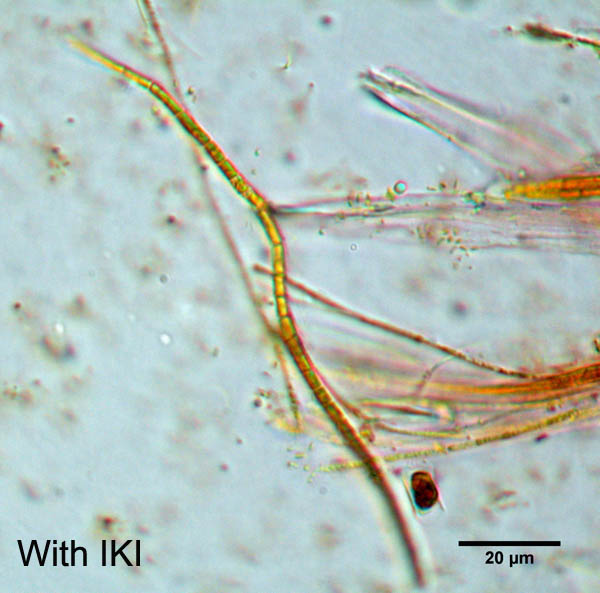
The ascospores are filiforme as well and are bundled twisted within the Asci. The spore depictured below measures 134x1,8 µm (measured not straight, but curve by curve!). They are septatet every 4 or 8 µm.
It was remarkable as well that the fresh preparation for the microscope was full of oildrops after squeezing.
Well, this is my start for a quite complicated fungus. Hope one of you can show me some shortcuts for determination.
Cheers,
Martin
this is what I have achieved so far:
Date: 31.10.2009
Location: Kleingemünd (near Heidelberg, Germany)
Host: old (last years?) moistly lying stem of Zea mays (maize)
Ascomata have a dm of c. 0,3 mm., Hymenium ist of orange colour with a white border (you will tell me the right word for this part of the fungus, will you?)
The Asci I measured are 201-203 x 12-16µm by size, their tips are turning slightly blue with IKI (see picture below).
Paraphyses are filiforme with slightly clavate tips. They bear a crystaline crust that turns blue in IKI as well.
The ascospores are filiforme as well and are bundled twisted within the Asci. The spore depictured below measures 134x1,8 µm (measured not straight, but curve by curve!). They are septatet every 4 or 8 µm.
It was remarkable as well that the fresh preparation for the microscope was full of oildrops after squeezing.
Well, this is my start for a quite complicated fungus. Hope one of you can show me some shortcuts for determination.
Cheers,
Martin
Martin Bemmann,
31-10-2009 22:07
Re:Stictis...
Asci in Water
Martin Bemmann,
31-10-2009 22:10
Re:Stictis...
a spore (with IKI):
Martin Bemmann,
31-10-2009 22:12
Re:Stictis...
and an Ascus tip with IKI:
Martin Bemmann,
01-11-2009 22:49
Re:Stictis...
Hi,
can somebody give me an advice how to get good sections/slices of this tiny fungus (Zotto, you did it so well!). My trials crumbled into the wastebin.... I want to see and document the margin. Should I use something like solid paraffin to stabilise the texture? I avoid normaly things that possibly cause chemical reactions changing the natural appeareance of the specimen. Is paraffin uncritical?
Regards,
Martin
can somebody give me an advice how to get good sections/slices of this tiny fungus (Zotto, you did it so well!). My trials crumbled into the wastebin.... I want to see and document the margin. Should I use something like solid paraffin to stabilise the texture? I avoid normaly things that possibly cause chemical reactions changing the natural appeareance of the specimen. Is paraffin uncritical?
Regards,
Martin
Bernhard Oertel,
04-11-2009 08:34
Re:Stictis...
Hello Martin,
here I am (thank you very much for helping me to come in here into this forum).
The both papers of Martha Sherwood are not so much loved by practicing field mycologists. By the way, if you want to use the original printed versions: they are badly bound and they have the tendency to break into pieces ...
I think that the crucial point is navigation through the text of these two papers:
Key for genera of Ostropales: p. 28
Key for Sticits: p. 145
Stictis species p. 148-263, and in the second paper: Sherwood, Mycotaxon 6(2), p. 247-259
epithet indices for her Sticits pages: p. 275 and in vol. 6(3), p. 524
And I would recommend you the "unsystematic approach": Just to look through the descriptions of the grass inhabiting species. In my list of European Ascomycota I have listed here the following species on more or less big grasses (Poaceae):
Stictis arundinacea, Sherwood p. 150
Stictis graminicola, Sherwwod p. 189
Stictis pusilla, Sherwood p. 230
Stictis stellata, Sherwood p. 251
Martin, normally I even prefer to use texts in Cyberliber: the texts are faster on the desk, and I need not to pull out the volumes in a big collection of series in the cupboard. By the way: Both volumes here I could buy directly from Dick Korf during his great private auction some years ago. On the front cover of my pieces I can find the imprint "From the library of Richard P. Korf".
I wish you good success proceeding with your determination!
Amicalement
Bernd
here I am (thank you very much for helping me to come in here into this forum).
The both papers of Martha Sherwood are not so much loved by practicing field mycologists. By the way, if you want to use the original printed versions: they are badly bound and they have the tendency to break into pieces ...
I think that the crucial point is navigation through the text of these two papers:
Key for genera of Ostropales: p. 28
Key for Sticits: p. 145
Stictis species p. 148-263, and in the second paper: Sherwood, Mycotaxon 6(2), p. 247-259
epithet indices for her Sticits pages: p. 275 and in vol. 6(3), p. 524
And I would recommend you the "unsystematic approach": Just to look through the descriptions of the grass inhabiting species. In my list of European Ascomycota I have listed here the following species on more or less big grasses (Poaceae):
Stictis arundinacea, Sherwood p. 150
Stictis graminicola, Sherwwod p. 189
Stictis pusilla, Sherwood p. 230
Stictis stellata, Sherwood p. 251
Martin, normally I even prefer to use texts in Cyberliber: the texts are faster on the desk, and I need not to pull out the volumes in a big collection of series in the cupboard. By the way: Both volumes here I could buy directly from Dick Korf during his great private auction some years ago. On the front cover of my pieces I can find the imprint "From the library of Richard P. Korf".
I wish you good success proceeding with your determination!
Amicalement
Bernd