
08-06-2026 10:16
 Spooren Marco
I don`t have a clou about this fungus,it is not in
08-06-2026 17:00
François BartholomeeusenGood day everyone, On June 5 2026, I collected de
07-06-2026 15:10
 William Slosse
Hello everyone,On 05-06-26, I found following asco
05-06-2026 11:02
Thomas Læssøehttps://svampe.databasen.org/observations/10596691
07-06-2026 12:09
 François Freléchoux
Bonjour, Voici une brève description de ce qui m
07-06-2026 12:43
Steve ClementsBojour. This was a strange find on a stick on my
12-07-2015 00:05
 Nedim Jukic
This one from the same locality as the previous on
06-06-2026 17:44
Steve ClementsBonjour, This disco was on planed wood 3 x 1.5 cm
14-08-2016 23:15
 Alex Akulov
Dear friendsCan you help me to find the descriptio
Ascolichen on Blechnum?
Enrique Rubio,
03-09-2025 12:44
 Hi to somebody.
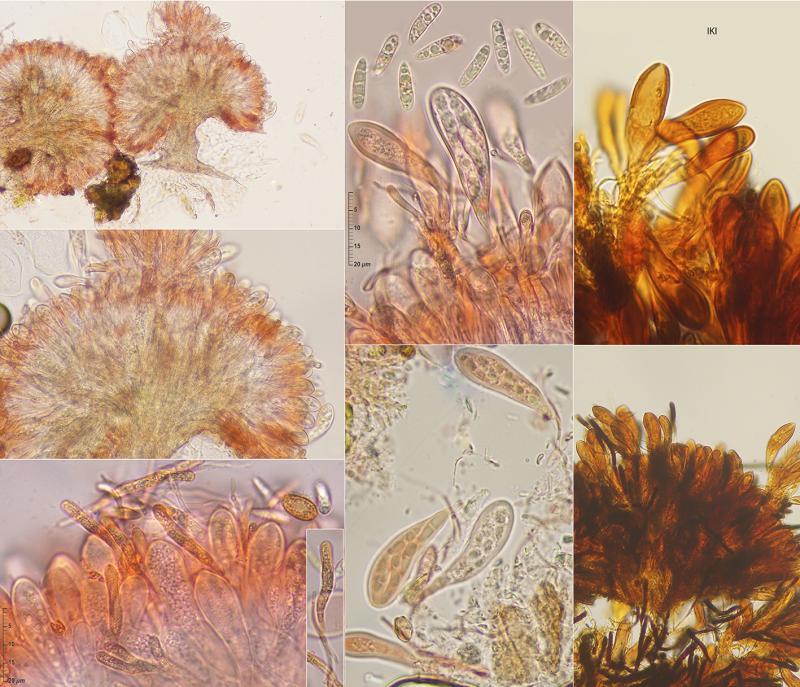
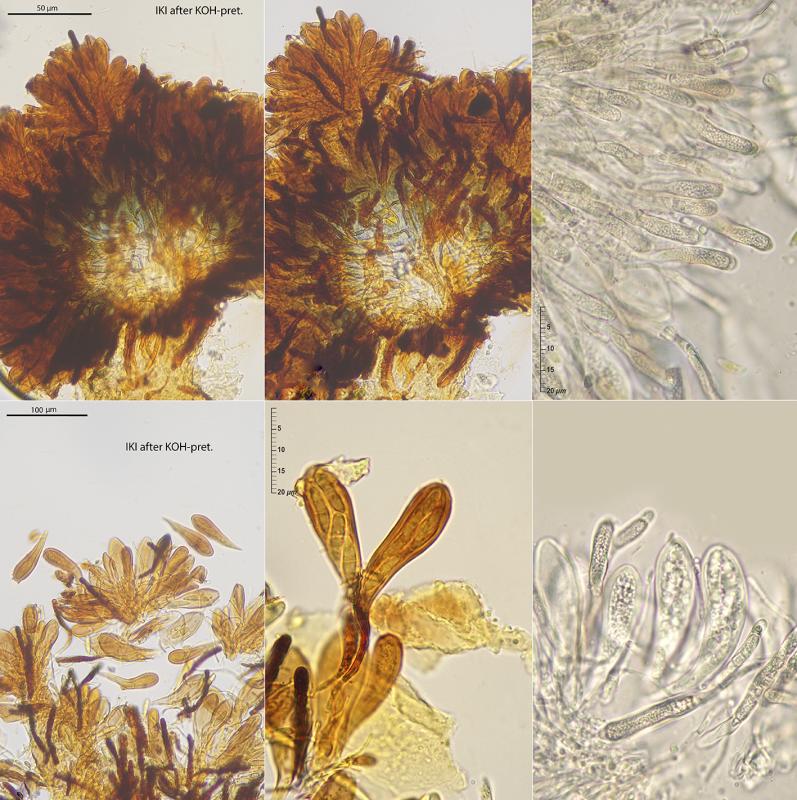
I would like to know your opinion on these apothecium-like, gregarious, whitish, pubescent, briefly stipitate fungi, up to 200 microns in height and 150-160 microns in width, which were growing on Blechnum spicant fronds on a quartzite wall that was oozing water.
The asci are bitunicate and the whole structure appears dextrinoid, as only the medulla of the fruiting body appears to turn slightly blue in IKI after KOH-pretreatment. Peculiar paraphyses with a highly refractive content can be seen, and perhaps also a pilosity formed by similar elements, although I have not been able to make a vertical section of the ascoma that would give me a good idea of the whole. Nor have I been able to clearly observe a possible thallus at the base of the stipe base.
Could this be an ascolychen?
Thank you very much for your ideas.

Hans-Otto Baral,
03-09-2025 16:31

Re : Ascolichen on Blechnum?
This must be Vezdaea stipitata (Vezdaeaceae). You had it already some years ago (2022?) on a ?liverwort.
The red ascus reaction is hemiamyloid, not dextrinoid (in MLZ without KOH you would get nothing).
I was unaware of such prominent VBs in Lecanorales, staining deep red-brown in IKI. Very probably the family is misplaced there. Available DNA does not give a clear hint on their relationship. Syllabus gives it as Vezdaeales in Xylonomycetes while in the Outline 2024 it is Vezdaeales in Pezizomycetes incertae sedis.
Enrique Rubio,
04-09-2025 12:02
Re : Ascolichen on Blechnum?
Hi Zotto.
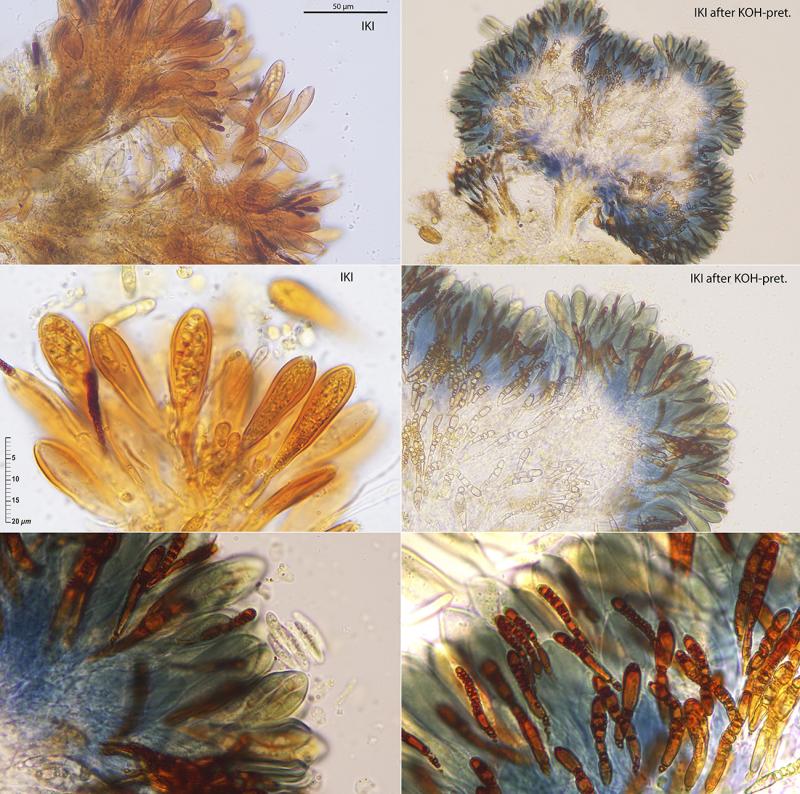
You're right. It's the same one you identified for me years ago, although this time the blue reaction of the interascale elements is much less intense.
Thank you again.
You're right. It's the same one you identified for me years ago, although this time the blue reaction of the interascale elements is much less intense.
Thank you again.
Franz Berger,
16-09-2025 11:20

Re : Ascolichen on Blechnum?
More text can be found in Poelt & Vezda 1977: Bestimmungsschlüssel europäischer Flechten. - ergänzungsheft 1 . Cramer Vaduz.
With remarks like: "Paraphysen spärlich bis schwierig zu erkennen" - which is in contrast to the images.
and: Asci amyloid, mit jung deutlich amyloidem Tholus. Sporen 1-septate.
Another remark: genus certaily contains more species.
Regards: Franz
With remarks like: "Paraphysen spärlich bis schwierig zu erkennen" - which is in contrast to the images.
and: Asci amyloid, mit jung deutlich amyloidem Tholus. Sporen 1-septate.
Another remark: genus certaily contains more species.
Regards: Franz