
11-05-2026 12:32
 Bernard CLESSE
Pourriez-vous m'aider à identifier cette héloti
13-05-2026 15:26
 François Freléchoux
Bonjour,Voici une récolte faite il y a quelques j
12-05-2026 15:41
 Nicolas VAN VOOREN
Dear Ascolovers, especially interested in Pezizale
13-05-2026 12:05
 Thierry Blondelle
Bonjour à tous,J'aimerais avoir confirmation de c
10-05-2026 23:17
 Andreas Gminder
Hello,today we found in a moist steep decidous for
28-04-2026 20:07
 Lothar Krieglsteiner
... on twig in the air at standing Ceratonia siliq
27-04-2026 20:52
Lothar Krieglsteiner
Found on hanging tiwg of Olea europaea in dried-ou
11-05-2026 20:22
Lothar Krieglsteiner
on attached twig of standing Ficus caricaquite uns
29-04-2026 10:44
Lothar Krieglsteiner
growing at moist, drying-out soil at the side of a
I have unsuccessfully tried to determine with the key Key to hysterioid fungi on bark and wood in Scandinavia, AGARICA vol. 42 103.
substrate: Picea, rotten wood, pretty much brittle, on bark
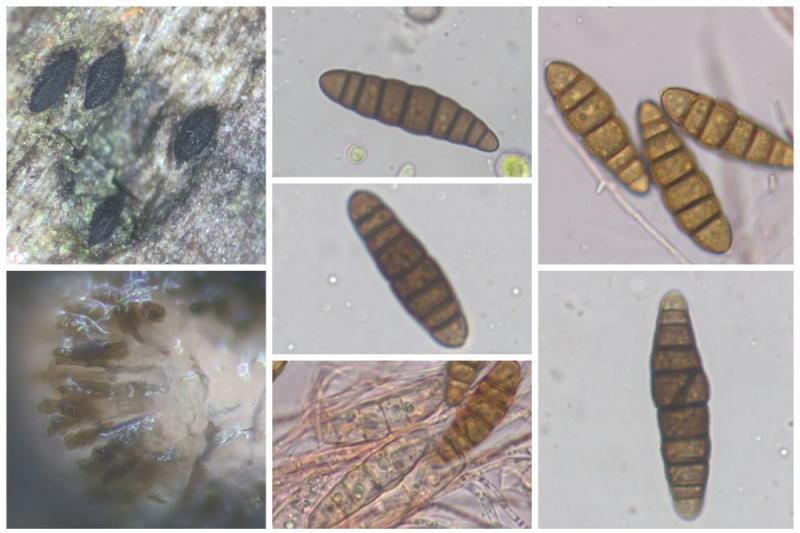
Fruiting body / habit / growth form: immersed, black, like a little mussle
Spores 1: 31.2 - 40.6 x 8.5 - 10.2 µm - Q: 3.55 - 4.10 (Ø LxB: 34.8 x 9.2 ØQ:3.8 N: 9)
Spores 2: 31.6 - 37.9 x 8.4 - 10.2 µm - Q: 3.31 - 4.32 (Ø LxB: 34.3 x 9.3 ØQ:3.7 N: 9)
Spore characteristics: 7-9fach septated, ends on old spores sometimes a little bit brighter
Ascus: biseriat
Paraphyses: filamentous
Spores : brown
Congo red: negativ
Melzers reagent: IKI-

https://fungi.myspecies.info/all-fungi/oedohysterium-insidens
according to Zogg (1962) and other authors the spores don't match perfectly but come close. they are brown and the number of cells fits.
Best regards from Bavaria
Till

I'm having trouble seeing if the ascomata are hysterioid-shaped or mytilinidioid-shpaed.
From what I can see it would be more like mytilinidioid.
A vertical section would be useful.
Thus your fungus grows on Picea. And at last, ascospores don't match. I join a paper to compare with the true Oedhysterium insidens.
I think your fungus belongs to Mytilinidiaceae.
And as I'm preparing a thesis on the subject, I'd be very happy to study it.
If you'd be willing to send me as much material as you can, here's my address:
Alain GARDIENNET
14 rue roulette
21260 VERONNES (France)
If you want you can contact me at : agardiennet@gmail.com. It's a very interesting find
 Oedohysterium-insidens-0001.pdf
I wonder if it could be a lophiostomataceous fungus, maybe something around Lophiostoma macrostomoides. A vertical section of the ascomata would indeed help, as you said, Alain. But soon we will know more!
Best wishes,
Gernot
Thanks,Alain
PS : Verpa bohemica is already there, Morchella deliciosa perhaps, I will check this afternoon. Morels or mussels , that's a question :)