12-06-2026 14:50
 François Freléchoux
Bonjour, Voici la brève description d'une Mollis
10-06-2026 21:16
François Freléchoux
Bonsoir,Le dernier du jour, en attendant votre avi
11-06-2026 19:01
 William Slosse
Hello all,In an attempt to make a culture of a sus
11-06-2026 19:03
 Nicolas VAN VOOREN
Chers membres d'Ascofrance,Le site sera placé en

09-06-2026 18:32
Camille MertensSur morceau de roseau immergé 0,5 - 0,7 mm de dia
10-06-2026 12:54
Steve ClementsBonjour encore, Pouvez-vous m'aider, s'il vous pl
10-06-2026 21:07
François Freléchoux
Toutes les tiges de gentianes jaunes de l'an passÃ
10-06-2026 13:41
François Freléchoux
Bonjour à nouveau, Voici une trouvaille d'hier.
Pronectria sp. ?
Pascal RIBOLLET,
02-06-2009 14:04
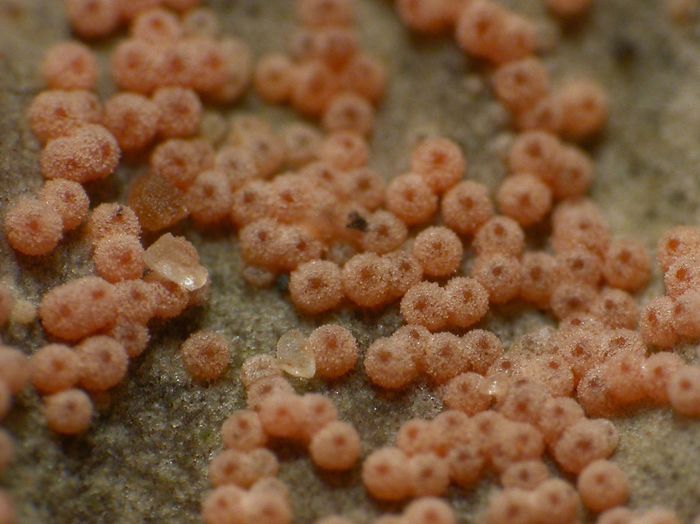
je bute sur cette petite Hypocreale trouvée sur vieux thalle de Peltigera (canina ? Je ne peux pas l'affirmer), dans la dune de St Brévin en novembre dernier.
Perithèces 0,4 x 0,3 mm, profondément cupulés sur le sec, KOH et acide lactique négatifs.
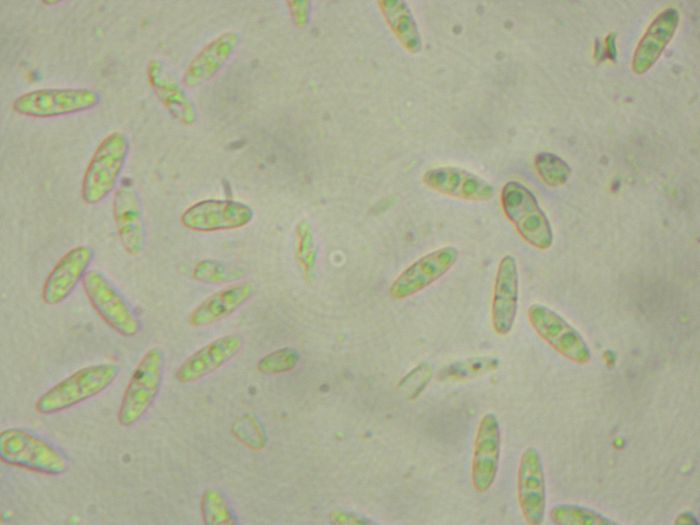
Spores à 1 cloison centrale, 8-11 (12) x 3-3,5 (4) µ, lisses, hyalines, quelques petites guttules.
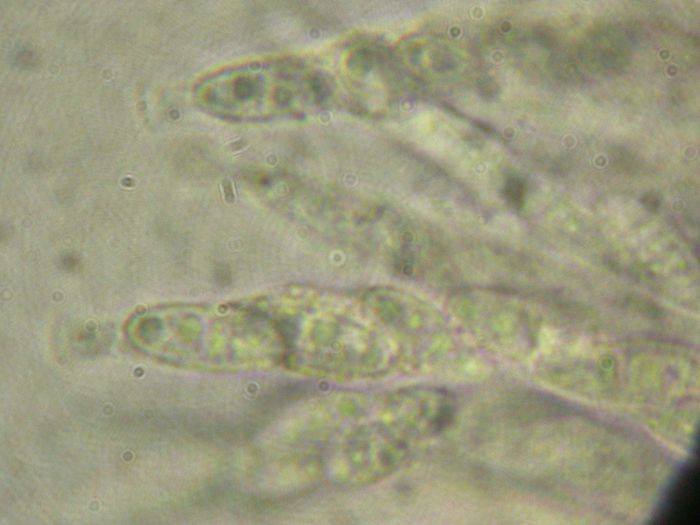
Asques jusqu'à 65 x 5*, à spores 1 (2) sériées, IKI -.
Les perithèces ont des parois à cellules subglobuleuses de diamètre 7-15 µ, parois légèrement épaissies.
Je vais envoyer des photos micro mais quelqu'un a-t-il déjà une idée ?
Je n'arrive à rien avec les clés d'Amy Rossmann et al. Peut-etre un Pronectria, mais ça ne correspond pas non plus (P. robergei se rapproche mais possède des spores de 8-16 x (3) 4-8 µ).
Qu'en pensez-vous ?
Christian Lechat,
02-06-2009 17:18

Re:Pronectria sp. ?
Pronectria pourrait coller mais il faut absolument une coupe de la paroi, savoir s'il y a des paraphyses dans l'hamatecium, si les asques ont un anneau apical et bien entendu les images micro de tout ça.
Par ailleurs, que sont ces poils que l'on voit sur la paroi des ascomes? on pourrait les voir de près?
Amitiés,
Christian
Par ailleurs, que sont ces poils que l'on voit sur la paroi des ascomes? on pourrait les voir de près?
Amitiés,
Christian
Javier Etayo,
02-06-2009 17:35
Re:Pronectria sp. ?
Dear friend,
if the hos is a Peltigera and with those sessile perithecia and spores size, it should be Nectriopsis lecanodes (Cesati) Diederich & Schoers although you do not say anything about hairs. Really a very nice sample!
if the hos is a Peltigera and with those sessile perithecia and spores size, it should be Nectriopsis lecanodes (Cesati) Diederich & Schoers although you do not say anything about hairs. Really a very nice sample!
Pascal RIBOLLET,
05-06-2009 14:08
Re:Pronectria sp. ?
Dear Javier and Christian, thank you for your help. Javier, the macro and habitat of Nectriopsis lecanodes seems to fit perfectly. I've tried to found micro data about N.lecanodes but without success.
Here are some micro of my fungus, poorly photographied (sorry)
Apical apex
Here are some micro of my fungus, poorly photographied (sorry)
Apical apex
Pascal RIBOLLET,
05-06-2009 14:08
Re:Pronectria sp. ?
Spores
Pascal RIBOLLET,
05-06-2009 14:11
Re:Pronectria sp. ?
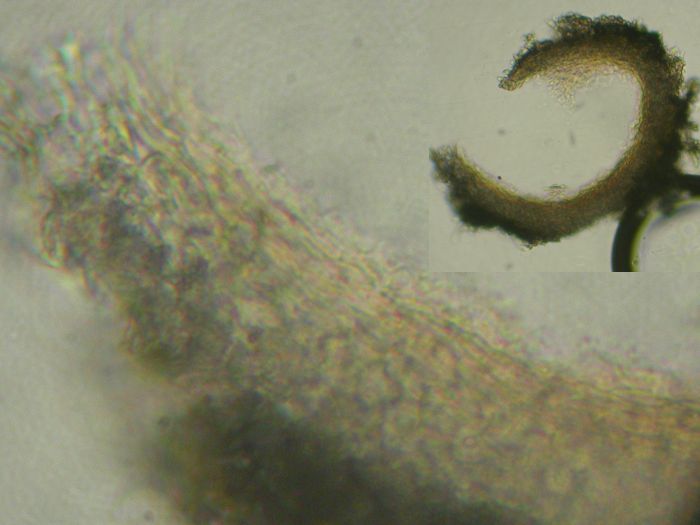
Coupe, thickness about 30µm.
Pascal RIBOLLET,
05-06-2009 14:15
Re:Pronectria sp. ?
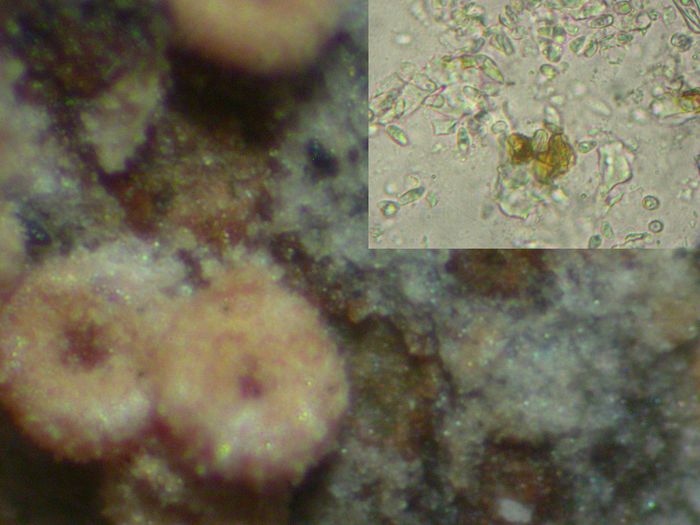
Problems with the "hairs" : it seems to be cristalline structure rather than hairs. I found the same thing on the perithecia and within them, on the thallius of Peltigera.
Amitiés
Pascal
Amitiés
Pascal
Christian Lechat,
05-06-2009 16:07
Re:Pronectria sp. ?
Hi Pascal and Javier,
I never saw N. lecanodes, Pascal , could you please to send me a part of your collection? I would like to do some images for the ascofrance data base and to see this amazing hairs.
all the best
Christian
I never saw N. lecanodes, Pascal , could you please to send me a part of your collection? I would like to do some images for the ascofrance data base and to see this amazing hairs.
all the best
Christian
Pascal RIBOLLET,
05-06-2009 16:16
Re:Pronectria sp. ?
Ok Christian, I post it for tomorrow.
I wanted to make a fiche for Ascofrance but if you do some images micro, it will be better than mine (this was my first cross section of a perithece for microscopic use...not easy...)
Amitiés
Pascal
I wanted to make a fiche for Ascofrance but if you do some images micro, it will be better than mine (this was my first cross section of a perithece for microscopic use...not easy...)
Amitiés
Pascal
Christian Lechat,
05-06-2009 17:02
Re:Pronectria sp. ?
Merci Pascal :)
Javier Etayo,
05-06-2009 18:43
Re:Pronectria sp. ?
Dear Pascal and friends,
the habit is very similar to Nectriopsis but this species has hairs with thin wall. In your photo there are things like wall rests but not hairs. Sometimes in this genus the hairs are eroded, it could be an answer. In your photo, the ascomatal wall seems to be brown. It is not a feature of this species. Could you corroborate it?
bien amicalement, Javier
the habit is very similar to Nectriopsis but this species has hairs with thin wall. In your photo there are things like wall rests but not hairs. Sometimes in this genus the hairs are eroded, it could be an answer. In your photo, the ascomatal wall seems to be brown. It is not a feature of this species. Could you corroborate it?
bien amicalement, Javier
Christian Lechat,
05-06-2009 21:33
Re:Pronectria sp. ?
Dear Javier and Pascal,
you are right Javier, I agree with you, hairs from this collection are not in accordance with Nectriopsis lecanodes, that is why I asked to receive some ascomata, I would like to see them because they are amazing, as soon as I will have received them, I will let you know my observations. Merci Pascal:)
Best regards,
Christian
Christian
you are right Javier, I agree with you, hairs from this collection are not in accordance with Nectriopsis lecanodes, that is why I asked to receive some ascomata, I would like to see them because they are amazing, as soon as I will have received them, I will let you know my observations. Merci Pascal:)
Best regards,
Christian
Christian
Christian Lechat,
10-06-2009 20:16
Re:Pronectria sp. ?
Dear friends,
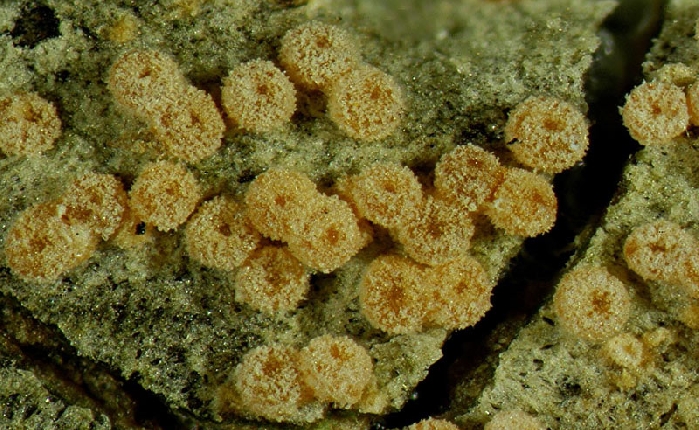
I studied Pascal's collection , I post here the photos, I had not enough time to describe this species but the ascospores are really striate! Unfortunately, the striations are very difficult to see, I have not photo from them. Ascomatal wall , 30-40 µm thick made of a single region with hairs.
I will go to Spain tomorrow until on 16th of june, I will reply to your comment and questions when I will be back.
All the best,
Christian
I studied Pascal's collection , I post here the photos, I had not enough time to describe this species but the ascospores are really striate! Unfortunately, the striations are very difficult to see, I have not photo from them. Ascomatal wall , 30-40 µm thick made of a single region with hairs.
I will go to Spain tomorrow until on 16th of june, I will reply to your comment and questions when I will be back.
All the best,
Christian
Christian Lechat,
10-06-2009 20:19
Re:Pronectria sp. ?
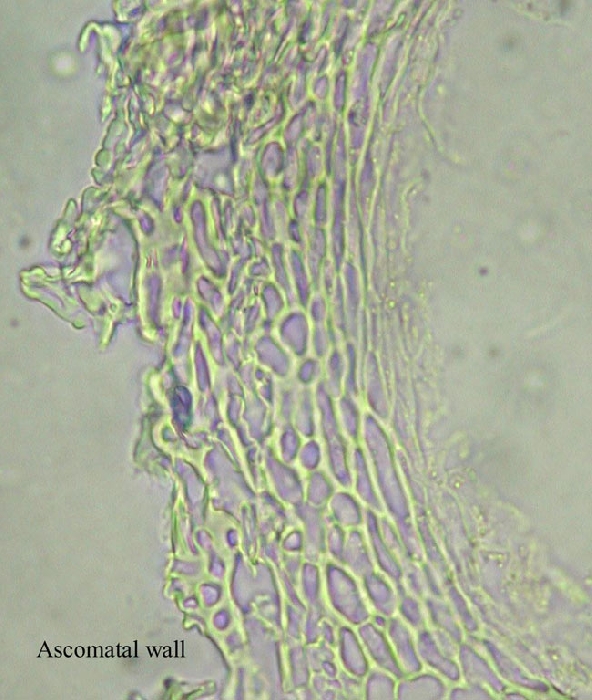
Ascomatal wall
Christian Lechat,
10-06-2009 20:20
Re:Pronectria sp. ?
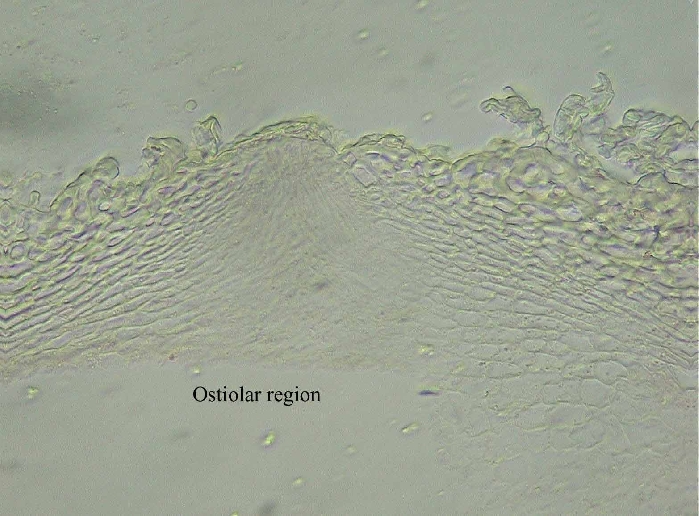
Ostiolar region