
02-06-2026 17:58
Louis DENYBonjour forum, Sur feuille de Populus tremula, en
02-06-2026 14:33
 Nicolas VAN VOOREN
Hello.I'm searching for a PDF copy of the followin

28-07-2011 18:31
 Alex Akulov
Dear FriendsToday I made the pdf file of Velenovsk
11-09-2025 16:57
 Jason Karakehian
Our revision of Marthamycetales (Leotiomycetes) is
12-11-2019 10:32
 Miguel Ángel Ribes
Hi againExactly at the same place than my previous
25-12-2019 17:54
Valencia Lopez Francisco JavierHola a todos/asEstas supuestas pezizas estaban en
12-07-2015 00:05
 Nedim Jukic
This one from the same locality as the previous on

30-05-2026 21:12
Philippe PELLICIERSur branche de mélèze (Larix) près de la neige,
Help with this species :D
Man Myco,
25-06-2021 13:56
 Hello,
I am working on this species, but I cannot figure out where it may be positionned...
Any help with its taxonomic position would be greatly appreciated !
Best regards,
R.
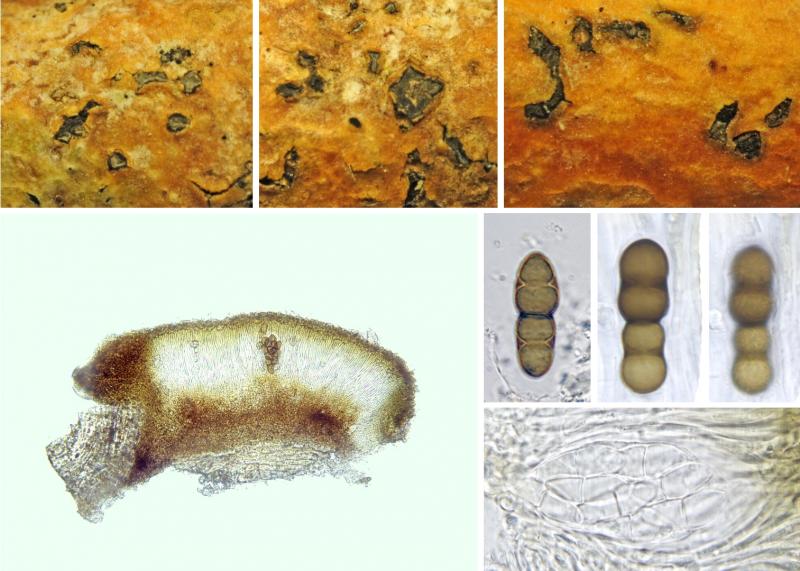
Man Myco,
25-06-2021 14:19
Re : Help with this species :D
I am adding below some description features that may help :
- Ascomata (0.3-)0.4-0.8(1.1) mm in the longest length
- Hymenial disc with a calcium oxalate crystals layer covering the disc
- Hymenium 125-140 µm high, I-, K/I-
- Paraphyses cellular, simple (sometimes furcate or geniculate at apex), 2.5-3 µm wide, but 4 µm thick toward the apices
- Ascospores 30-35 x 11.5-13.8 µm
Many thanks for your help !
- Ascomata (0.3-)0.4-0.8(1.1) mm in the longest length
- Hymenial disc with a calcium oxalate crystals layer covering the disc
- Hymenium 125-140 µm high, I-, K/I-
- Paraphyses cellular, simple (sometimes furcate or geniculate at apex), 2.5-3 µm wide, but 4 µm thick toward the apices
- Ascospores 30-35 x 11.5-13.8 µm
Many thanks for your help !
Hans-Otto Baral,
25-06-2021 17:08

Re : Help with this species :D
Hi
Can you tell us the substrate?
Are the asci saccate? Any apical thickening in dead state?
Are the apos elongate?
Man Myco,
25-06-2021 17:52
Re : Help with this species :D
Hi !
thanks for your message ! Here are some additional features which may help (I hope ;))
Ascomata numerous, evenly distributed, variable in shape, elongate-sublirelliform or angulose-subrounded, simple, unbranched, sometimes slightly crenulated, immersed, at most leveled with the bark, (0.3-)0.4-0.8(1.1) mm in the longest length, hymenial disc exposed, flat, black to greyish due to a calcium oxalate crystals layer covering the disc, surrounded by a thin black border of visible and persistent excipulum.
Hymenium mostly hyaline, with a brownish-olivaceous in upper part, not inspersed or sometimes a few very little oil droplets, 125-140 µm high, I-, K/I-. Paraphyses cellular, simple (sometimes furcate or geniculate at apex), 2.5-3 µm wide, but 4 µm thick toward the apices.
Asci subglobose to shortly clavate, bitunicate, thickened at the apex and with a short internal apical beak when young, I-, K/I-. 8-spored, 65-80 x 35-40 µm.
Ascospores hyaline at first in the asci but brown at maturity before discharge, finely ornamented, I-, ellipsoid to sole-shaped, 1-septate, straight, constricted at the septum, upper cell often slightly bigger, both cells with an internal thickening of the wall in their central part (most mature ascospores seems to be in fact 3-septate...), 30-35 x 11.5-13.8 µm, perispore absent.
The substratum is a branchlett of Psiadia altissima ; location is Mozambique Channel.
Best regards,
R
thanks for your message ! Here are some additional features which may help (I hope ;))
Ascomata numerous, evenly distributed, variable in shape, elongate-sublirelliform or angulose-subrounded, simple, unbranched, sometimes slightly crenulated, immersed, at most leveled with the bark, (0.3-)0.4-0.8(1.1) mm in the longest length, hymenial disc exposed, flat, black to greyish due to a calcium oxalate crystals layer covering the disc, surrounded by a thin black border of visible and persistent excipulum.
Hymenium mostly hyaline, with a brownish-olivaceous in upper part, not inspersed or sometimes a few very little oil droplets, 125-140 µm high, I-, K/I-. Paraphyses cellular, simple (sometimes furcate or geniculate at apex), 2.5-3 µm wide, but 4 µm thick toward the apices.
Asci subglobose to shortly clavate, bitunicate, thickened at the apex and with a short internal apical beak when young, I-, K/I-. 8-spored, 65-80 x 35-40 µm.
Ascospores hyaline at first in the asci but brown at maturity before discharge, finely ornamented, I-, ellipsoid to sole-shaped, 1-septate, straight, constricted at the septum, upper cell often slightly bigger, both cells with an internal thickening of the wall in their central part (most mature ascospores seems to be in fact 3-septate...), 30-35 x 11.5-13.8 µm, perispore absent.
The substratum is a branchlett of Psiadia altissima ; location is Mozambique Channel.
Best regards,
R
Hans-Otto Baral,
25-06-2021 18:24
Re : Help with this species :D
So an apotheciod species with bitunicate, saccate asci. Spore shape would fit such a dothidealean taxon. A tropical species probably. I am not familiar with such fungi.
Adam Polhorský,
25-06-2021 18:28
Re : Help with this species :D
Hi,
I would look at Stigmatodiscus. You probably won't find a perfect fit, as all described species are from Europe.
A.
Man Myco,
25-06-2021 18:44
Re : Help with this species :D
Hi,
Thank you very much ! Stigmatodiscus seems a very good direction !
Bests,
R
Thank you very much ! Stigmatodiscus seems a very good direction !
Bests,
R