
27-04-2026 20:52
 Lothar Krieglsteiner
Found on hanging tiwg of Olea europaea in dried-ou
27-04-2026 18:48
Tony MoverleyCollected 23rd April 2026, Norfolk, EnglandSwarms
27-04-2026 17:41
Lothar Krieglsteiner
.. Algarve, same leaf than the last post. The con
27-04-2026 18:05
Lothar Krieglsteiner
... still attached at standing tree. The green con
27-04-2026 17:16
Lothar Krieglsteiner
.. Algarve, moist lying.The conidiomata look like
27-04-2026 12:54
Steve ClementsBonjour. Ce petit champignon blanc résupiné et
27-04-2026 09:59
Pauline. PennaBonjour Can anyone advise me on these pycnidia fo
22-04-2026 20:54
 Enrique Rubio
Hi to everybody.This Pyrenopeziza grew in moist le
 Hello Forum,
on 14/02/20 I again collected a collection of Mollisia in a dune forest in Oostduinkerke, Belgium. The asco's grew on the underside of an old, fallen branch of Betula pendula.
I recently studied a collection of Mollisia cinerea that turned out to be Mollisia 'atlantica' nom.prov. A.Gminder.
This time it seems that I'm dealing with 'atlantica' again.
Can anyone confirm this?
° Apothetia measure max 2 mm in diameter.
° Ectal exipulum consists of dark olive-brown to blackish cells. Hymenium mouse gray and discolouring yellow on drying.
° KOH-
° Spores: 9.94 x 2.72 µm (N = 31); free spores 1-septated; spores in the asci 1-septated; a few small oil drops scattered in both halves.
° Some paraphyses club-shaped; most filled with non-refractive oil drops.
° Asci: J +; 62.71x5.11
I feel that 'atlantica', here on the coast anyway, is much more spread out than might be thought.
Many thx in advance.
Willliam


fotos are to small to see the spores.
Can you take pictures of the spores and put them here without reducing them?
Also the paraphyses? The descritpion sounds unlike Mollisia, or like dead material - then a spetation of the asci might also be due to overmaturity.
Can you give me the data of the other collection of Mollisia "atlantica" too, as I'm preparing a paper for publication in near future. And are there microfotos?
all the best,
Andreas

Indeed not such a good idea to present the photos in collage.
I again provide the separate photos of the spores in the asci and the paraphyses.
All preparations were made in tap water.
Greets,
William


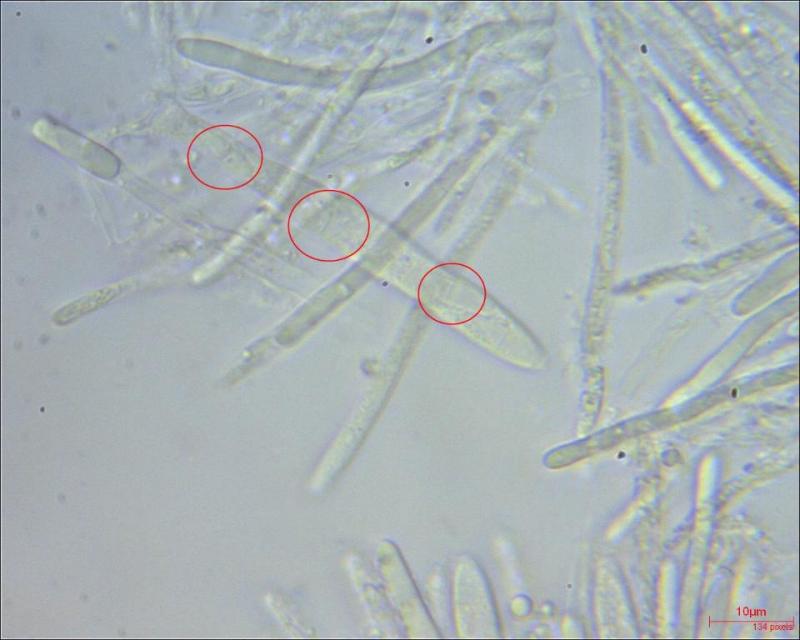


At Koksijde, Belgium 19/01/20 growing on the underside of an old branch half burried in the leaflitter in an old (= grey) dune.
Greets,
William


 Mollisia-atlantica-45--0001.jpg
as Zotto said, the beforelast ascus shows the spore septation in still living ascus. The asci in the othe fotos are dead, but not for long time obviousely, as most of the parapyses are still showing a fully expanded vacuolar body.
My expercience in western France near the costs in spring showed that M. atlantica is the most common species there, growing often on small sized woody substrate, e.g. Ruscus, but also on "normal" wood. I think I have even found it on Miscanthus.
best regards,
Andreas