Accès membres

Mot de passe perdu? S'inscrire

07-01-2026 22:22

Danny Newman Danny Newman

Tatraea sp. on indet. hardwood The Swag, Great Sm

07-01-2026 17:29

Marc Detollenaere Marc Detollenaere

Dear Forum,On a barkless Populus I found some smal

10-11-2021 17:33

Riet van Oosten Riet van Oosten

Add-on topic http://www.ascofrance.com/forum/7059

07-01-2026 10:24

Danny Newman Danny Newman

Pezicula sp. on indet. hardwood Appalachian Highl

07-01-2026 10:05

Danny Newman Danny Newman

cf. Chaetospermum on XylariaCosby Campground, Grea

06-01-2026 20:54

Thierry Blondelle Thierry Blondelle

Bonjour à tous et meilleurs voeux pour cette nouv

02-01-2026 17:43

MARICEL PATINO

Hi there, although I couldn't see the fruitbody, I

04-01-2026 17:45

Stephen Martin Mifsud Stephen Martin Mifsud

I was happy to find these orange asmocyetes which

02-01-2026 22:48

éric ROMERO éric ROMERO

Bonjour tous, Je profite de cette nouvelle demand

02-01-2026 19:35

William Slosse William Slosse

Good evening everyone,First of all, my best wishes

« < 1 2 3 4 5 > »
En tela de algodón
Castillo Joseba, 29-11-2019 12:11
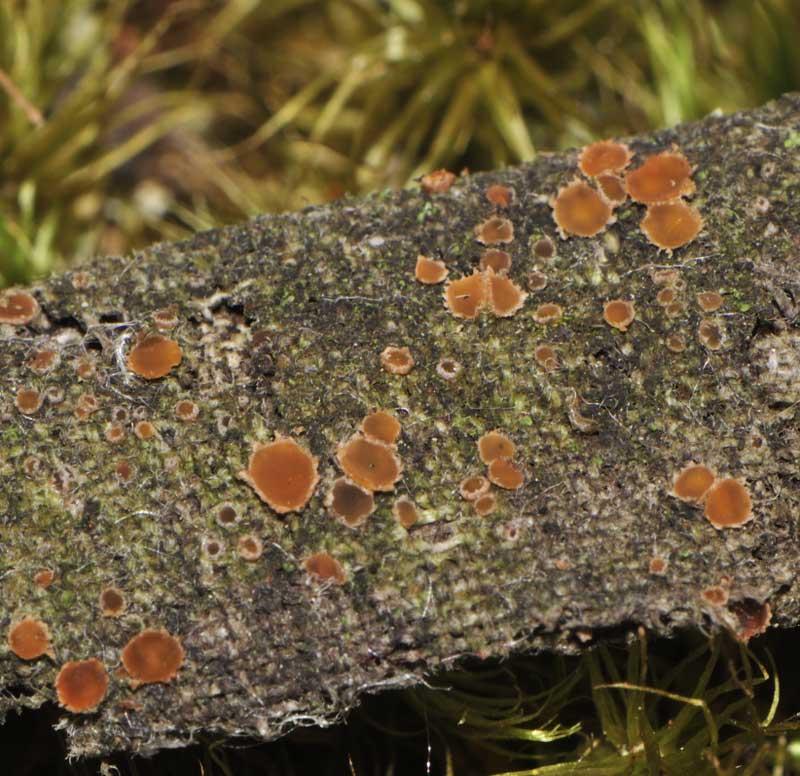
Castillo JosebaMe mandan esta muestra de Galicia,  recolectada en restos de una ropa de tela de algodón.

A vewr que os parece


Saludos


Joseba
  • message #60251
  • message #60251
  • message #60251
  • message #60251
  • message #60251
  • message #60251
Martin Bemmann, 29-11-2019 12:45
Martin Bemmann
Re : En tela de algodón
Hi Joseba,

this seems to be Orbilia flavideroseola (current name?) already reported from weathered cotton. Zotto will surely comment on this.

Regards

Martin
Hans-Otto Baral, 29-11-2019 12:57
Hans-Otto Baral
Re : En tela de algodón
O flavidorosella and O. carpoboloides are very similar, differences are in spore size.

O flavidorosella *(6.8–)7.3–10(–11.3) × (1.5–)1.7–2(–2.2) µm

O. carpoboloides *(7.7–)8.5–14(–17) × (2–)2.2–2.8(–3.5) µm

So it should be the latter.
Miguel Ángel Ribes, 29-11-2019 13:58
Miguel Ãngel Ribes
Re : En tela de algodón
Hey, great, I founded it some days ago at Portugal on Salix bark. O. carpoboloides too.

Thanks.
Hans-Otto Baral, 29-11-2019 14:56
Hans-Otto Baral
Re : En tela de algodón
Ah, both Galicia and Portugal are empty on my distribution map. Would be pleased to get the collection data. Miguel-Angel, are your spores also long and narrow like those?
Hans-Otto Baral, 01-12-2019 08:57
Hans-Otto Baral
Re : En tela de algodón
Hi Joseba and Miguel-Angel

I would be pleased to hear from where your samples come.

Zotto
Castillo Joseba, 01-12-2019 09:46
Castillo Joseba
Re : En tela de algodón
Hola Zotto,  estoy pendiente de que me envien los datos de recolecta de Galicia, en cuanto los tenga te los envio
Castillo Joseba, 01-12-2019 19:19
Castillo Joseba
Re : En tela de algodón
Estos datos me mandan desde Galicia

Recolectos Miguel Angel Delgado
 Fecha de la reclecta  27/10/2019
courdenadas 42.478222 -8.882649
Ogrove Pontevedra España


Saludos
Joseba
Miguel Ángel Ribes, 01-12-2019 20:27
Miguel Ãngel Ribes
Re : En tela de algodón
Hi Zotto

My spores are 16x2,2 microns. Perhaps tomorrow I could send more accuracy measurements. 

Portugal, Sabugal, Quercus pyrenaica forest with Salix, Castanea sativa and more, on Salix bark with another orange-red Orbilia not studied yet, 40°21'18.4"N, 7°02'01.9"W, 925 m., leg. Miguel Á. Ribes.

Thanks a lot.
Hans-Otto Baral, 01-12-2019 20:42
Hans-Otto Baral
Re : En tela de algodón
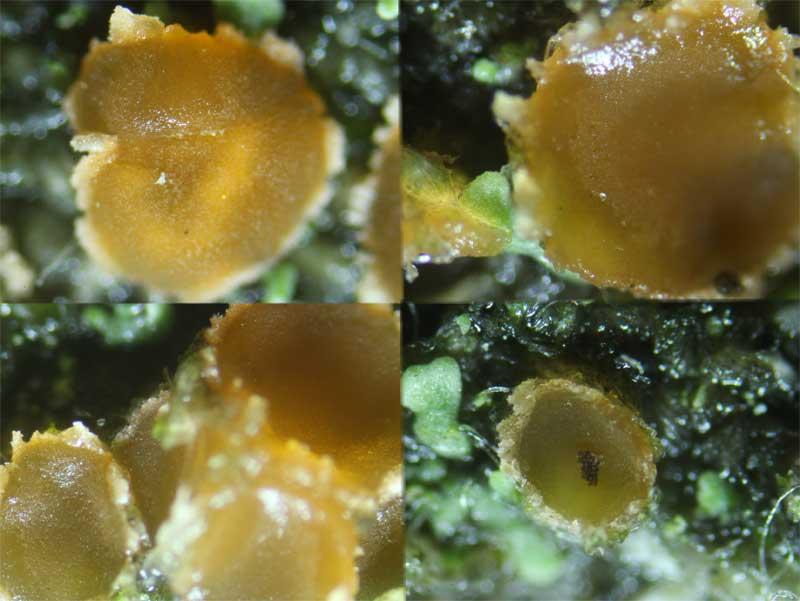
Thanks Miguel-Angel! So you had very long and narrow spores as well. Do you have any images? Of course the apothecia were hairy?

And thanks Joseba!
Miguel Ángel Ribes, 02-12-2019 00:12
Miguel Ãngel Ribes
Re : En tela de algodón
Hi Zotto

Tomorrow I will send you some pictures too.

Miguel Ángel
Miguel Ángel Ribes, 02-12-2019 13:23
Miguel Ãngel Ribes
Re : En tela de algodón
Hi Zotto

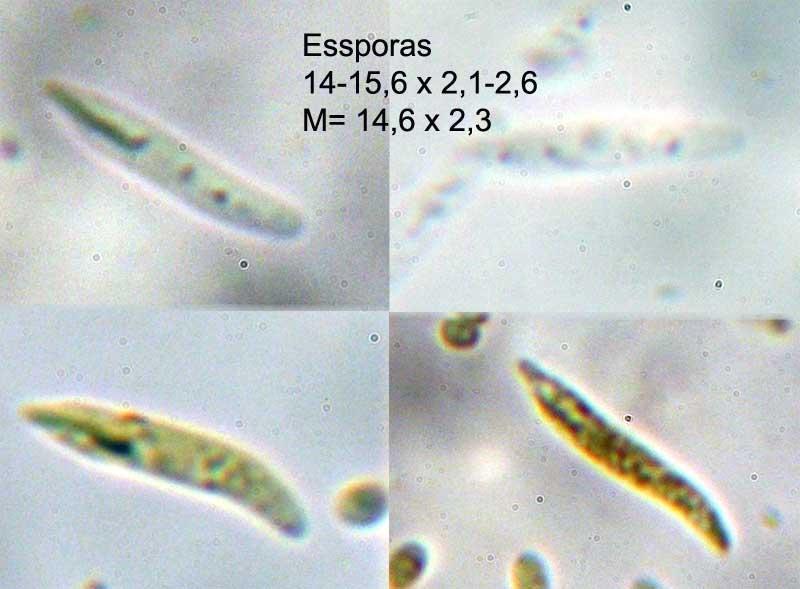
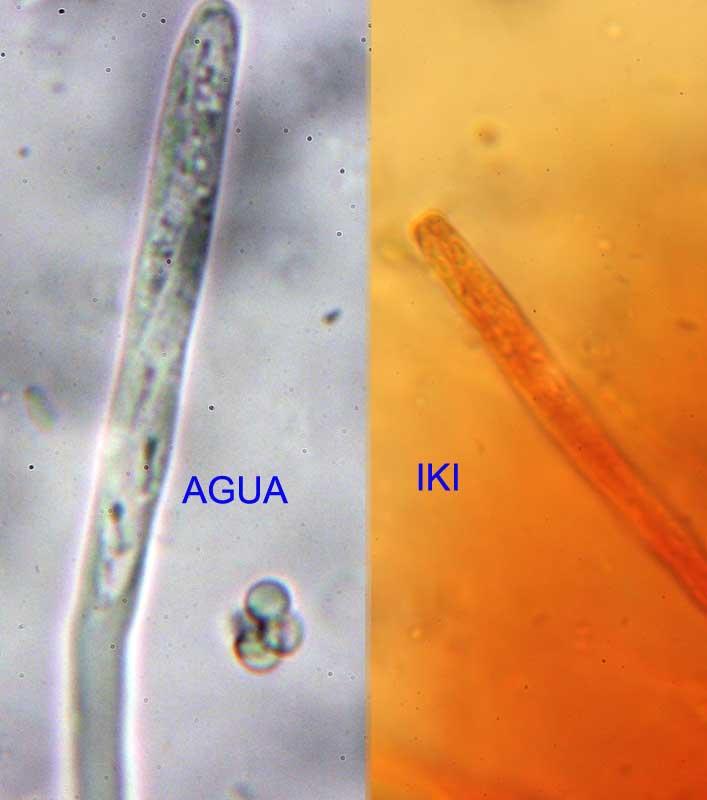
Here are some measurements and pictures:

Spores (1000x, H2O, live)
(13,8) 14 - 18,3 (19,1) × (2) 2,2 - 2,5 (2,8) µm
Q = (4,9) 6,1 - 7,9 (8,4) ; N = 45
Me = 16,2 × 2,3 µm ; Qe = 7


Asci (1000x, H2O, live + died)
(79,7) 80,2 - 104,7 (118,9) × (4,9) 5 - 6,1 (6,6) µm
N = 17; Me = 93,1 × 5,7 µm


Conidiospores?? (1000x, H2O, live)
23,1 - 28,46 (28,5) × (18,5) 18,53 - 20 µm
N = 5; Me = 24,5 × 19,6 µm


Asci have the first fourth spores not inverted and the second fourth spores inverted.

I saw "in situ", at Portugal, a sample plenty of "conidiospores??", but I hadn't my camera. Days later, at home, I have only find some of them.

Miguel Ángel
  • message #60331
  • message #60331
  • message #60331
  • message #60331
  • message #60331
Hans-Otto Baral, 02-12-2019 15:22
Hans-Otto Baral
Re : En tela de algodón
Boah, such long and narrow spores! This supports a suspicion that carpoboloides is heterogeneous. But a sharp line to short+wide-spored samples is very difficult to draw.

The conidia should belong to Hyalorbilia orbiliicola (a species very similar to H. erythrostigma) growing on Orbilia apos, often also with their small apothecia.

A sequence could clarify whether the long-spored variants merit distinction, given that the parasitic Hyalorbilia does not disturb the extract.

The two identical sequences that we have are short+wide-spored:

Netherlands: *9.5–11.7(–13) × 2.7–3(–3.5) µm,

Luxembourg: *10–14 × 3–3.4(–3.8) µm.

Zotto
Hans-Otto Baral, 03-12-2019 16:01
Hans-Otto Baral
Re : En tela de algodón
Miguel-Angel, I miss a date for your sample. The orange Orbilia might be O. aurantiorubra?
Miguel Ángel Ribes, 03-12-2019 22:03
Miguel Ãngel Ribes
Re : En tela de algodón
Ok, Zotto, I will try to sequenced it.

I have not study yet the other Orbilia, I will send it here.

Thanks.