
01-05-2026 22:45
 Thierry Blondelle
Bonjour à tous, Une récolte sur bouse séchée d
28-04-2026 20:07
 Lothar Krieglsteiner
... on twig in the air at standing Ceratonia siliq
14-04-2026 05:32
Ethan CrensonHi all, A few weeks back a friend pointed out som
28-04-2026 20:33
Vitus SchäfftleinHello, I found Trochila ilicina on Ilex aquifoliu

30-04-2026 10:28
Rot BojanHello, by appearance I would say that I am dealing
27-04-2026 18:48
Tony MoverleyCollected 23rd April 2026, Norfolk, EnglandSwarms
27-04-2026 20:52
Lothar Krieglsteiner
Found on hanging tiwg of Olea europaea in dried-ou
28-04-2026 22:51
 Bernard CLESSE
Bonsoir à toutes et tous,Pourriez-vous m'aider à
29-04-2026 08:01
Lothar Krieglsteiner
... on twig attached to small tree of Citrus auran
Trichopeziza encore
Andgelo Mombert,
12-07-2018 23:27
 Bonsoir,
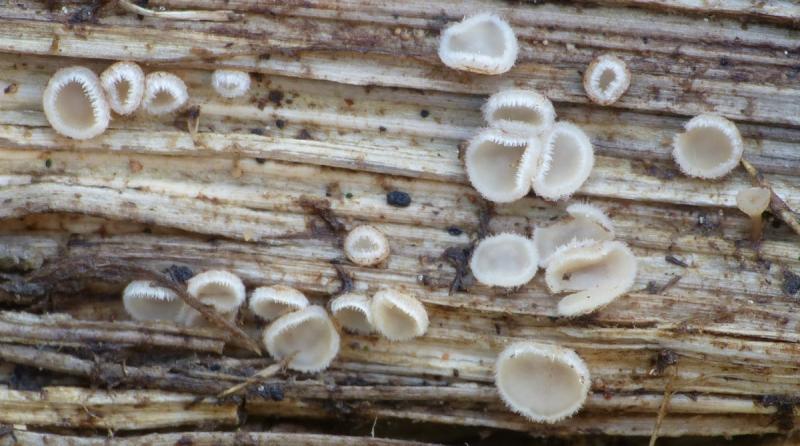
Sur tiges mortes de Cirsium spinosissimum. Chablais, France.
Apothécies de 1-1,5 µm, cupuliformes puis planes avec la marge restant longgtemps relevée. Hyménium blanc de lait. Marge et surface externe couvertes de poils blanchâtres.
Ascospores : 14-20 x 2,5-3 µm, cylindriques, souvent un peu courbées, sans goutte, hyalines, lisses, avec une cloison à maturité.
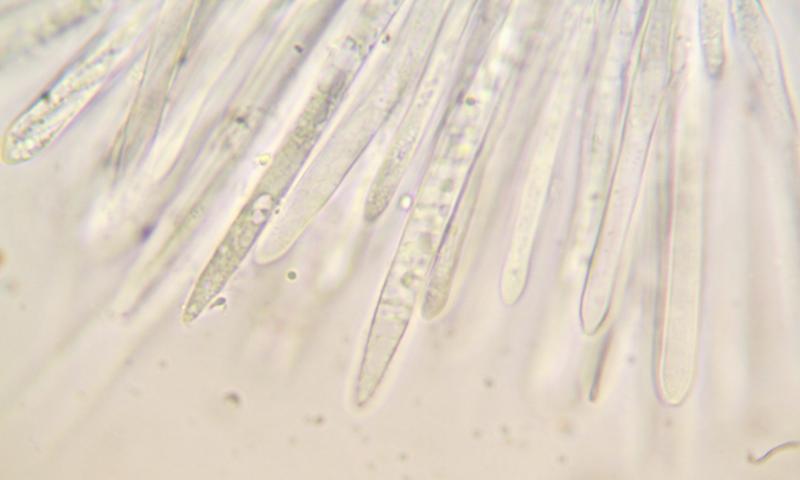
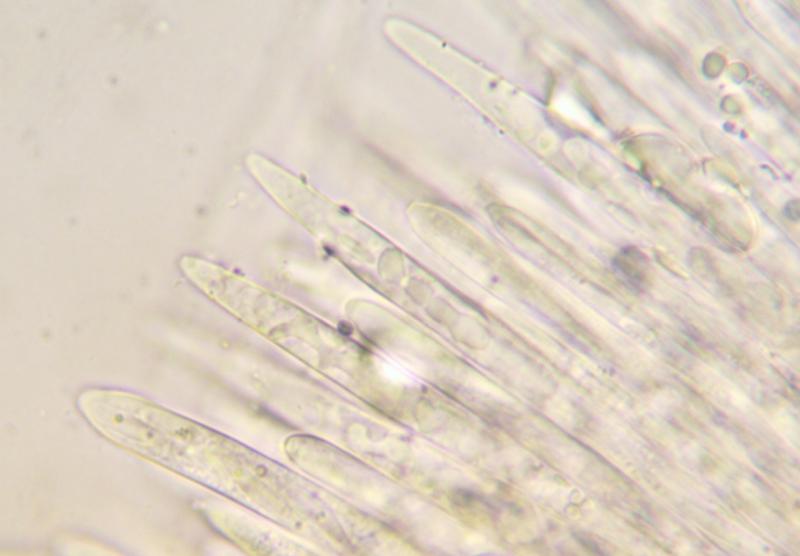
Asques : 70-80 x 4-4,5 µm, cylindracés, peu atténués à la base, à sommet hémiamyloïde, avec crochet, contenant huit spores uni ou bisériées.
Paraphyses : dressées, lancéolées, dépassant les asques, de 10-15 µm, hyalines, larges de 4,5-5,5 µm.
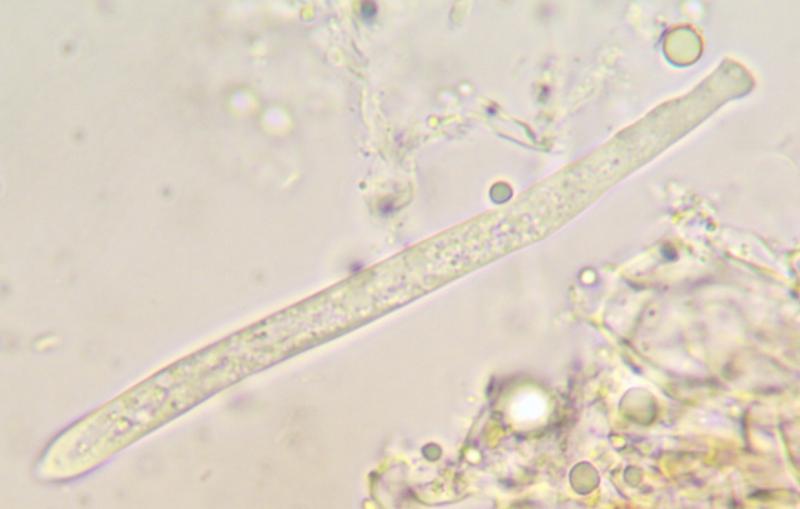
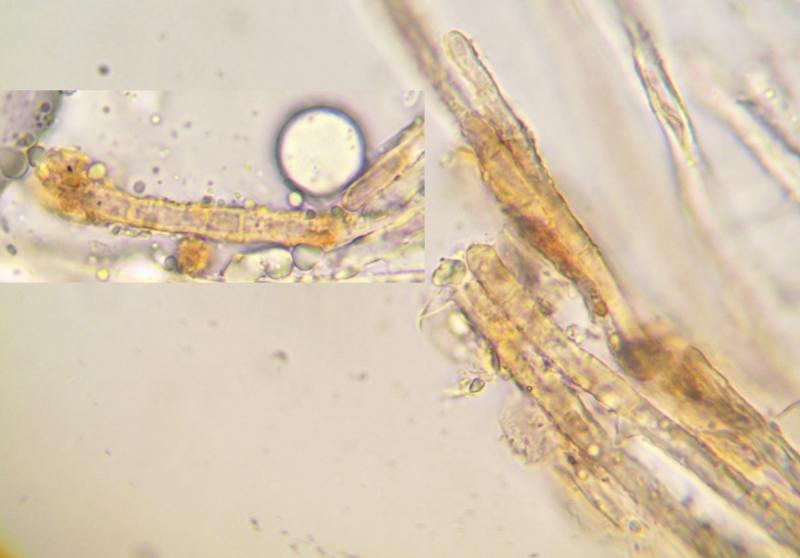
Poils : 160-200 x 3,5-4,5 µm, flexueux, hyalins ou brunâtres, à paroi épaisse, couverts de cristaux, parfois au sommet.
Ici on est proche de Trichopeziza mollissima (leucophaea), mais les spores un peu grandes et surtout les crochets à la base des asques me surprennent.
Il s'agirait d'une forme blanche de T. limonopilosa ???
Merci d'avance !
Andgelo




Hans-Otto Baral,
13-07-2018 06:55

Re : Trichopeziza encore
I think T. mollissima, yes.
Andgelo Mombert,
13-07-2018 06:58
Re : Trichopeziza encore
Merci ! La présence de croziers n'est-elle pas gênante ?
Hans-Otto Baral,
13-07-2018 07:29
Re : Trichopeziza encore
You are right, most collections in my folder have no croziers, some were not studied, but a few have croziers, for instance HB 7841:
Bayern, 1600 m, , indet. herb. Ap. 1-1.5 mm diam., 250-270 µm thick. Asci *75 x 6.5 µm, with croziers with perforation, IKI 3rb. Sp. *13-19 x 2.3-2.5 µm, lipid 1.5. Hairs *(70-)100-200(-300) x (3.5-)4-4.7(-5.3) µm, wall *1-1.7 µm thick, at margin 0.3-1 µm. Paraph. /*5.3-6.3 µm.
Whether we can split white populations into two species based on croziers I do not know. Published DNA data on this do not exist, to my knowledge.
Bayern, 1600 m, , indet. herb. Ap. 1-1.5 mm diam., 250-270 µm thick. Asci *75 x 6.5 µm, with croziers with perforation, IKI 3rb. Sp. *13-19 x 2.3-2.5 µm, lipid 1.5. Hairs *(70-)100-200(-300) x (3.5-)4-4.7(-5.3) µm, wall *1-1.7 µm thick, at margin 0.3-1 µm. Paraph. /*5.3-6.3 µm.
Whether we can split white populations into two species based on croziers I do not know. Published DNA data on this do not exist, to my knowledge.