
02-05-2026 13:06
Pauline. PennaBonjour Please can someone help me with this id
02-05-2026 12:42
Alain BRISSARDBonjour à tousJeuidi 30 avril dernier on m'a remi
01-05-2026 22:45
 Thierry Blondelle
Bonjour à tous, Une récolte sur bouse séchée d
28-04-2026 20:07
 Lothar Krieglsteiner
... on twig in the air at standing Ceratonia siliq
14-04-2026 05:32
Ethan CrensonHi all, A few weeks back a friend pointed out som
28-04-2026 20:33
Vitus SchäfftleinHello, I found Trochila ilicina on Ilex aquifoliu

30-04-2026 10:28
Rot BojanHello, by appearance I would say that I am dealing
27-04-2026 18:48
Tony MoverleyCollected 23rd April 2026, Norfolk, EnglandSwarms
27-04-2026 20:52
Lothar Krieglsteiner
Found on hanging tiwg of Olea europaea in dried-ou

Good evening everybody,
A few days ago I found a Hypho on a living branch of Corylus avellana.
It had a rough darkgray surface without ostioles. Under the microscope I only found round spores of about 5µ , each with a large drop.I have no idea of the genus.Anyone can help?
Marc


I think that Periconia conidia do not have that thick wall.
We are not even sure that we have to do with an ascomycete. Could be aleuriospores, or even oospores of some oomycete.
We need a description and photos of the conidiophores or sporangiophores before we can make a further move.
Bernard
Dear Zotto and Bernard,
Thank you very much for your quick response.
I found some new microscopic features. Hyphal structures-conidiophores were scarse. They were all septated and thick-walled , size about 2µ, branched and bifurcated. Hyphae and spores were not echinulate. I did not find conidia in short chains as described in Periconia cambrensis. No match with other Periconia's in Dematiaceous Hypho's(MB Ellis)
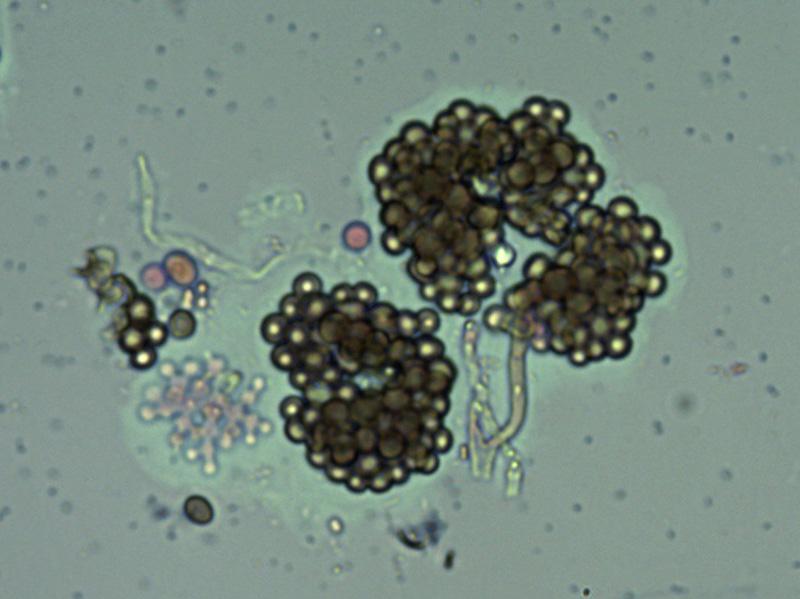
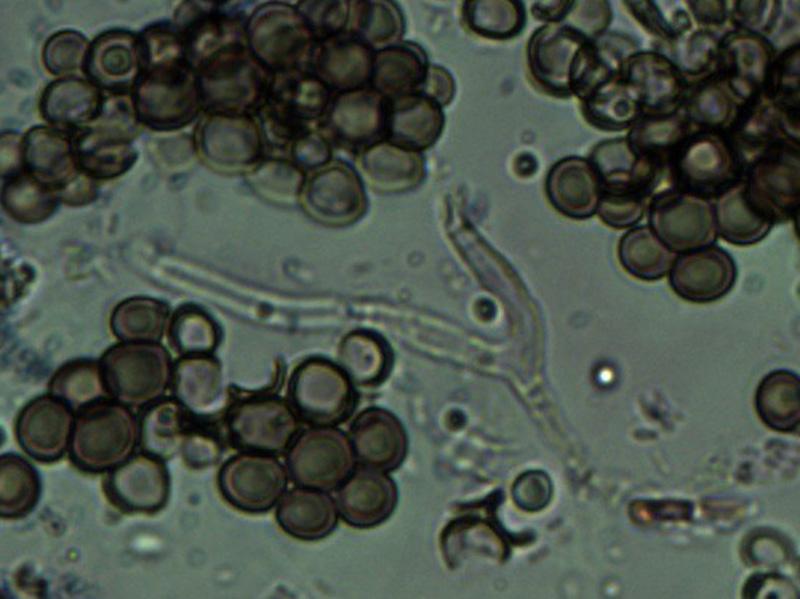
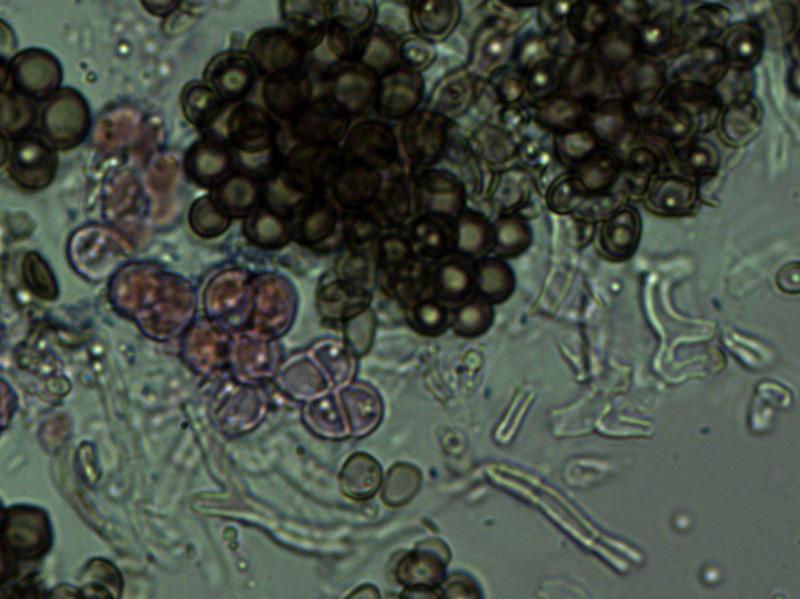

To me there seems to be two conflicting concepts of Cheirospora botryospora:
1 - The anamorph of P.atrovinosa
2 - The anamorph of a species close to Mollisia, described here:
https://www.researchgate.net/publication/289618166_Fungal_systematics_and_Evolution_FUSE_1
I don't yet know which one is correct in the sense of the original, but at least they both seem separable morphologically (The former has darker, spherical conidia in loose clusters and the latter lighter, +/- oblong conidia in digitate chains).
This collection on Corylus clearly belongs to the former concept.....
Cheers,
Nick
The pictures of Cheirospora from Gernot Friebes in the base de données and the illustrations in The genera of Hyphomycetes match completely with my last photo.
Thank you very match for your help