
27-04-2026 18:48
Tony MoverleyCollected 23rd April 2026, Norfolk, EnglandSwarms
27-04-2026 20:52
 Lothar Krieglsteiner
Found on hanging tiwg of Olea europaea in dried-ou
28-04-2026 22:51
 Bernard CLESSE
Bonsoir à toutes et tous,Pourriez-vous m'aider à
29-04-2026 08:01
Lothar Krieglsteiner
... on twig attached to small tree of Citrus auran
29-04-2026 10:44
Lothar Krieglsteiner
growing at moist, drying-out soil at the side of a
28-04-2026 20:33
Vitus SchäfftleinHello, I found Trochila ilicina on Ilex aquifoliu

28-04-2026 21:50
 Pablo Sandoval
Hola a todos,Espero se encuentren bien. Hace mucho
27-04-2026 18:05
Lothar Krieglsteiner
... still attached at standing tree. The green con
28-04-2026 20:07
Lothar Krieglsteiner
... on twig in the air at standing Ceratonia siliq
Mollisia ID
Nicolas VAN VOOREN,
25-05-2017 18:40
 Hello.
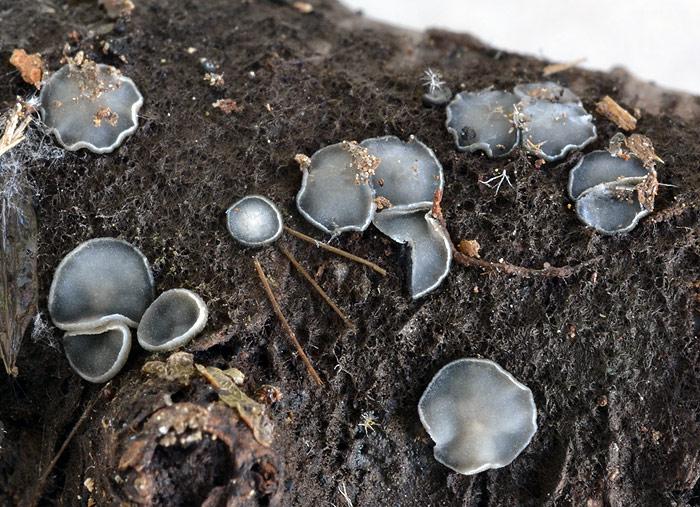
Here is a collection of Mollisia made on a dead branch of Quercus, on soil, with Lachnum virgineum and another Mollisia species (not yet studied). A subiculum is present.
Apothecia Ø 1-2.5 mm. 5% KOH negative.
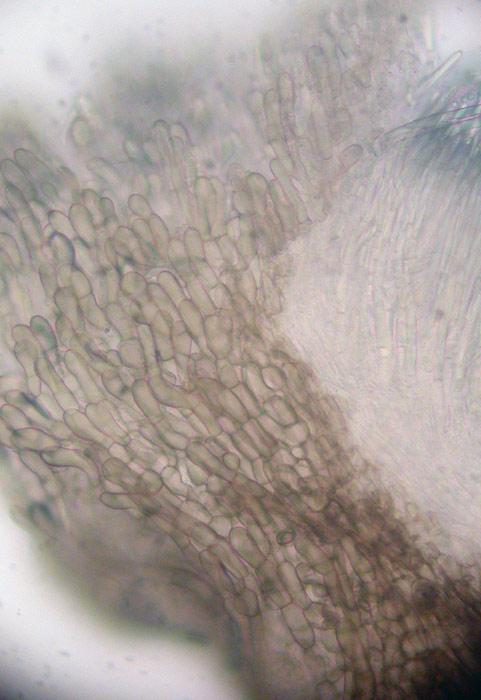
Ectal excipulum of textura angularis/subglobulosa, with cells 5–18 µm wide, becoming a textura ± prismatica on the flanks (see fig. 2), emerging in pseudo-hairs, up to 42 µm in length. Medullary excipulum of t. intricata, with hyaline hyphae.
Asci 100-110 × 7-8 µm, with crozier, pars spor. ~47-52 µm, apical ring IKI+ (bb).
Paraphyses with a long refractive VB, Ø 2.5–3.5 µm
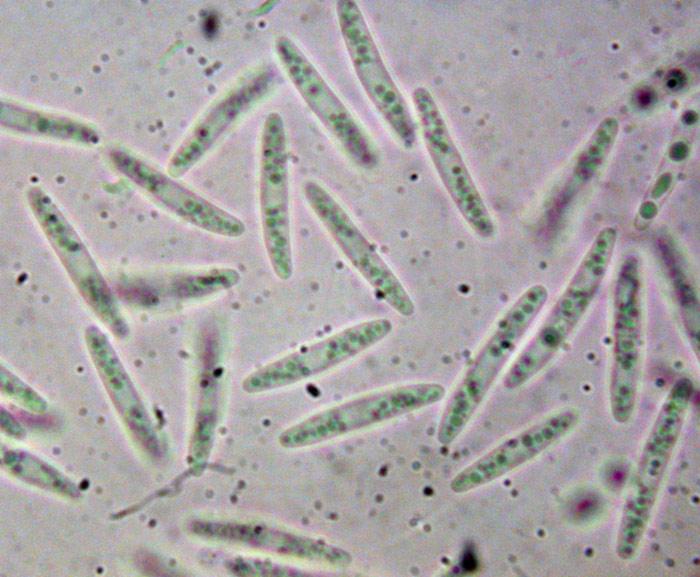
Ascospores 17–20 (21.5) × 2.8-3 µm, OCI~3, sometimes with a central septum (but not in asci).
I didn't find any species that matches with these characters, so any help will be useful.
Hans-Otto Baral,
25-05-2017 20:27

Re : Mollisia ID
Hi Nicolas
I do not remember such a species. It reminds me a bit of Mollisia elegantior, but the much larger spores and their much higher oil content exclude this.
Did you study the brown subiculum, are the hyphae thick-walled and 4-6 µm wide?
Zotto
P.S. just detected a collection which seems to be the same, with spores 15-21 x 2.5-3.5:
E. Rubio: Pola de Somiedo, 29-IV-2017, growing on a dense felty brown subiculum on wood of Corylus avellana.
I put both in a directory named "elegantior aff.".
I do not remember such a species. It reminds me a bit of Mollisia elegantior, but the much larger spores and their much higher oil content exclude this.
Did you study the brown subiculum, are the hyphae thick-walled and 4-6 µm wide?
Zotto
P.S. just detected a collection which seems to be the same, with spores 15-21 x 2.5-3.5:
E. Rubio: Pola de Somiedo, 29-IV-2017, growing on a dense felty brown subiculum on wood of Corylus avellana.
I put both in a directory named "elegantior aff.".
Nicolas VAN VOOREN,
25-05-2017 22:22
Re : Mollisia ID
Thanks Zotto.
About the subiculum, I just noted that the wall measures up to 1 µm thick.
About the subiculum, I just noted that the wall measures up to 1 µm thick.