
06-05-2026 11:25
 Castillo Joseba
Me mandan el material seco de Galicia (España) re
06-05-2026 17:23
Thomas Læssøehttps://svampe.databasen.org/observations/10594257
28-04-2026 20:07
 Lothar Krieglsteiner
... on twig in the air at standing Ceratonia siliq
05-05-2026 22:40
Gernot FriebesHi,I believe this is a Plagiostoma growing on a Sa
04-05-2026 18:13
 Stephen Martin Mifsud
ID request for what seems to be a true aquatic fun
04-05-2026 16:39
Stephen Martin Mifsud
ID request: This specimen was collected in Malta o
28-07-2011 18:31
 Alex Akulov
Dear FriendsToday I made the pdf file of Velenovsk
04-05-2026 09:50
Castillo Joseba
Me mandan el material seco de Galicia,(España) re
02-05-2026 12:42
Alain BRISSARDBonjour à tousJeuidi 30 avril dernier on m'a remi
Picoa possibly juniperi or lefebvrei (or other?)
Stephen Martin Mifsud,
18-05-2017 06:29
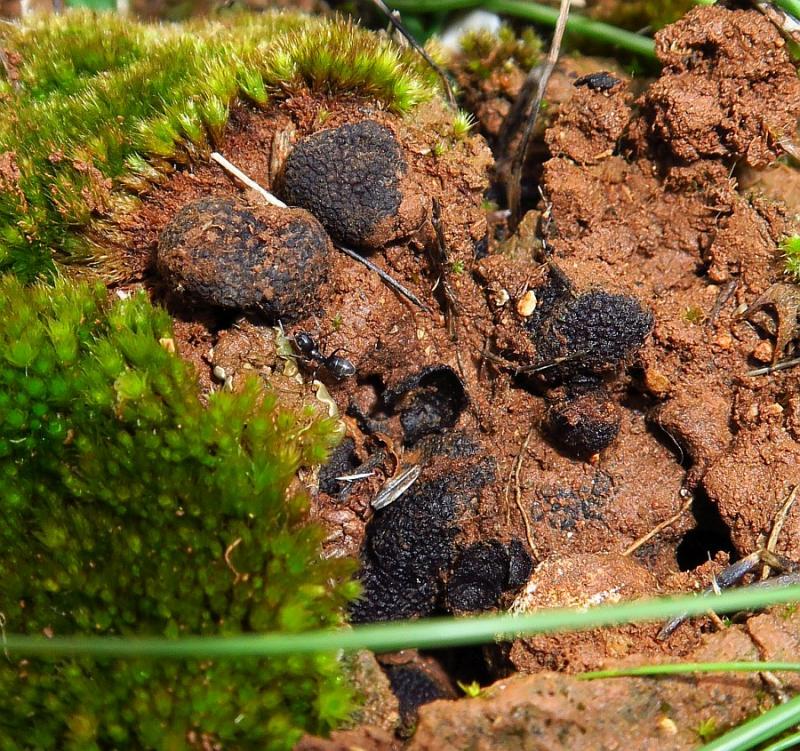
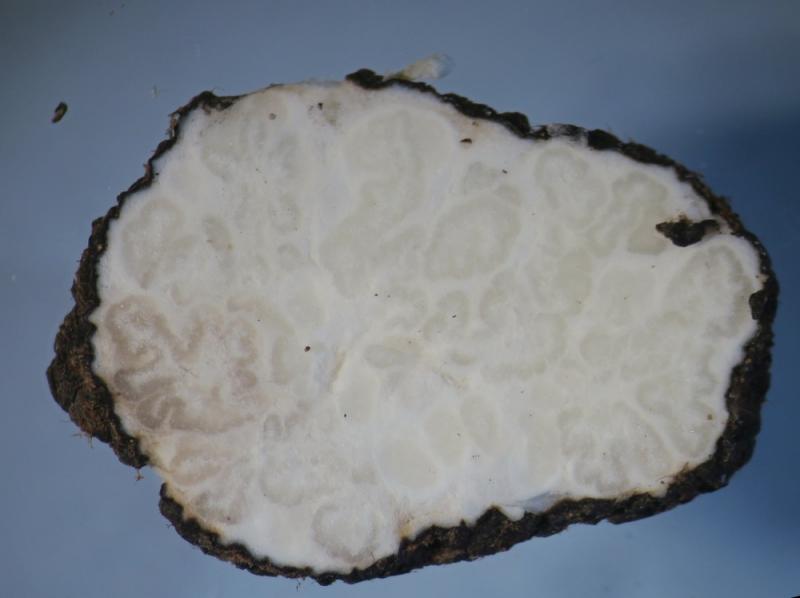
Ascocarp type: CleistotheciaAscocarp morphology: Small. irregularly ovoid-globular structures
Acocarp colour (peridium): Black
Ascocarp colour (core): White with pale ash-grey islets, convoluted and irregularly lobed
Ascocarp diameter: 1.0–2.5cm
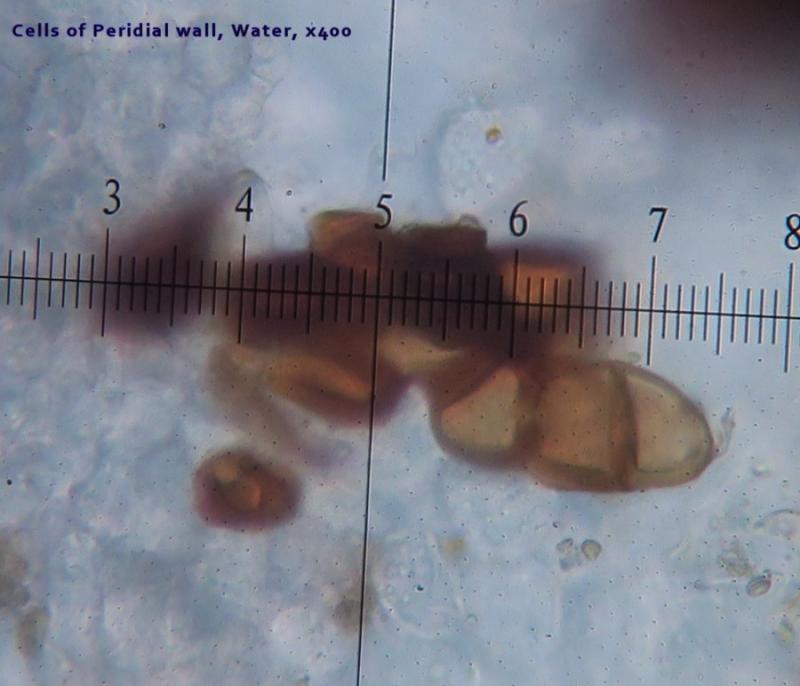
Peridium texture: Solid, quite hard, crusted with distinct cracks leaving angular crumbs, each 0.5–1.8mm across with 4–6 sides.
Peridium thickness: Thin, egg-shell, c. 1mm
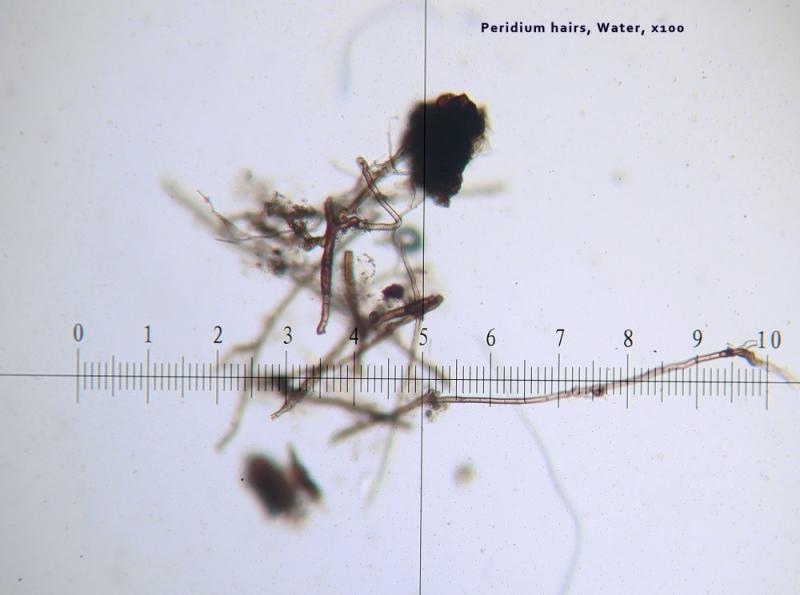
Peridial hair: 6um thick, angular or irregularly curved with rounded knobs,
Ascum shape: Balloon shaped with a long rather thick stipe
No. of Spores per ascum: 8
Tunic (Wall): Bitunicate
Ascum Total length incl. stipe: 130 – 180 µm
Length excl. stipe (range): 66.73 – 95 µm
Length excl. stipe (mean): 79.8 µm
Width excl. stipe (range): 46 – 65 µm
Width excl. stipe (mean): 53.2 µm
Ascum L:W ratio: 1.5
Ascum stipe length: 40 – 95 µm (mean 66 µm)
Iodine reaction: J-ve
Spore length (range): 20 - 29.5 µm
Spore length (mean): 24.5 µm
Spore width (range): 18.95 - 26 µm
Spore width (mean): 22.8 µm
Spore Q factor (range): 1.02 - 1.21 µm
Spore Q factor (mean): 1.1
Spore shape: Globular or subglobular
Spore surface: Smooth or perhaps finely warted due a certain cloudiness in some slides at different focal ranges.
Oil bodies: One huge guttule at the centre occupying almost all the spore content, sometimes slightly eccentrical.
Peridial hair: 6um thick, irregularly curved or subangular (obtuse angles) with rounded knobs or small lobe-like structures, septate.
Peridial cells: 15–22um across; squarish with rounded corners or subglobose-ovoid, quite irregular but more or less equidistant axis (long as wide), dark brown.
Sterile hyphae: Hyaline, profusely branched, mesh network, apparently finely pitted, septate. Apparently with small guttulae in hyphal content. Margin straigh or slightly irregular.
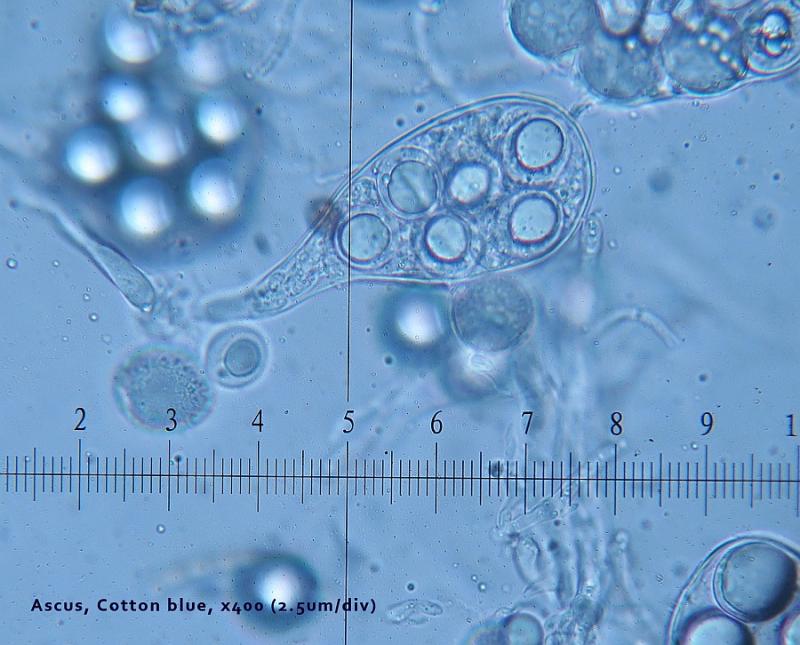
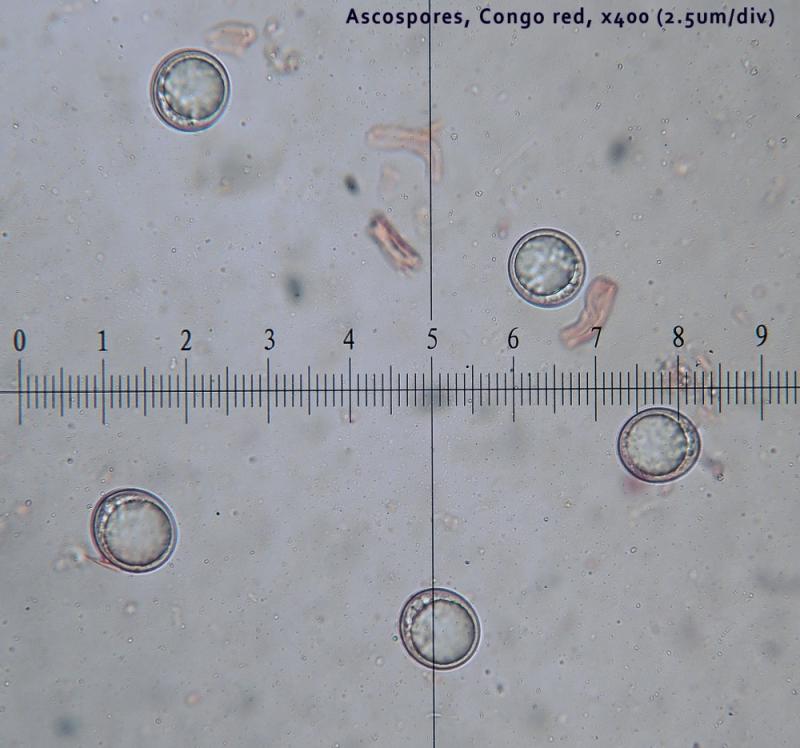
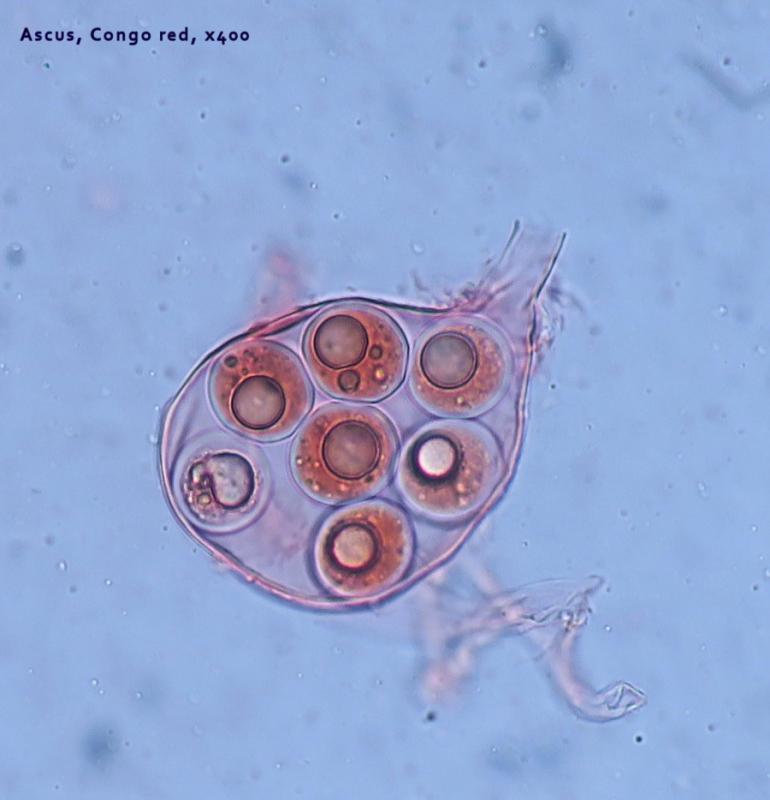
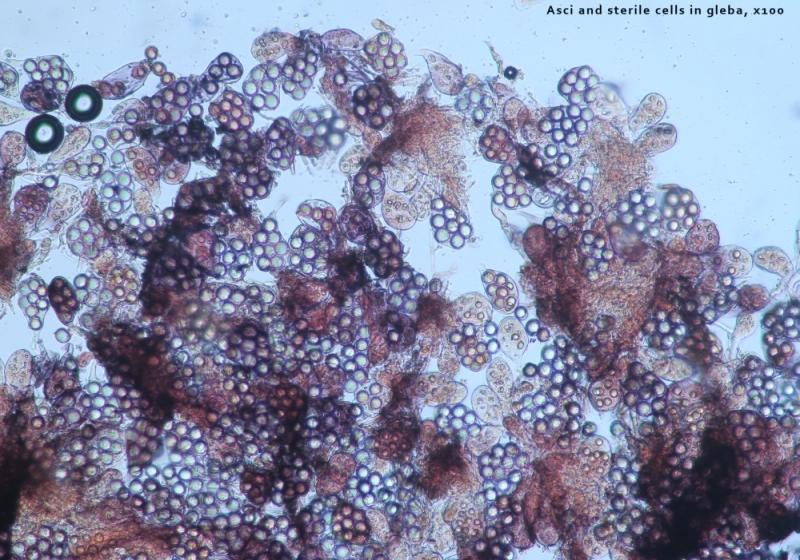
Stephen Martin Mifsud,
18-05-2017 06:47
Re : Picoa possibly juniperi or lefebvrei (or other?)
http://www.micobotanicajaen.com/Revista/Articulos/MARibesR/Fuerteventura001/Picoa%20lefebvrei%20130310%2063.pdf
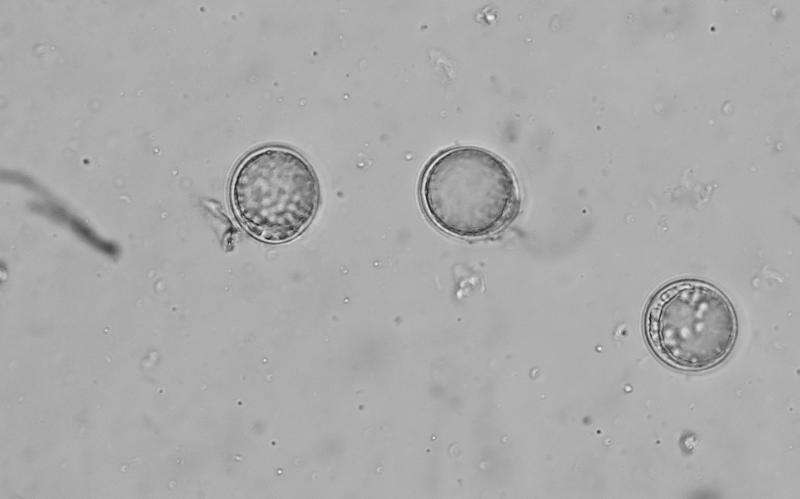
After finding this document on Ascofrance link and another post related to my question, it is being said that P. lefebvrei has verrucose ascospores and in the photo attached below, I can (with you kind cnfirmation) confirm that it is indeed verrucose.
I also forgot to mention that the truffles were found in close distance to Fumana sp. (Cistaceae) in an area surrounded sparsely by Pine trees, and then Juniperus phoenicea some 200m away. I am reading that P. lefebvrei has been reported on another Cistaceae (Helianthemum sp.)
P. lefebvrei then ?
After finding this document on Ascofrance link and another post related to my question, it is being said that P. lefebvrei has verrucose ascospores and in the photo attached below, I can (with you kind cnfirmation) confirm that it is indeed verrucose.
I also forgot to mention that the truffles were found in close distance to Fumana sp. (Cistaceae) in an area surrounded sparsely by Pine trees, and then Juniperus phoenicea some 200m away. I am reading that P. lefebvrei has been reported on another Cistaceae (Helianthemum sp.)
P. lefebvrei then ?
Vasileios Kaounas,
18-05-2017 10:36

Re : Picoa possibly juniperi or lefebvrei (or other?)
some clade....
Contrasted Genetic Diversity, Relevance of Climate and Host Plants, and Comments on the Taxonomic Problems of the Genus Picoa (Pyronematacee, Pezizales)
Contrasted Genetic Diversity, Relevance of Climate and Host Plants, and Comments on the Taxonomic Problems of the Genus Picoa (Pyronematacee, Pezizales)
Stephen Martin Mifsud,
18-05-2017 15:11
Re : Picoa possibly juniperi or lefebvrei (or other?)
Dear Vasileios Kaounas,
According to the suggested paper, this falls to Lineage/Clade VI of verrucose ascospored species like the Italian, Greek, Algerian and some Spannish material with the Mediterranean region, as if it occurs in a narrow longitudinal band.
Then one can interpret (I still need to read the discussion in depth as it is quite heavy) that the verrucose/smooth character of the ascospores is not fully supported by this study to discriminate juniperi/lefebvrei - complicated matter. But let's say that using traditional concepts, this would classify as P. lefebvrei because of the verrucose spores... right?
According to the suggested paper, this falls to Lineage/Clade VI of verrucose ascospored species like the Italian, Greek, Algerian and some Spannish material with the Mediterranean region, as if it occurs in a narrow longitudinal band.
Then one can interpret (I still need to read the discussion in depth as it is quite heavy) that the verrucose/smooth character of the ascospores is not fully supported by this study to discriminate juniperi/lefebvrei - complicated matter. But let's say that using traditional concepts, this would classify as P. lefebvrei because of the verrucose spores... right?
Vasileios Kaounas,
18-05-2017 15:50
Re : Picoa possibly juniperi or lefebvrei (or other?)
Dear Stephen
I think it's a new species.
Belongs to the black group and has verrucose spores.
Obviously in the future to show that the plant has the greatest role in separating of these species.
I think it's a new species.
Belongs to the black group and has verrucose spores.
Obviously in the future to show that the plant has the greatest role in separating of these species.