

05-05-2026 22:40
Gernot FriebesHi,I believe this is a Plagiostoma growing on a Sa
06-05-2026 11:25
 Castillo Joseba
Me mandan el material seco de Galicia (España) re
06-05-2026 17:23
Thomas Læssøehttps://svampe.databasen.org/observations/10594257
28-04-2026 20:07
 Lothar Krieglsteiner
... on twig in the air at standing Ceratonia siliq
04-05-2026 18:13
 Stephen Martin Mifsud
ID request for what seems to be a true aquatic fun
04-05-2026 16:39
Stephen Martin Mifsud
ID request: This specimen was collected in Malta o
28-07-2011 18:31
 Alex Akulov
Dear FriendsToday I made the pdf file of Velenovsk
04-05-2026 09:50
Castillo Joseba
Me mandan el material seco de Galicia,(España) re
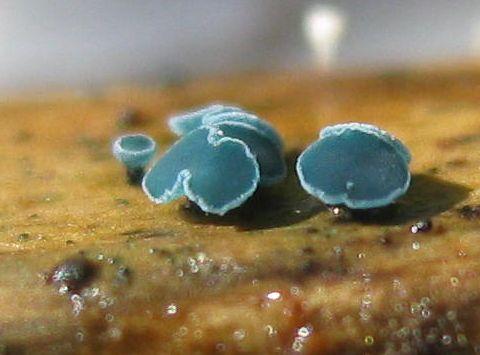
once again I did not find a solution, when looking for a determination to my finding.
These bluish ones color the stem of Filipendula blue and are short stipate, up to 0,7 mm wide.
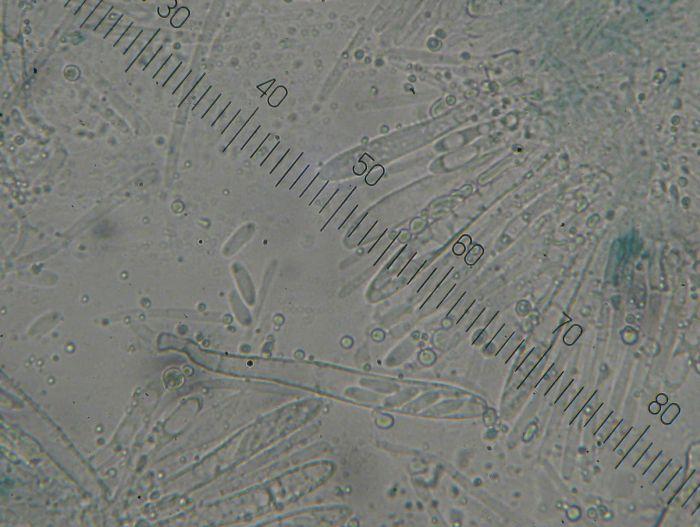
The spores are about 7-9x2-3 and have a couple of small droplets.
The asci are about 55-70x7-8, IKI- and paraphyses are septate, about 2 micrometers wide.
NM1 tells, that Chlorociboria are found on woody substrates and should have amyloid asci, but to my seeing these were not. So, is there some other genus fitting better or different species in Chlorociboria?
Curiously: Marja
Dear Marja,
this should be C. aeruginella. I found it once in Germany and published about it. It also grew on Filipendula, but it seems to grow on other substrates, too. Surely a rare species.
Best regards from Lothar
 Chlorociboria.-Boletus-2002-0001.pdf
I just see my spores and asci were a bit larger than your measurements are. Did you examine living material?
Best regards fom Lothar

thank you.
I have found C. aeruginella on Salix leaves ealier, but the species is not included in NM1, so I have no description of it.
Lothar, I study only fresh ascomycete specimen in snowless season and interesting ones as soon as possible, the substrate made this interesting ;)
Marja