
12-04-2026 17:56
 Hardware Tony
Found on dead stems in February earlier this year
12-04-2026 15:52
Gernot FriebesHi,I'm looking for help with this anamorph collect
12-04-2026 12:22
 William Slosse
In a dune grassland in Oostduinkerke (Belgium), on
11-04-2026 15:45
 Zuzana Sochorová (Egertová)
Please, could anyone send me this paper?Moyne G.,
11-04-2026 13:34
Artem PtukhaHello, I am seeking assistance with the identific

11-04-2026 10:19
 Michel Hairaud
Chers amis d'Ascofrance , voici une très bonne no
11-04-2026 10:10
Michel Hairaud
Dear Ascofrance members, here is some very good ne
10-04-2026 23:22
Gernot FriebesHi,ascospores are 1- to 3-septate, approximately
10-04-2026 15:51
William Slosse
Hello everyone, On 08/04/26, I found a growth sit
Otidea umbrina ? Dark Brown Throughout
Peter Thompson,
27-11-2014 10:16
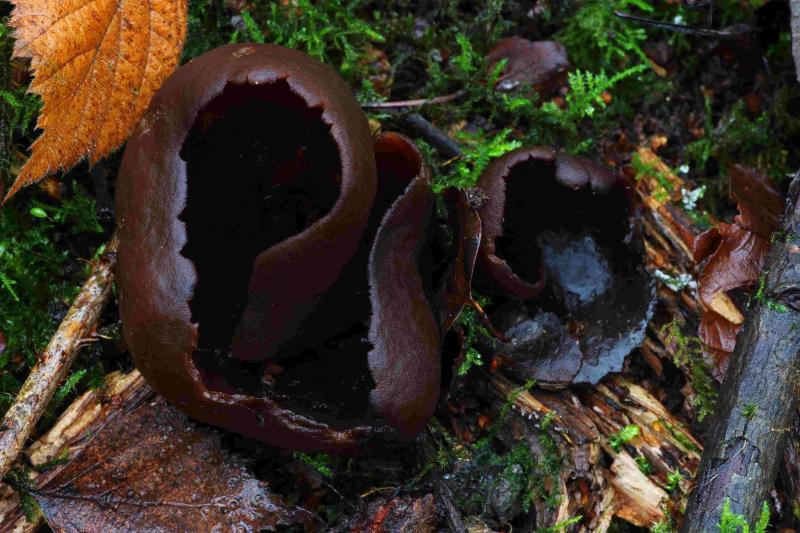
I recently collected a fruit body of a large cup fungus, which was deeply split down one side. It seems that the genus Otidea is most likely, and the closest species which I can find seems to be O. umbrina. Using Nicolas Van Vooren's key to Otidea, my sample also looks closest to O. umbrina.
The fruit bodies were moist and looked fresh when found, so I assume that dark brown hymenium and exterior are correct. The exterior is quite smooth, unlike that of O. bufonia.
The substrate is moss covered rotting wood of Salix.
I have attached a photo of the fruit bodies (very compressed, causing pinkish and greenish tones which were not on the fruit body itself).
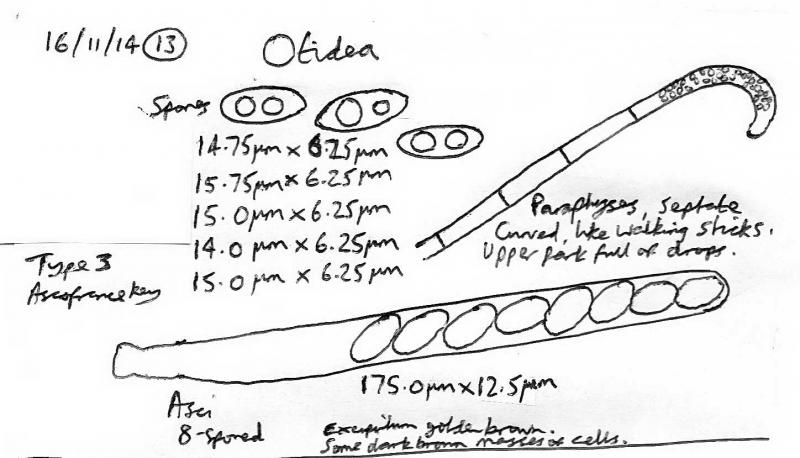
The microscopy is also attached.
I wonder if I have identified it correctly?
Thank you,
With Best Wishes,
Peter.
Nicolas VAN VOOREN,
01-12-2014 07:56

Re : Otidea umbrina ? Dark Brown Throughout
In my opinion, this is Otidea bufonia. O. umbrina is a synonym.
Peter Thompson,
02-12-2014 10:05
Re : Otidea umbrina ? Dark Brown Throughout
Hello Nicolas,
Thank you for your reply.
I must admit to being confused now.
When I worked through your Otidea key (Dec. 2008), I selected as the best options:
1 (b) split down one side = 3.
Then 3 (c) dark brown colour = 11.
Then 11 (b) without violaceous tinges = 13.
Then 13 (b) without olivaceous tinges = 15.
Then 15 (b) paraphyses with simple apex = 17.
Then 17 (b) apothecia high, deep, dark coloured = O. umbrina.
When I considered O. bufonia, I did not see any folding of the excipulum on my sample, but quite a smooth surface, at most coarsely granulate. Also no olivaceous colouring of the hymenium.
Since the 2008 key, have the species been redefined? Is there a new key to use?
Thank you,
With Best Wishes,
Peter.
Thank you for your reply.
I must admit to being confused now.
When I worked through your Otidea key (Dec. 2008), I selected as the best options:
1 (b) split down one side = 3.
Then 3 (c) dark brown colour = 11.
Then 11 (b) without violaceous tinges = 13.
Then 13 (b) without olivaceous tinges = 15.
Then 15 (b) paraphyses with simple apex = 17.
Then 17 (b) apothecia high, deep, dark coloured = O. umbrina.
When I considered O. bufonia, I did not see any folding of the excipulum on my sample, but quite a smooth surface, at most coarsely granulate. Also no olivaceous colouring of the hymenium.
Since the 2008 key, have the species been redefined? Is there a new key to use?
Thank you,
With Best Wishes,
Peter.