27-04-2026 20:52
 Lothar Krieglsteiner
Found on hanging tiwg of Olea europaea in dried-ou
27-04-2026 18:48
Tony MoverleyCollected 23rd April 2026, Norfolk, EnglandSwarms
27-04-2026 17:41
Lothar Krieglsteiner
.. Algarve, same leaf than the last post. The con
27-04-2026 18:05
Lothar Krieglsteiner
... still attached at standing tree. The green con
27-04-2026 17:16
Lothar Krieglsteiner
.. Algarve, moist lying.The conidiomata look like
27-04-2026 12:54
Steve ClementsBonjour. Ce petit champignon blanc résupiné et
27-04-2026 09:59
Pauline. PennaBonjour Can anyone advise me on these pycnidia fo

22-04-2026 20:54
 Enrique Rubio
Hi to everybody.This Pyrenopeziza grew in moist le
White Mollisia-like (?) disco
Yatsiuk Iryna,
23-06-2014 23:41
 Hello, friends,
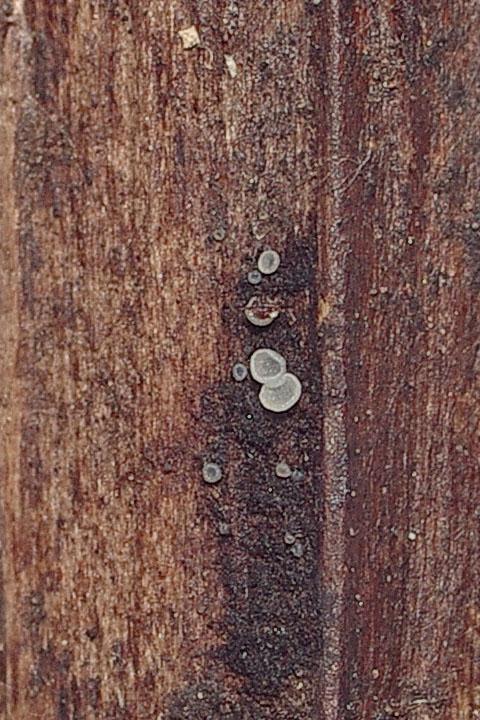
This one was collected on the deciduous twig 2 cm in diam.
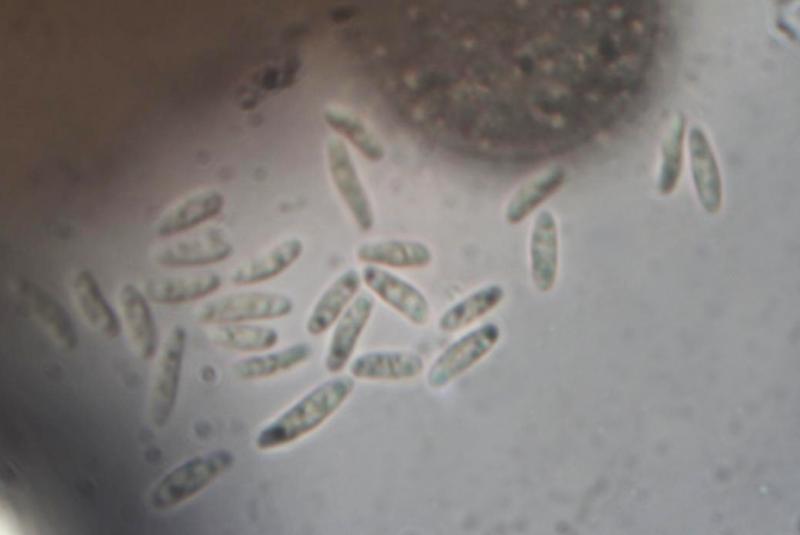
It is a dried specimen and I don't have a good idea about its genus. When I made a mount in tap water 2 times I observed a rich white exudate appearing from a fruitbody with abundant spores floating in it. One time I didn't observed it. Also some (maybe gelatinous) content is visible in paraphyses although they obviously should be dead.
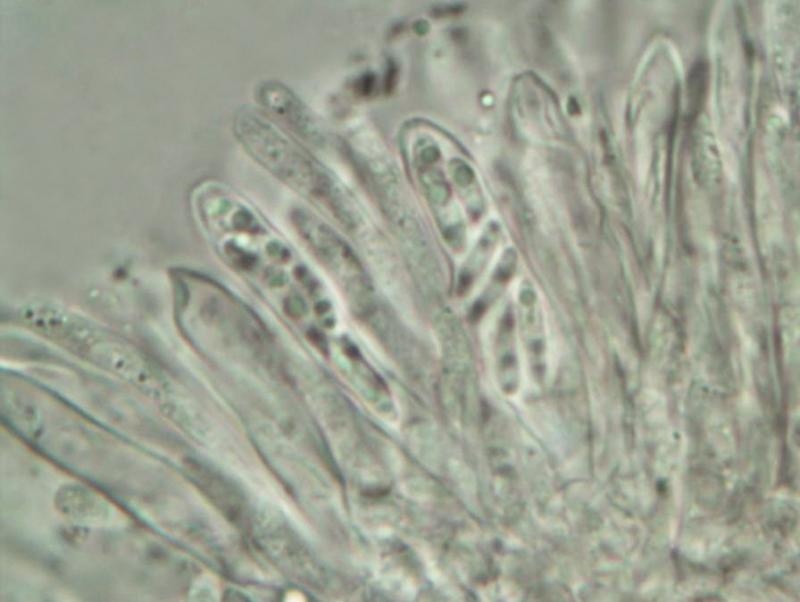
Its excipulum was different at the base and at margin. At the base - brown prismatic cells, and near the margin - more elongated hyaline cells. I haven't seen clearly any hairs.
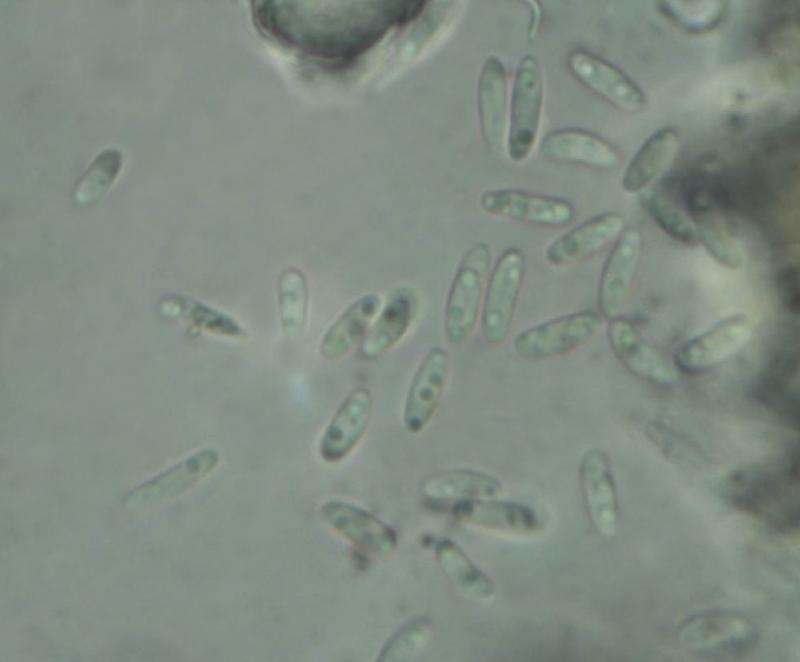
Spores are 5.8-7.2*2.3-2.6 um. 2 or more oil drops in spores.
KOH-, ascus apparatus IKI dark blue
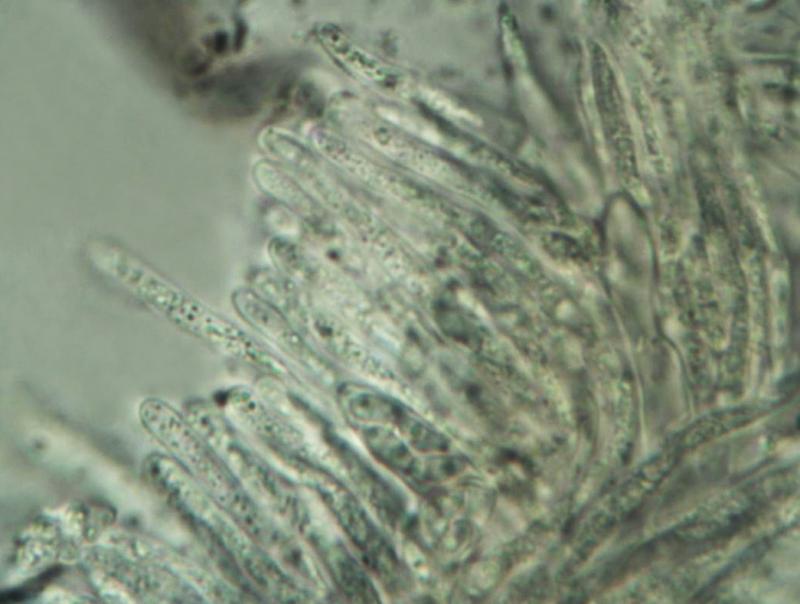
Asci with croziers which grow from the upper part of the ascus base but do not merge with the base.
I hope someone can tell me something about the genus.
Best regards,
Irina
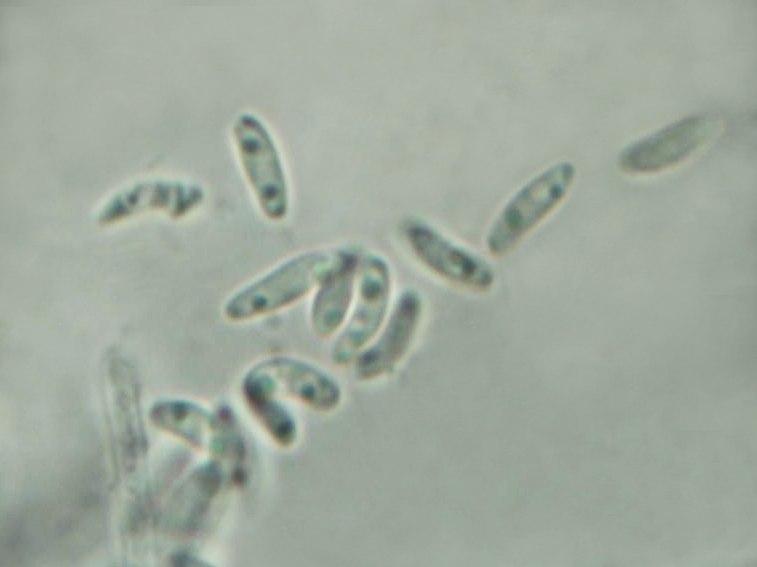
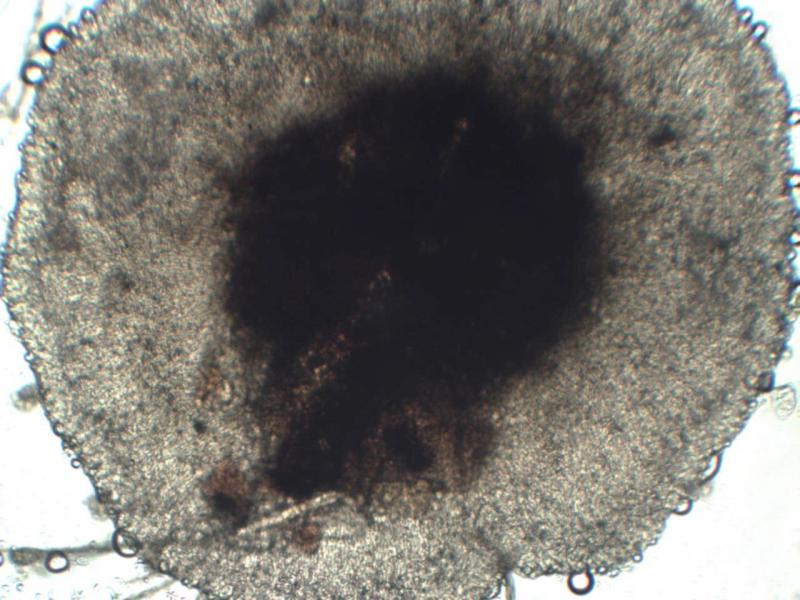
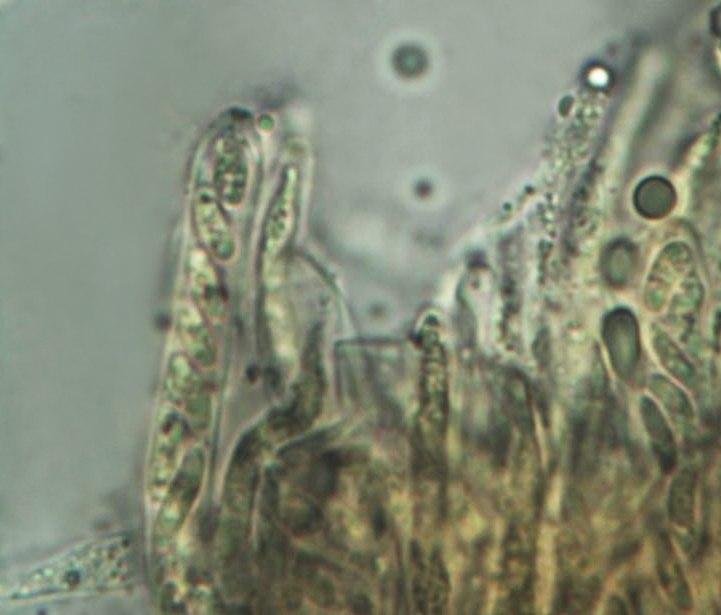
Yatsiuk Iryna,
23-06-2014 23:44
Re : White Mollisia-like (?) disco
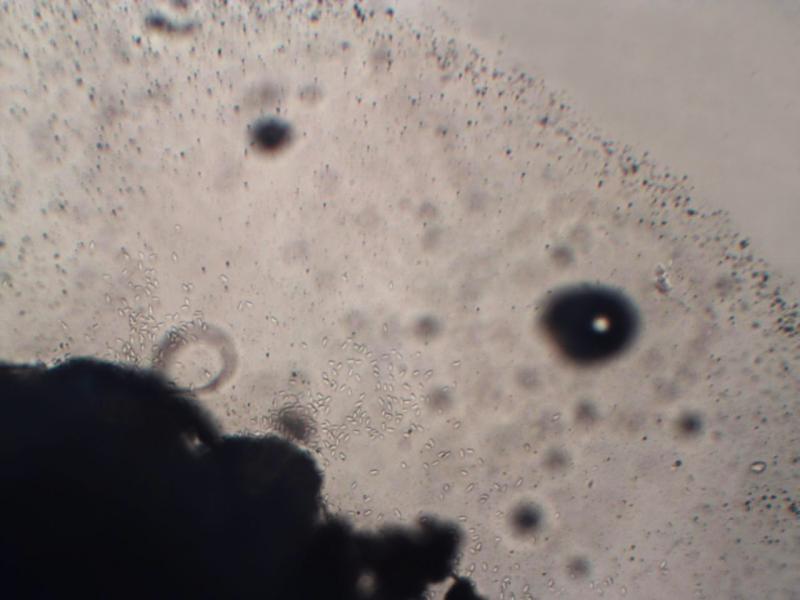
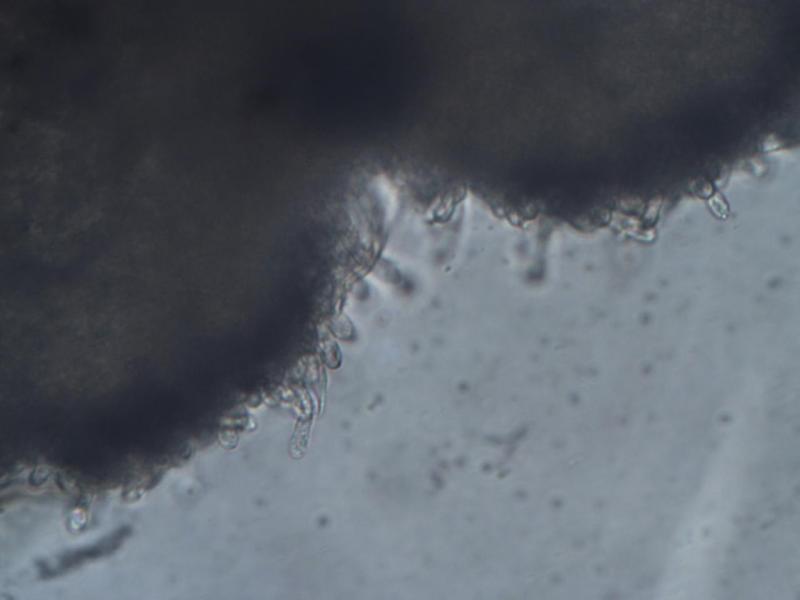
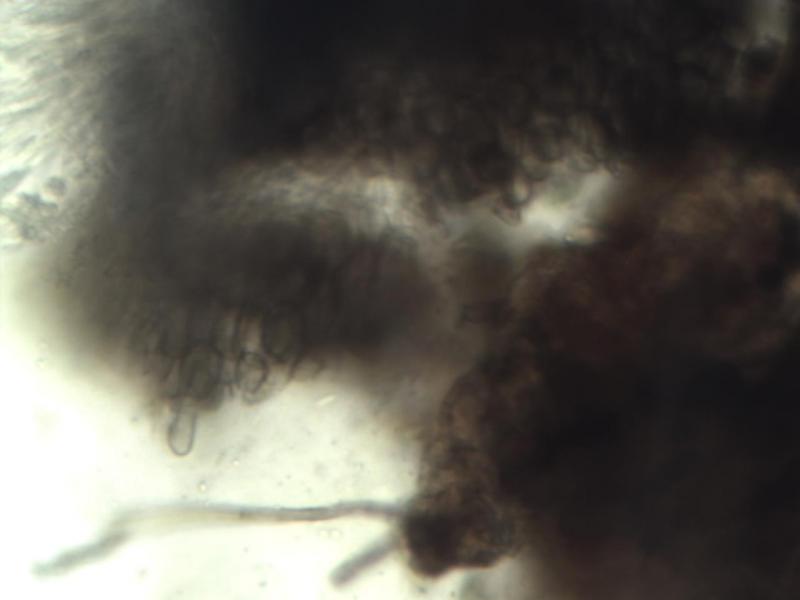
The rest of pictures. On the second photo this exudate with floating spores is shown. The 3d photo shows some structures at the margin (hairs? asci?), and the 4 one is excipulum cells from the base of apothecium.
Hans-Otto Baral,
24-06-2014 08:57

Re : White Mollisia-like (?) disco
Could be something of the Pyrenopeziza subviridula aggregate to which also Mollisia dextrinospora seems to belong, but without vital characters difficult to say.
Zotto
Zotto
Brian Douglas,
24-06-2014 14:28

Re : White Mollisia-like (?) disco
Hi Irina,
You could also compare to Pyrenopeziza laricina f. microsperma (Le Gal & F. Mangenot), which looks similar but not identical to your species. I think it probably also belongs in the Mollisia (=Pyrenopeziza) dextrinospora group, which seems to be a clade of predominantly lignicolous Pyrenopezizas. It has similar size ascospores to your species, but they look different in shape and oil droplet content.
You could also compare to Pyrenopeziza laricina f. microsperma (Le Gal & F. Mangenot), which looks similar but not identical to your species. I think it probably also belongs in the Mollisia (=Pyrenopeziza) dextrinospora group, which seems to be a clade of predominantly lignicolous Pyrenopezizas. It has similar size ascospores to your species, but they look different in shape and oil droplet content.
I've attached Le Gal & Mangenot's description in case it is of any use to you (or anyone).
Cheers,
Brian
 Le-Gal-amp-Mangenot-Mollisia-cinerella-amp-Pyrenopeziza-laricina-var.-microsperma-0001.pdf
Yatsiuk Iryna,
24-06-2014 15:52
Re : White Mollisia-like (?) disco
Hi, Brian,
Thank you for the article. Although I can't read fast in french, I see that spore shape of P. laricina f. microsperma differs from my specimen. Also a coniferous habitat doesn't fit, becouse my substrate was for sure deciduous, probably it was Sambucus.
Thank you for telling with the genus and complex within it, I'll try to recollect it and study in fresh condition.
Best regards,
Irina
Thank you for the article. Although I can't read fast in french, I see that spore shape of P. laricina f. microsperma differs from my specimen. Also a coniferous habitat doesn't fit, becouse my substrate was for sure deciduous, probably it was Sambucus.
Thank you for telling with the genus and complex within it, I'll try to recollect it and study in fresh condition.
Best regards,
Irina
Yatsiuk Iryna,
24-06-2014 16:02
Re : White Mollisia-like (?) disco
Thank you, Zotto,
I didn't really hope to identify this old material to the species level, but it seemed interesting and I'm glad that now I know the genus.
I'll look for P. subviridinula at your DVD.
With best regards,
Irina
I didn't really hope to identify this old material to the species level, but it seemed interesting and I'm glad that now I know the genus.
I'll look for P. subviridinula at your DVD.
With best regards,
Irina
Brian Douglas,
24-06-2014 16:41
Re : White Mollisia-like (?) disco
Hi Irina,
Pyrenopeziza subviridula is here in Zotto's amazing Cubby collection (I don't think it was on his 2005 DVD):
https://www.cubby.com/pl/CC+Ascomycota/_1354d48ffaad4b59bd3ffdbb35915d1f#CC%20Ascomycota/7a%20Helotiales/m%20Mollisiaceae/Pyrenopeziza%20on%20woody%2Bbark
The ascospores do look very similar to your species. The macro and micromorphology of the apothecium is (I think) also very reminiscent of Mollisia dextrinospora - I would have thought Zotto's collections were M. dextrinospora if the ascospores weren't so different.
Do you have any idea if your species was the same sort of light-dark brown when it was collected?
I wonder if the ascospores also have a very visible dextrinoid reaction in IKI, or if this is restricted to M. dextrinospora?
I don't think I've seen any host specificity in the sequences in the Mollisia dextrinospora group in GenBank: M. dextrinospora has been detected in/on Acacia, Fraxinus, Taxus and Actinidia, while the other big clades also colonise some of these substrates as well as Picea and Pinus. I suspect they're quite good generalists, but some might be host-specific, or there might be host specific strains or subspecies, you never know!
Cheers,
Brian
Pyrenopeziza subviridula is here in Zotto's amazing Cubby collection (I don't think it was on his 2005 DVD):
https://www.cubby.com/pl/CC+Ascomycota/_1354d48ffaad4b59bd3ffdbb35915d1f#CC%20Ascomycota/7a%20Helotiales/m%20Mollisiaceae/Pyrenopeziza%20on%20woody%2Bbark
The ascospores do look very similar to your species. The macro and micromorphology of the apothecium is (I think) also very reminiscent of Mollisia dextrinospora - I would have thought Zotto's collections were M. dextrinospora if the ascospores weren't so different.
Do you have any idea if your species was the same sort of light-dark brown when it was collected?
I wonder if the ascospores also have a very visible dextrinoid reaction in IKI, or if this is restricted to M. dextrinospora?
I don't think I've seen any host specificity in the sequences in the Mollisia dextrinospora group in GenBank: M. dextrinospora has been detected in/on Acacia, Fraxinus, Taxus and Actinidia, while the other big clades also colonise some of these substrates as well as Picea and Pinus. I suspect they're quite good generalists, but some might be host-specific, or there might be host specific strains or subspecies, you never know!
Cheers,
Brian
Yatsiuk Iryna,
25-06-2014 15:14
Re : White Mollisia-like (?) disco
Hi Brian,
Thank you for the link to very valuable resource! And of course many thanks to Zotto for this work. Yes, my spores are very similar to M.subviridicola and also the apothecial structures.
I checked spores in IKI and they don't have strong dextrinoid reaction, which is shown on the attached photo. As for the apothecia colour in fresh condition, I cannot say anything for sure, cause I didn't make a photo:(
Cheers,
Irina
Thank you for the link to very valuable resource! And of course many thanks to Zotto for this work. Yes, my spores are very similar to M.subviridicola and also the apothecial structures.
I checked spores in IKI and they don't have strong dextrinoid reaction, which is shown on the attached photo. As for the apothecia colour in fresh condition, I cannot say anything for sure, cause I didn't make a photo:(
Cheers,
Irina