
05-05-2026 22:40
Gernot FriebesHi,I believe this is a Plagiostoma growing on a Sa
04-05-2026 18:13
 Stephen Martin Mifsud
ID request for what seems to be a true aquatic fun
04-05-2026 16:39
Stephen Martin Mifsud
ID request: This specimen was collected in Malta o
28-07-2011 18:31
 Alex Akulov
Dear FriendsToday I made the pdf file of Velenovsk
28-04-2026 20:07
 Lothar Krieglsteiner
... on twig in the air at standing Ceratonia siliq
04-05-2026 09:50
 Castillo Joseba
Me mandan el material seco de Galicia,(España) re
02-05-2026 12:42
Alain BRISSARDBonjour à tousJeuidi 30 avril dernier on m'a remi
02-05-2026 13:06
Pauline. PennaBonjour Please can someone help me with this id
01-05-2026 22:45
 Thierry Blondelle
Bonjour à tous, Une récolte sur bouse séchée d
Coprotus granuliformis 140112 60
Miguel Ángel Ribes,
12-03-2014 20:57
 Good night
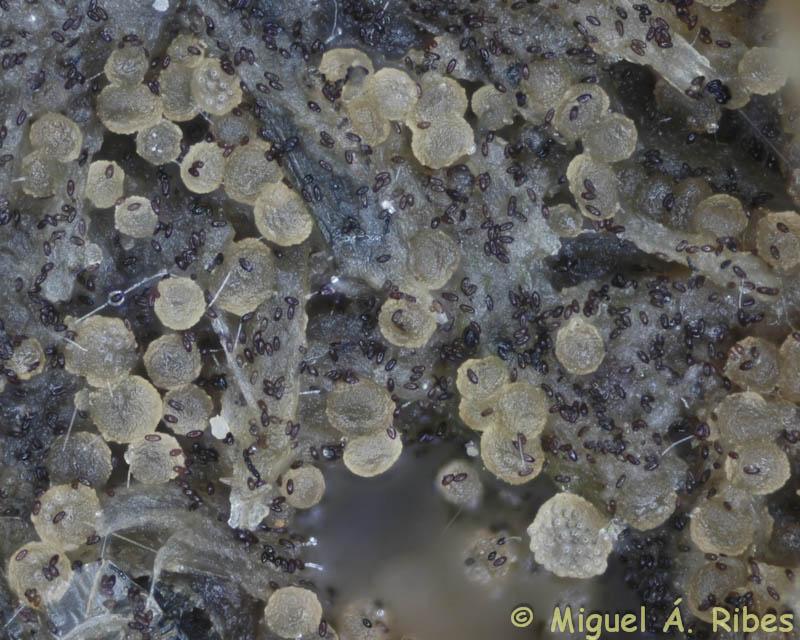
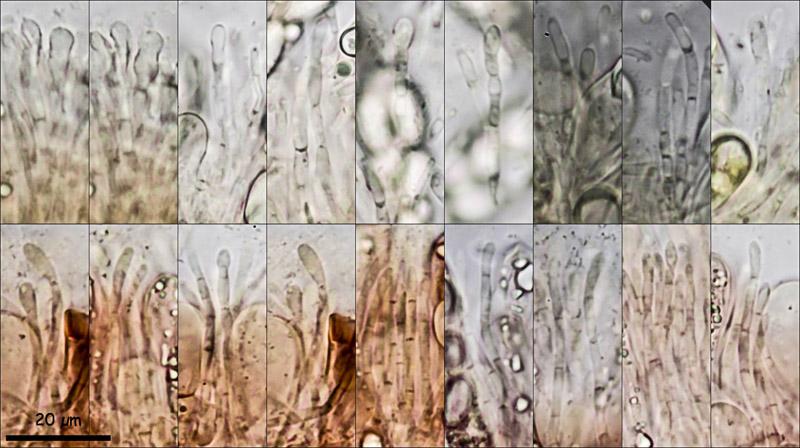
I had this collection like C. granuliformis, but it hasn't "paraphyses with strongly inflate apices" as said by Franceso Doveri in Fungi Fimicoli Italici, and apos are very, very small, (80-)90-130(-140) µm, globose to subesferich at first, pulvinate at maturity. Spores are very small for C. leucopocillum; and C. trichosurus is a New Zealand species.
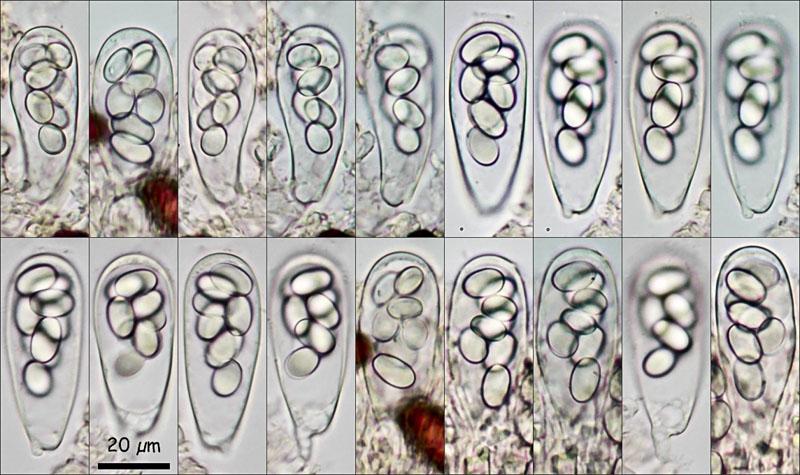
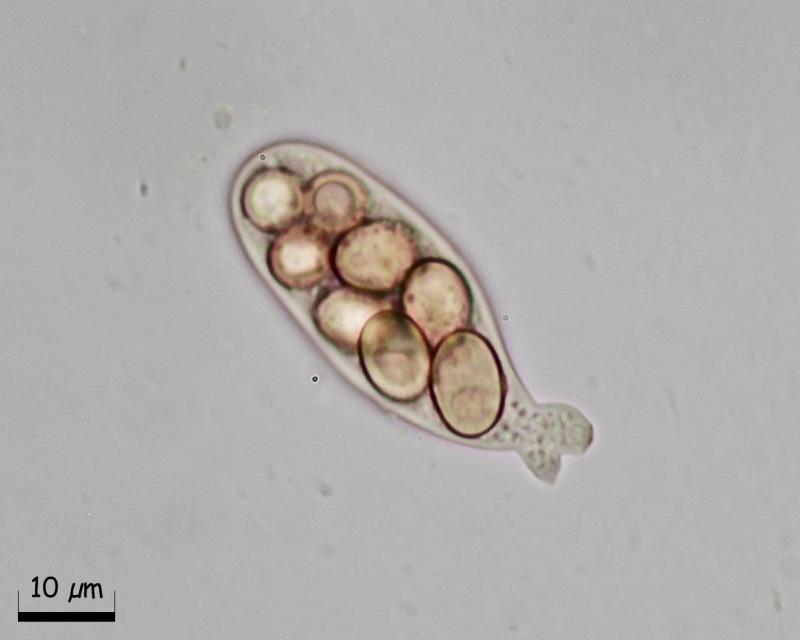
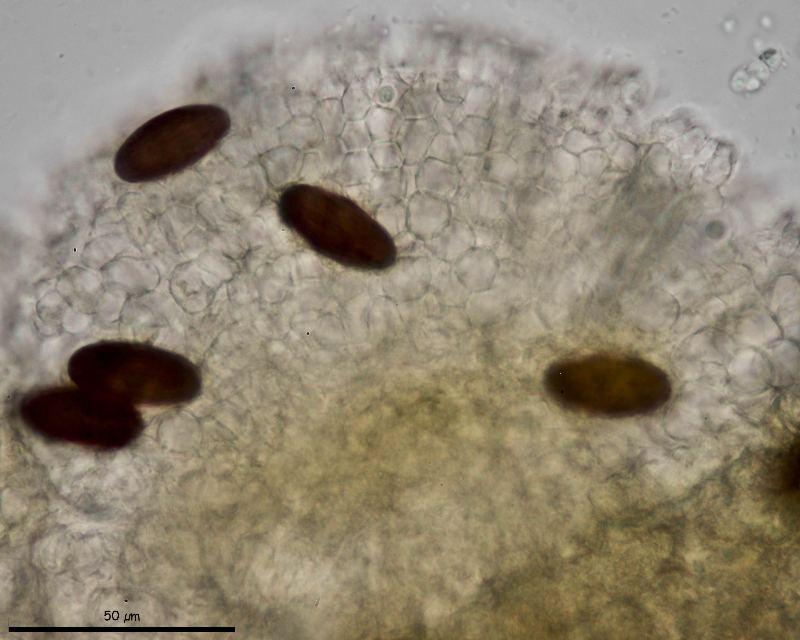
Asci clavate to saciforme, rounded at apex, with a short walk and lobed, with croziers, irregularly biseriate of ( 36.8 -) 37.6 - 53.1 ( -66.2 ) x ( 12.7 - ) 14.2 - 19.8 (-20.7 ) um, N = 17, Me = 46.2 x 16.5 µm. Ellipsoidal, hyaline, smooth ascospores, rounded at the ends, ( 10.2 -) 11.1 - 12.4 ( -12.8 ) x (6.2 -) 6.6 - 7.8 (-8.1 ) um, Q = (1.4 -) 1.5-1.8 (-1.9 ), N = 61 , Me = 11.7 x 7.2 µm ; Qe = 1.6 . Paraphyses filiform, septate, relatively thick-walled, slightly constricted in the septa, without pigment or lipid content, exceeding the height of the asci, not forked, straight, (1,3 -) 1.8-2 , 8 (-3.3 ) um, Me = 2.3 µm wide at the penultimate cell and thickened up to (2.2 -) 2.4-4.3 (-5.0 ) um, Me = 3.3 µm at the apex. Undifferentiated medullary excipulum. Ectal excipulum of globular-angular texture with cells (6.2 -) 7.4 - 11.1 (-13.1 ) x ( 4.9 -) 5.7 - 9.3 (-10.8 ) um , Q = (1.0 -) 1.1-1.5 (-1.9 ), N = 111 , Me = 9.1 x 7.4 µm ; Qe = 1.3.
Thank you in advance.
Miguel Ángel Ribes
Norbert Heine,
13-03-2014 22:01

Re : Coprotus granuliformis 140112 60
Dear Miguel,
I think you should compare with Coprotus trichosurus.
Why should this species not grow in Europe?
Ann Bell and J.W.Kimbrough described it, which is closely to C. granuliformis, in 1973.
It's a very small species with apothecia from 125 - 175 µm!
Only your ascospores seems to be a little bit too broad.
Norbert
I think you should compare with Coprotus trichosurus.
Why should this species not grow in Europe?
Ann Bell and J.W.Kimbrough described it, which is closely to C. granuliformis, in 1973.
It's a very small species with apothecia from 125 - 175 µm!
Only your ascospores seems to be a little bit too broad.
Norbert
 Coprotus-trichosurus-Bell-amp-Kimbrough-1973-0001.pdf
Miguel Ángel Ribes,
14-03-2014 01:22
Re : Coprotus granuliformis 140112 60
Wooooow
Dear Norbert
The nearest species for my collection is, as you say, C. trichosurus (I had read that paper), but I am affraid to asigned that name, because it is from New Zealand and were found on fecal pellets of an opossum. Really macro and micro fits more with C. trichosurus than C. granuliformis nor breviascus.
I do not know what to do, perhaps is it possible to ask Ann Bell or J.W.Kimbrough?
Thank you.
Dear Norbert
The nearest species for my collection is, as you say, C. trichosurus (I had read that paper), but I am affraid to asigned that name, because it is from New Zealand and were found on fecal pellets of an opossum. Really macro and micro fits more with C. trichosurus than C. granuliformis nor breviascus.
I do not know what to do, perhaps is it possible to ask Ann Bell or J.W.Kimbrough?
Thank you.
Michel Delpont,
14-03-2014 12:24

Re : Coprotus granuliformis 140112 60
Hello Miguel and Norbert.
Very interesting specie, but it is difficult to decide. F.Doveri indicates the top of paraphyses up to maximum 5 microns. We also find little C.granuliformis without pigment in the paraphyses.
Thank you Miguel and to Norbert for this paper.
Michel.
Very interesting specie, but it is difficult to decide. F.Doveri indicates the top of paraphyses up to maximum 5 microns. We also find little C.granuliformis without pigment in the paraphyses.
Thank you Miguel and to Norbert for this paper.
Michel.
Miguel Ángel Ribes,
14-03-2014 12:42
Re : Coprotus granuliformis 140112 60
Hello Michel
Small collections of C. granuliformis without pigment in the paraphyses that you find, has strongly inflate apices and normal spore size for C. granuliformis?
Has anyone the mail of Ann Bell or J.W.Kimbrough?
Thank you.
Small collections of C. granuliformis without pigment in the paraphyses that you find, has strongly inflate apices and normal spore size for C. granuliformis?
Has anyone the mail of Ann Bell or J.W.Kimbrough?
Thank you.
Michel Delpont,
14-03-2014 14:06
Re : Coprotus granuliformis 140112 60
Yes, no differences in size to the spores and paraphyses.
Sorry, I do not have the adesses you ask.
Michel.
Sorry, I do not have the adesses you ask.
Michel.
Miguel Ángel Ribes,
16-03-2014 22:00
Re : Coprotus granuliformis 140112 60
Thanks Norbert and Michel, very kind.
Best wishes.
Best wishes.