
05-05-2026 22:40
Gernot FriebesHi,I believe this is a Plagiostoma growing on a Sa
06-05-2026 11:25
 Castillo Joseba
Me mandan el material seco de Galicia (España) re
06-05-2026 17:23
Thomas Læssøehttps://svampe.databasen.org/observations/10594257
28-04-2026 20:07
 Lothar Krieglsteiner
... on twig in the air at standing Ceratonia siliq
04-05-2026 18:13
 Stephen Martin Mifsud
ID request for what seems to be a true aquatic fun
04-05-2026 16:39
Stephen Martin Mifsud
ID request: This specimen was collected in Malta o
28-07-2011 18:31
 Alex Akulov
Dear FriendsToday I made the pdf file of Velenovsk
04-05-2026 09:50
Castillo Joseba
Me mandan el material seco de Galicia,(España) re
02-05-2026 12:42
Alain BRISSARDBonjour à tousJeuidi 30 avril dernier on m'a remi
Stictis
Bometon Javier,
16-12-2013 21:16
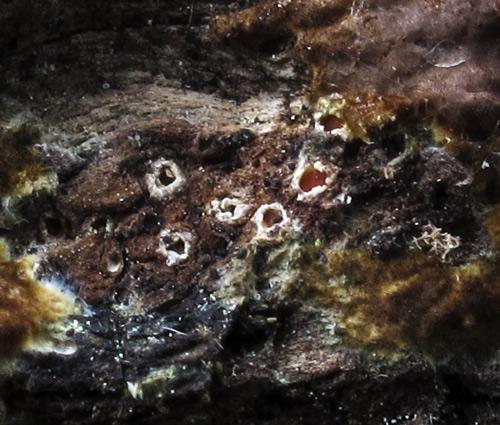
 En madera de Quercus.
Tamaño 0,5 mm
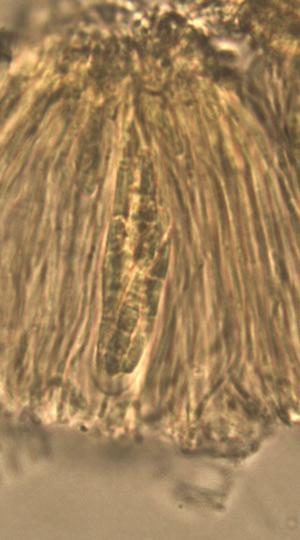
Ascas 50-60 um IKI-
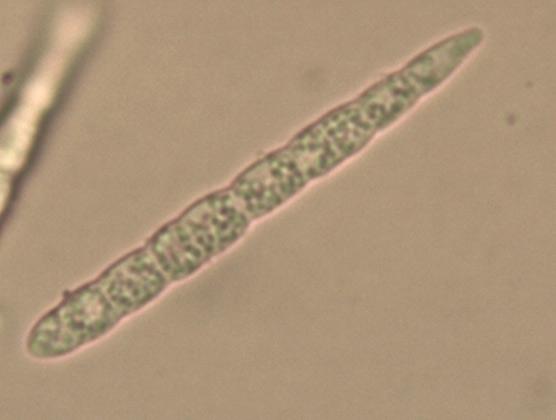
Esporas de 35-48 X 4-5um, con 7- 9 septos
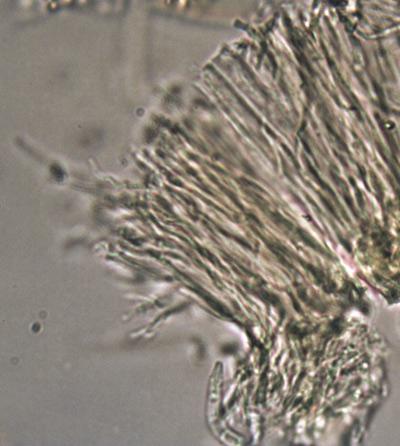
Parafisis filiformes y ramificadas, no azulean con IKi
Alguna idea?
Gracias y saludos
Javier
Daniel Ghyselinck,
16-12-2013 21:32
Re : Stictis
Bonjour Javier,
Regarde du côté de Cryptodiscus rhopaloides, il me semble que la microscopie correspond assez bien. C'est une espèce assez commune sur écorce de feuillus. Les spores sont un peu grandes, mais j'ai aussi des récoltes avec des spores jusque 47 µm.
Amitiés,
Daniel
Regarde du côté de Cryptodiscus rhopaloides, il me semble que la microscopie correspond assez bien. C'est une espèce assez commune sur écorce de feuillus. Les spores sont un peu grandes, mais j'ai aussi des récoltes avec des spores jusque 47 µm.
Amitiés,
Daniel
Martin Bemmann,
16-12-2013 21:35

Re : Stictis
Hi Javier,
with these clavate spores (fig. 3) consider Cryptodiscus.
Regards
Martin
Update: Daniel seems to have the same thoughts. But I must admit that Zotto (in a circulating paper) excluded Cryptodiscus rhopaloides from this genus in his comments on Breitenbach&Kränzlin 1984, as well Baloch et al 2009 did.
with these clavate spores (fig. 3) consider Cryptodiscus.
Regards
Martin
Update: Daniel seems to have the same thoughts. But I must admit that Zotto (in a circulating paper) excluded Cryptodiscus rhopaloides from this genus in his comments on Breitenbach&Kränzlin 1984, as well Baloch et al 2009 did.
Bometon Javier,
16-12-2013 22:41
Re : Stictis
Muchsas gracias, Daniel y Martin
Saludos
Javier
Saludos
Javier
Hans-Otto Baral,
16-12-2013 23:04

Re : Stictis
Yes, there are two species rather common, rhopaloides and the less common idaei which has narrower spores than rhopaloides. Both are very closely related, and belong in Karstenia. By the way, Lugol provokes a red reaction to the entire hymenium, with a faint blue running ahead. After KOH treatment the hymenium stains deep blue in iodine.
My maximum was actually 50 µm, but with spores strongly clavate and hardly constricted at septa.
C. rhopaloides is also known as Ramonia interjecta, being probably erroneously thought to be a lichen.
Zotto
My maximum was actually 50 µm, but with spores strongly clavate and hardly constricted at septa.
C. rhopaloides is also known as Ramonia interjecta, being probably erroneously thought to be a lichen.
Zotto

Daniel Ghyselinck,
17-12-2013 18:23
Re : Stictis
Thanks for these very precise information (as usual), Zotto.
Daniel
Daniel
Bometon Javier,
17-12-2013 21:54
Re : Stictis
Muchas Gracias Zotto, por tus excelentes explicaciones.
Saludos
Javier
Saludos
Javier