11-05-2026 12:32
 Bernard CLESSE
Pourriez-vous m'aider à identifier cette héloti
13-05-2026 15:26
 François Freléchoux
Bonjour,Voici une récolte faite il y a quelques j
12-05-2026 15:41
 Nicolas VAN VOOREN
Dear Ascolovers, especially interested in Pezizale
13-05-2026 12:05
 Thierry Blondelle
Bonjour à tous,J'aimerais avoir confirmation de c
10-05-2026 23:17
 Andreas Gminder
Hello,today we found in a moist steep decidous for
28-04-2026 20:07
 Lothar Krieglsteiner
... on twig in the air at standing Ceratonia siliq
27-04-2026 20:52
Lothar Krieglsteiner
Found on hanging tiwg of Olea europaea in dried-ou
11-05-2026 20:22
Lothar Krieglsteiner
on attached twig of standing Ficus caricaquite uns
29-04-2026 10:44
Lothar Krieglsteiner
growing at moist, drying-out soil at the side of a
 Hi everyone,
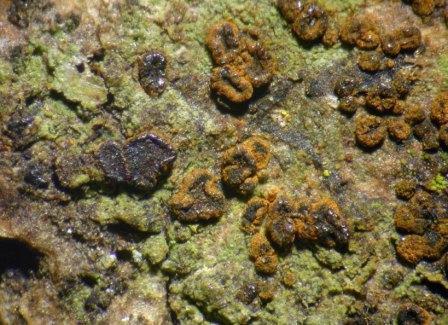
I got a fungus on bark from southern Italy, seemingly with no connection to the surrounding lichens. If it were lichenicolous, I would presume it to be a Buelliella. Has anybody any idea what this could be?
Ascomata sessile, constricted below, initially closed, later apothecioid, up to 0.5 mm diam., irregularly roundish, disc black but covered with a rusty pruina, margin prominent, densely rusty pruinose.
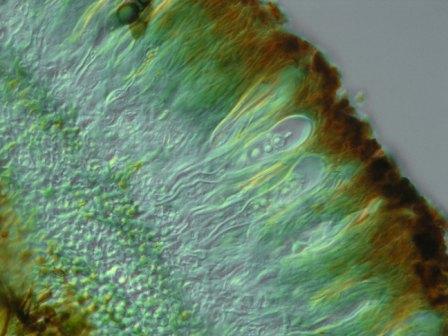
Hypothecium brownish, 55 µm high, hymenium hyaline below, brownish above, 120 µm high, epithecium brown, covered with dark brown granules, excipulum dark brown, up to 50 µm thick.
Paraphyses septate, sparsely ramified, 2–2.5 µm wide, hyaline below, brownish above, the upper cell sometimes enlarged up to 4 µm, brown in the upper half.
Asci clavate, 80–95 × 15–26 µm, apically thickened, with an internal beak, with a long stalk, 4–8-spored.
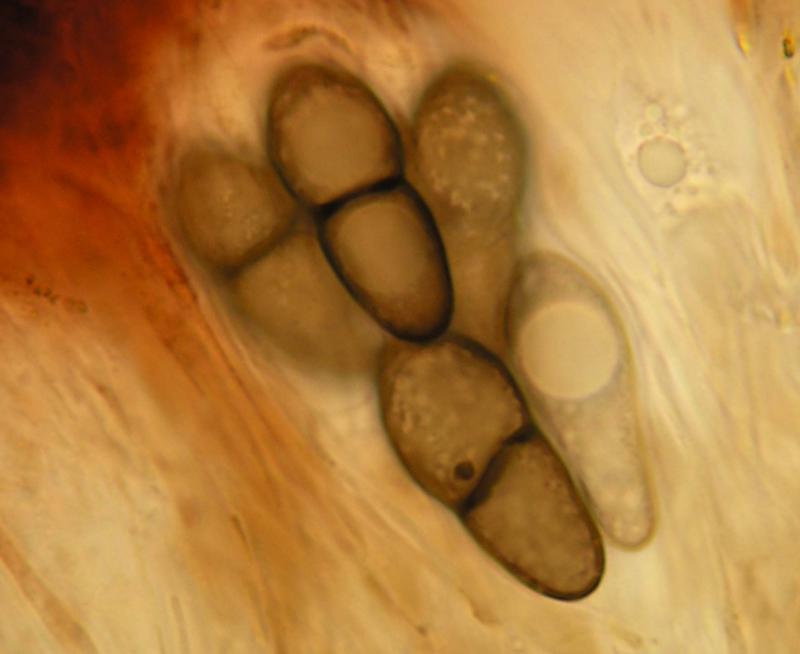
Ascospores 1-septate, grey, the upper cell rounded or slightly attenuated, the lower attenuated, narrower than the upper one, constricted at the septum, with one big guttule in each cell, surface ± smooth but appearing foveate, (20–)20.8–23.1(–24) × (8.5–)9–9.9(–10) µm, l/b = (2–)2.2–2.5(–2.6) (n = 20).
Pruina K+ violet, not dissolving. Hymenium above K+ grey, I+ reddish. Asci externally I/KI+ pale blue, no I/KI reacting apical structures.?