
28-04-2026 20:07
 Lothar Krieglsteiner
... on twig in the air at standing Ceratonia siliq
14-04-2026 05:32
Ethan CrensonHi all, A few weeks back a friend pointed out som
28-04-2026 20:33
Vitus SchäfftleinHello, I found Trochila ilicina on Ilex aquifoliu

30-04-2026 10:28
Rot BojanHello, by appearance I would say that I am dealing
27-04-2026 18:48
Tony MoverleyCollected 23rd April 2026, Norfolk, EnglandSwarms
27-04-2026 20:52
Lothar Krieglsteiner
Found on hanging tiwg of Olea europaea in dried-ou
28-04-2026 22:51
 Bernard CLESSE
Bonsoir à toutes et tous,Pourriez-vous m'aider à
29-04-2026 08:01
Lothar Krieglsteiner
... on twig attached to small tree of Citrus auran
29-04-2026 10:44
Lothar Krieglsteiner
growing at moist, drying-out soil at the side of a
Fuscolachnum sp.
Nina Filippova,
09-02-2013 16:06
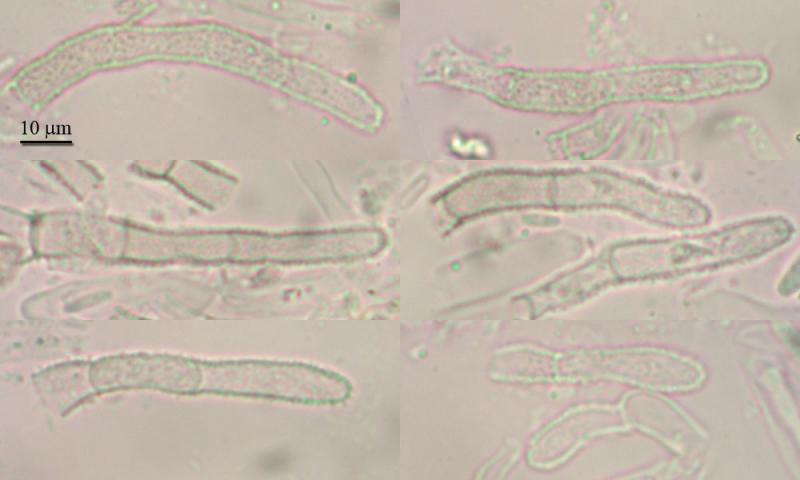
Apothecia cupulate, stipitate, up to 300 mk in diam, about 200 mk high, receptacle 50 mk thick; hymenium surface flat or convex, smooth, gray; outer surface brownish, with parralel roughness of hyphae; edge smooth, the same color as hymenium.
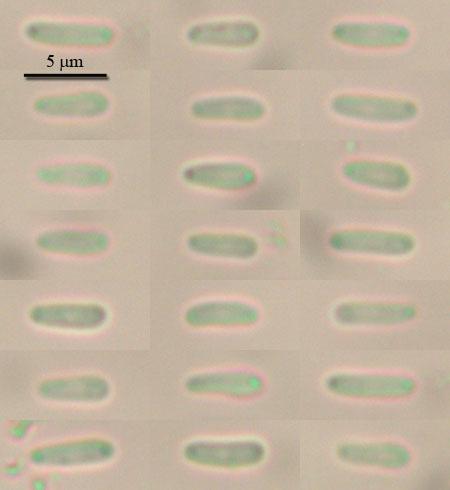
Excipulum from textura porrecta, hyphae 3,3- 4,3 mk broad, cells 13 mk long in the middle of receptacle, some swollen a the base, cylindrical otherwise, grayish-brown, in all parts with minute warty ornamentation (nature of ornamentation not clear now, i did not use dyes to save specimens); end segments of hyphae at the edge (hairs) cylindrical, not enlarged, about 20 mk long, with the same roughness and some lighter in color; asci clavate-utriform, thickened at tip, clamped, with small stalk or sessile, with small euamyloid pore, 8-spored, 21,4 (18-25) x 5,6 (5-6,6); paraphyses lageniform, not branched, 1-2 segmented at the base, probably with some vacuolar content, looking as pattern in rehydrated state, 29-35 x 2,7-4 x 1,2-1,8 (length x width at enlarged part x width at stalk); spores narrowly ellipsoid and pip-shaped, some slightly curved, with two small guttules at the ends (checked in vital), 4,6 (4,1-5,4) x 1,3 (1,2-1,6) (Q=3,5; N=18).
04.08.2012, N61,065408° E69,455652°.




Stip Helleman,
10-02-2013 00:36

Re : Fuscolachnum sp.
Hi Nina,
I agree with Fuscolachnum although te very short hairs intermixed on the excuipulum I did not see. It seems to be a mix of species. F. inopinatum has the stipitate fruitbodies and a cryptogamic host, F. dumorum the exceeding lanceolate paraphyses. So another riddle from Siberia
cheers,
Stip
I agree with Fuscolachnum although te very short hairs intermixed on the excuipulum I did not see. It seems to be a mix of species. F. inopinatum has the stipitate fruitbodies and a cryptogamic host, F. dumorum the exceeding lanceolate paraphyses. So another riddle from Siberia
cheers,
Stip
Hans-Otto Baral,
10-02-2013 21:16

Re : Fuscolachnum sp.
Great collection! F. dumorum I believe is a Brunnipila, but this one certainly not.
No idea, but Fuscolachnum I agree.
Zotto
No idea, but Fuscolachnum I agree.
Zotto