
27-04-2026 20:52
 Lothar Krieglsteiner
Found on hanging tiwg of Olea europaea in dried-ou
27-04-2026 18:48
Tony MoverleyCollected 23rd April 2026, Norfolk, EnglandSwarms
27-04-2026 17:41
Lothar Krieglsteiner
.. Algarve, same leaf than the last post. The con
27-04-2026 18:05
Lothar Krieglsteiner
... still attached at standing tree. The green con
27-04-2026 17:16
Lothar Krieglsteiner
.. Algarve, moist lying.The conidiomata look like
27-04-2026 12:54
Steve ClementsBonjour. Ce petit champignon blanc résupiné et
27-04-2026 09:59
Pauline. PennaBonjour Can anyone advise me on these pycnidia fo

22-04-2026 20:54
 Enrique Rubio
Hi to everybody.This Pyrenopeziza grew in moist le
Didymosphaeria diplospora?
Björn Wergen,
08-12-2012 11:44
 Hello everybody,
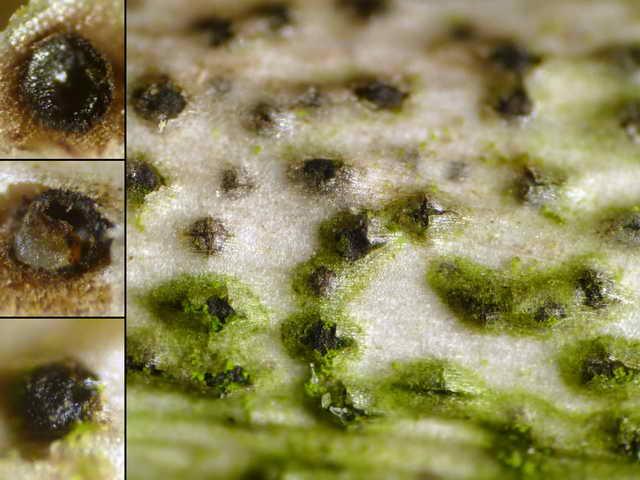
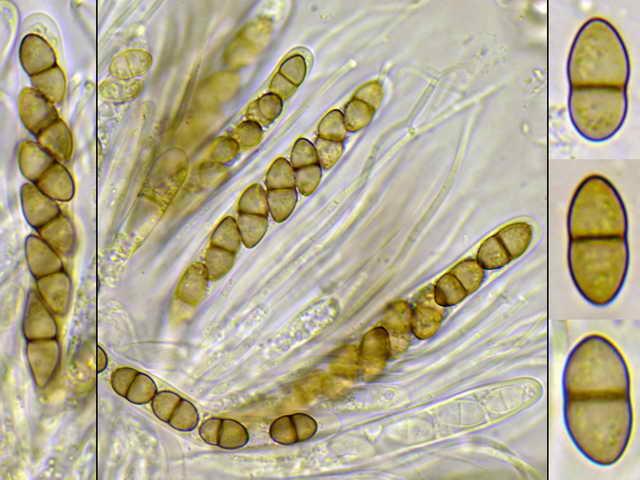
I am back with some new, unclear pyrenomycetes from old attached Cornus alba twigs and I think this one is definitely a Didymosphaeria, but I do not know how to identify them. DENNIS 1978 gives a description of D. diplospora, growing on Rubus but also on Cornus and not uncommon, but the spores do not fit in size.
Sp. are 13-16x5,5-6µm, brown and very finely warted to nearly smooth, Asci uniseriate and 80-90x7-9µm.
Any better idea than my D. diplospora? :)
regards,
björn
Christian Lechat,
08-12-2012 11:58

Re : Didymosphaeria diplospora?
Hi Björn,
Didymosphaeria diplospora is a synonym of D. oblitescens
Regards,
Christian
Didymosphaeria diplospora is a synonym of D. oblitescens
Regards,
Christian
Björn Wergen,
08-12-2012 11:59
Re : Didymosphaeria diplospora?
Damn this, I missed checking the new name, sorry :D
But anyway, this does not seem to be the "real" D. oblitescens, which I had several times on Rubus.
But anyway, this does not seem to be the "real" D. oblitescens, which I had several times on Rubus.
Yan Yinh,
08-12-2012 12:46
Your morphological understanding
Species of the genus Didymosphaeria have pseudothecia but no perithecia. You are aware of this?
Inform us about the characteristics of your cultures and what are the results of the sequencing?
You have no data. O.k. it is no problem. Because from Germany, we learn that there is buy a laboratory for 6.000 to 8.000 euros and then "ich mache dann DNA". If you are going to have a laboratory, please tell me. I will send you some of my students. Who want to learn from German specialists very much. Likewise, we read about a Mr HOB "mit Schwerpunktthema Kulturen und molekulare Methoden." You see, everything in Germany is easier than you think.
Yan
Inform us about the characteristics of your cultures and what are the results of the sequencing?
You have no data. O.k. it is no problem. Because from Germany, we learn that there is buy a laboratory for 6.000 to 8.000 euros and then "ich mache dann DNA". If you are going to have a laboratory, please tell me. I will send you some of my students. Who want to learn from German specialists very much. Likewise, we read about a Mr HOB "mit Schwerpunktthema Kulturen und molekulare Methoden." You see, everything in Germany is easier than you think.
Yan
Björn Wergen,
08-12-2012 13:04
Re : Didymosphaeria diplospora?
Hi Yan,
yes, I am, in my opinion this species has pseudothecia, because there was no clear ostiolus breaking through the bark, just the whole ascomata.
If it has perithecia, which species would be possible then?
Ouh, Yan, I am just an amateur mycologist, I do not have the chance to sequence funghi. But perhaps one time I will have.
regards,
björn
yes, I am, in my opinion this species has pseudothecia, because there was no clear ostiolus breaking through the bark, just the whole ascomata.
If it has perithecia, which species would be possible then?
Ouh, Yan, I am just an amateur mycologist, I do not have the chance to sequence funghi. But perhaps one time I will have.
regards,
björn
Paul LEROY,
08-12-2012 22:29
Re : Didymosphaeria diplospora?
Hello Bjorn,
Oui il s'agit très probablement de Didymosphaeria oblitescens. Les mensurations et les caractères
des spores et des asques conviennent pour cette espèce. Elle est assez commune et se
développe sur une large gamme d'hôtes , exclusivement feuillus.
Très cordialement
Paul LEROY
Oui il s'agit très probablement de Didymosphaeria oblitescens. Les mensurations et les caractères
des spores et des asques conviennent pour cette espèce. Elle est assez commune et se
développe sur une large gamme d'hôtes , exclusivement feuillus.
Très cordialement
Paul LEROY
Björn Wergen,
09-12-2012 02:01
Re : Didymosphaeria diplospora?
Hi Paul,
thank you very much for your opinion :)
regards,
björn
thank you very much for your opinion :)
regards,
björn