
02-05-2026 12:42
Alain BRISSARDBonjour à tousJeuidi 30 avril dernier on m'a remi
02-05-2026 13:06
Pauline. PennaBonjour Please can someone help me with this id
01-05-2026 22:45
 Thierry Blondelle
Bonjour à tous, Une récolte sur bouse séchée d
28-04-2026 20:07
 Lothar Krieglsteiner
... on twig in the air at standing Ceratonia siliq
14-04-2026 05:32
Ethan CrensonHi all, A few weeks back a friend pointed out som
28-04-2026 20:33
Vitus SchäfftleinHello, I found Trochila ilicina on Ilex aquifoliu

30-04-2026 10:28
Rot BojanHello, by appearance I would say that I am dealing
27-04-2026 18:48
Tony MoverleyCollected 23rd April 2026, Norfolk, EnglandSwarms
27-04-2026 20:52
Lothar Krieglsteiner
Found on hanging tiwg of Olea europaea in dried-ou
Another fungus on Alpaca dung, again I need help with the determination
Christiane Baethcke,
30-03-2012 12:19
 Hallo everybody,
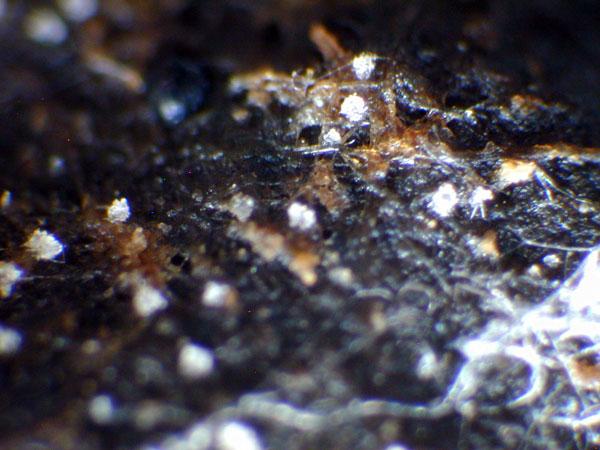
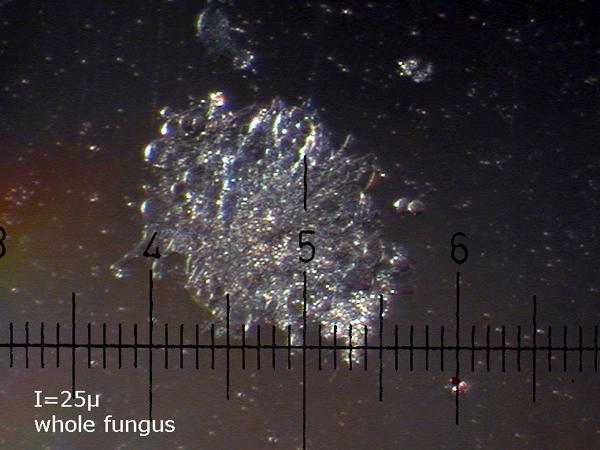
On a new collection of alpaca dung grows a very small ascomycete. This fungus is much smaller than the one of the former collection, but in some way the spores resembles the ones of the former one on alpaca dung. (which is probably Onygenales, Neven is still examining it)
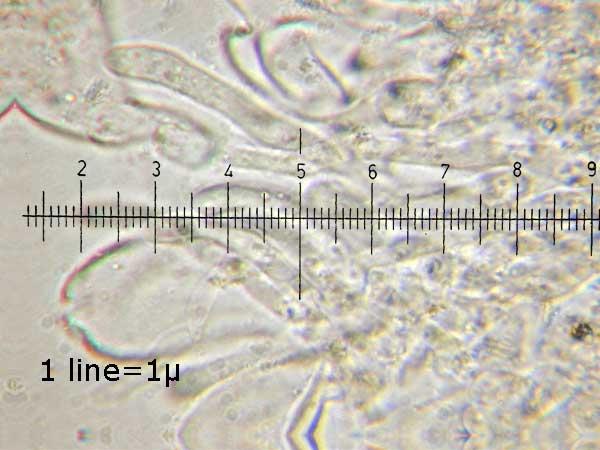
The size of the fungus is about 400µ. It seems, that the spores are in most cases roundish and in a few cases ellipsoid. The paraphyses seem to contain somewhat greenish oil drops. The spores are about 9 µ diameter. On the last photo you can see that the asci are opening with a split. I didn´t see any reaction with Lugol.
I need again help with the determination, since I don´t even know the genus.
Best regards
Christiane


Neven Matocec,
30-03-2012 12:48

Re : Another fungus on Alpaca dung, again I need help with the determination
Hi Christiane,
Please note my post of 19.03. 11:12! Some day earlier than I made this post (when I compared your data with our own material and the literature) I pretty much rejected the thoughts about onygenalean affinity of your first Alpaca dung fungus!
This one is surely another story....it could maybe match Thelebolales, but again, without some tests (Congo red, CRB etc) I cannot be sure. As I don't see any supportive (protecting/bearing the asci) tissues and on account of spore characters (if they are truly mature ones) at least it cannot be congeneric with the first one.
Cheers,
Neven
Please note my post of 19.03. 11:12! Some day earlier than I made this post (when I compared your data with our own material and the literature) I pretty much rejected the thoughts about onygenalean affinity of your first Alpaca dung fungus!
This one is surely another story....it could maybe match Thelebolales, but again, without some tests (Congo red, CRB etc) I cannot be sure. As I don't see any supportive (protecting/bearing the asci) tissues and on account of spore characters (if they are truly mature ones) at least it cannot be congeneric with the first one.
Cheers,
Neven
Christiane Baethcke,
30-03-2012 22:03
Re : Another fungus on Alpaca dung, again I need help with the determination
Hallo Neven,
Thank you for your advice with the congo red! You are right, the fungus is still immature. But staining with congo red, it was easy! Ascodesmis microscopia! I never found before, and it is as beautifull as small!
Thank you for your advice with the congo red! You are right, the fungus is still immature. But staining with congo red, it was easy! Ascodesmis microscopia! I never found before, and it is as beautifull as small!

Neven Matocec,
31-03-2012 00:08
Re : Another fungus on Alpaca dung, again I need help with the determination
Hi Christiane!
Oh! Superb! I'm glad you succeeded both to got your fungus matured and identified. A pezizalean again, ha? Interesting associate to our previous one!
Every time when you just spot something new teleomorphic emerging on dung units in your moist boxes, you should keep observing structures and ascosporogenesis. Only when you see sporulating ascomata or that living asci (in tap water) ejecting spores with no press applied just in front of you watching them through microscope or when you see that masses of spores are present in the prep without any trace of (evanescent) asci - you can be sure you have fully mature fruitbodies/ascal clusters...
In such cases you could often see the whole spectrum of ascospore change (in size, shape, colour, surface structures, guttulation etc..). At the end the finalized spores may strikingly differ from immature ones. However, in some cases when fully mature spores are smooth, thin-walled, hyaline and eguttulate one might differ them from immature ones only through great experience.
Good night,
Neven
Oh! Superb! I'm glad you succeeded both to got your fungus matured and identified. A pezizalean again, ha? Interesting associate to our previous one!
Every time when you just spot something new teleomorphic emerging on dung units in your moist boxes, you should keep observing structures and ascosporogenesis. Only when you see sporulating ascomata or that living asci (in tap water) ejecting spores with no press applied just in front of you watching them through microscope or when you see that masses of spores are present in the prep without any trace of (evanescent) asci - you can be sure you have fully mature fruitbodies/ascal clusters...
In such cases you could often see the whole spectrum of ascospore change (in size, shape, colour, surface structures, guttulation etc..). At the end the finalized spores may strikingly differ from immature ones. However, in some cases when fully mature spores are smooth, thin-walled, hyaline and eguttulate one might differ them from immature ones only through great experience.
Good night,
Neven
Chris Yeates,
01-04-2012 18:57

Re : Another fungus on Alpaca dung, again I need help with the determination
I have often wondered about whether an interesting mycobiota could be associated with the Camellids, they being 'pseudoungulates' and therefore possessing a different digestive system.
Your finds, Christiane, have encouraged me to think about paying a visit to a field with llamas in it not far from where I live . . . .
best wishes
Chris
Your finds, Christiane, have encouraged me to think about paying a visit to a field with llamas in it not far from where I live . . . .
best wishes
Chris
Christiane Baethcke,
01-04-2012 19:41
Re : Another fungus on Alpaca dung, again I need help with the determination
Good luck with the lamadung, Chris. At this moment I have finally the first ripe spores of the Ascodesmis microscopia.
Best regards
Christiane
Best regards
Christiane
