
05-06-2026 12:10
 François Freléchoux
Capitotricha sp. sur Lonicea caerulea Caractères
05-06-2026 11:02
Thomas Læssøehttps://svampe.databasen.org/observations/10596691

04-06-2026 11:36
Gernot FriebesHi,found on Vaccinium myrtillus.Asci: IKI –, 8-s
19-05-2026 10:27
Patrice TANCHAUDBonjour, récolte récente sur terre retournée i
04-06-2026 18:39
Gernot FriebesHi,I collected this species in two different locat
22-05-2026 13:29
Gernot FriebesHi,I am curious to hear your opinion on this mater
04-06-2026 10:50
François Freléchoux
Bonjour, J'ai trouvé hier un petit asco observé
Bombardia sp. from Fraxinus wood
Alex Akulov,
01-01-2011 12:12
 Dear Friends
Happy New year to all!
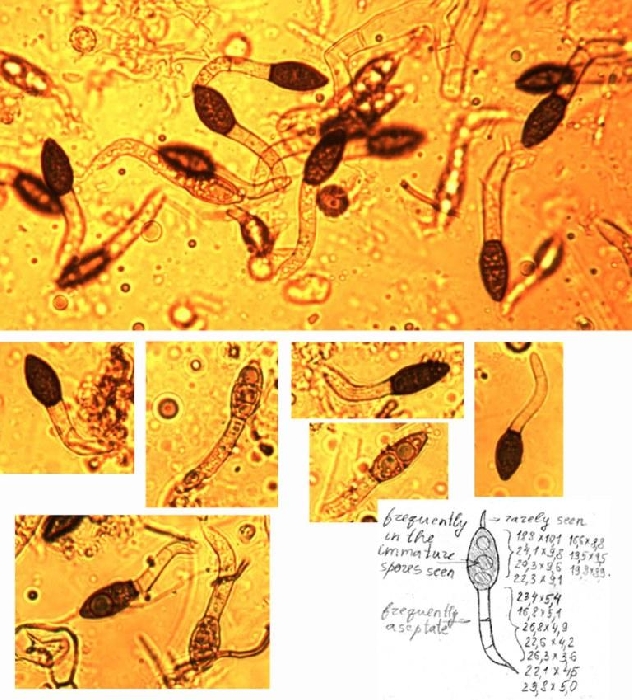
Today I found an interesting sample of Bombardia (similar with B. fasciculata, = B. bombarda). Unfortunately, the spores dimensions referred to this species in Ellis and Ellis book does not fit my sample. The other literature on this genus, I have not. Maybe someone knows the species with such parameters?
The sample was collected on the heavily rotten trunk of Fraxinus excelsior together with Tommentella sp. in December 2 in Ukraine.
Grateful before,
Alex.
Alex Akulov,
01-01-2011 12:13
Re:Bombardia sp. from Fraxinus wood
Photoes
Christian Lechat,
01-01-2011 12:24

Re:Bombardia sp. from Fraxinus wood
Hi Alex,
maybe Cercophora caudata? it would be necessary to see perithecia.
Christian
maybe Cercophora caudata? it would be necessary to see perithecia.
Christian
Alex Akulov,
01-01-2011 13:22
Re:Bombardia sp. from Fraxinus wood
Dear Christian
Yes, my sample really is similar with Cercophora caudata well. To test this I will need detailed literature on Cercophora, which is stored at my workplace at the university. Unfortunately, I do not have the article of Hilber & Hilber (Zeitschrift fur Mykologie 45 (2) :209-233. 1979). Have you got this paper?
Perithecia on my sample are old with a partially collapsed walls. In addition, they are almost completely submerged in the subiculum of Tommentella. There are black, with dark protuberant necks, but I see not setae.
Thank you for help!
Alex
Yes, my sample really is similar with Cercophora caudata well. To test this I will need detailed literature on Cercophora, which is stored at my workplace at the university. Unfortunately, I do not have the article of Hilber & Hilber (Zeitschrift fur Mykologie 45 (2) :209-233. 1979). Have you got this paper?
Perithecia on my sample are old with a partially collapsed walls. In addition, they are almost completely submerged in the subiculum of Tommentella. There are black, with dark protuberant necks, but I see not setae.
Thank you for help!
Alex