
02-05-2026 13:06
Pauline. PennaBonjour Please can someone help me with this id
02-05-2026 12:42
Alain BRISSARDBonjour à tousJeuidi 30 avril dernier on m'a remi
01-05-2026 22:45
 Thierry Blondelle
Bonjour à tous, Une récolte sur bouse séchée d
28-04-2026 20:07
 Lothar Krieglsteiner
... on twig in the air at standing Ceratonia siliq
14-04-2026 05:32
Ethan CrensonHi all, A few weeks back a friend pointed out som
28-04-2026 20:33
Vitus SchäfftleinHello, I found Trochila ilicina on Ilex aquifoliu

30-04-2026 10:28
Rot BojanHello, by appearance I would say that I am dealing
27-04-2026 18:48
Tony MoverleyCollected 23rd April 2026, Norfolk, EnglandSwarms
27-04-2026 20:52
Lothar Krieglsteiner
Found on hanging tiwg of Olea europaea in dried-ou
White hairy on Lycopodium
Marja Pennanen,
11-06-2010 14:16
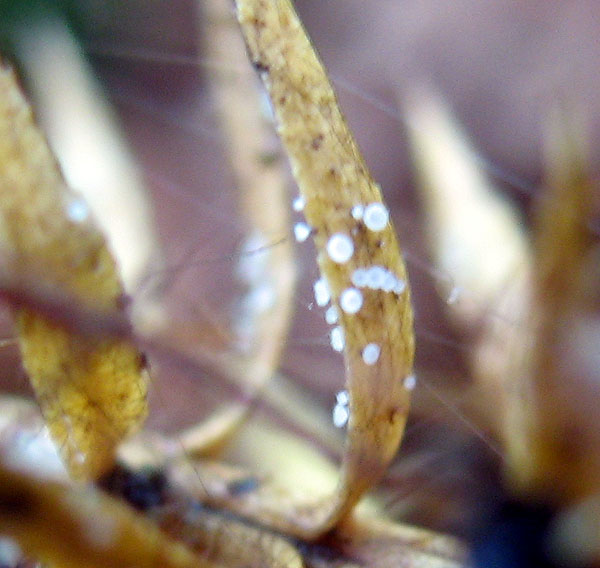
I found these yesterday and just couldn't get a proper photo. Maybe because these are quite small, about 0,1 mm wide.
Marja Pennanen,
11-06-2010 14:18
Re:White hairy on Lycopodium
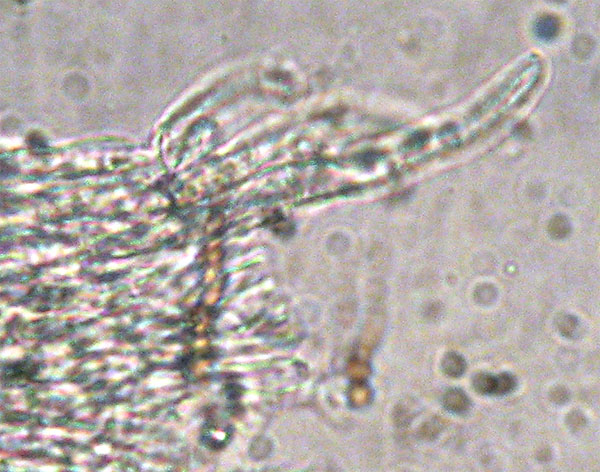
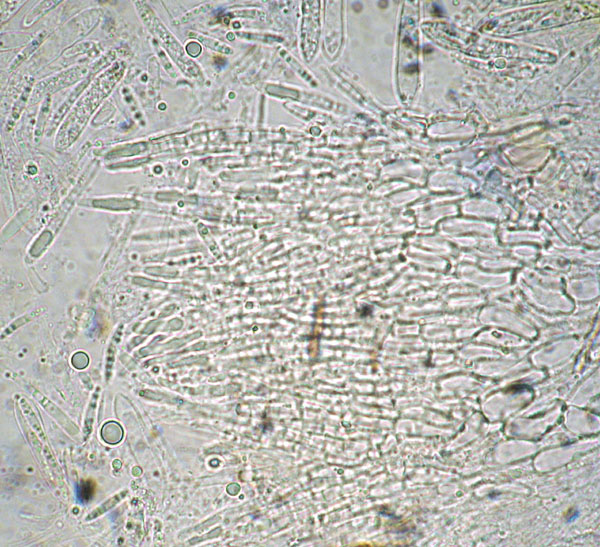
I thought I found some Cistella, but couldn't find cistellalike hairs, but these:
(Again sorry for the poor quality)
(Again sorry for the poor quality)
Marja Pennanen,
11-06-2010 14:23
Re:White hairy on Lycopodium
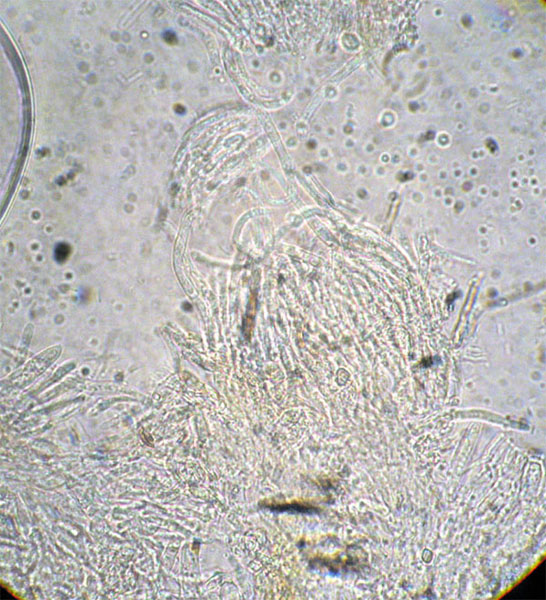
The spores look like canoes and are about 5-7x1-1,5 bearing some droplets.
Asci are 23-27x3,5-5 and paraphyses narrow (1,5).
Hairs are often bent and about 25-40x2,5-3 micrometers.
Asci are 23-27x3,5-5 and paraphyses narrow (1,5).
Hairs are often bent and about 25-40x2,5-3 micrometers.
Guy Garcia,
11-06-2010 18:48
Re:White hairy on Lycopodium
Peut-être un Psilachnum ? voir si les asques ne sont tétraspores.
Marja Pennanen,
12-06-2010 11:27
Re:White hairy on Lycopodium
Merci.
Psilachnum is a good option ;) Unfortunately I didn't find any quite matchng from Raitviirs descriptions.
Marja
Psilachnum is a good option ;) Unfortunately I didn't find any quite matchng from Raitviirs descriptions.
Marja
Guy Garcia,
12-06-2010 12:38
Re:White hairy on Lycopodium
With Zotto we have an undescribed Psilachnum on Lycopodium clavatum caracterised by asci tetraspores. The spores are with 4 guttules and 10-14 x 1.5-2 µm.
Marja Pennanen,
15-06-2010 12:17
Re:White hairy on Lycopodium
Hello again,
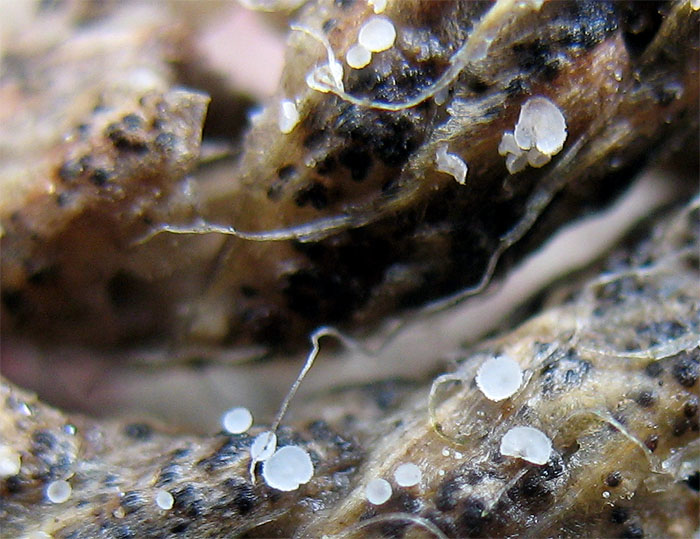
those were on L. annotinum, today I found these on L. clavatum:
those were on L. annotinum, today I found these on L. clavatum:
Marja Pennanen,
15-06-2010 12:30
Re:White hairy on Lycopodium
These can be even 0,5 mm wide.
The microscophy is a little different, but not very much.
Spores are 9-12x1,5-2 and have about 6 droplets.
Asci 25-30x4-6 and paraphyses 2-2,5 micrometers wide and they have often a big droplet near the tip.
Hairs are about 25-50 x1,5-2.
Greetings: Marja
The microscophy is a little different, but not very much.
Spores are 9-12x1,5-2 and have about 6 droplets.
Asci 25-30x4-6 and paraphyses 2-2,5 micrometers wide and they have often a big droplet near the tip.
Hairs are about 25-50 x1,5-2.
Greetings: Marja
Guy Garcia,
15-06-2010 22:27
Re:White hairy on Lycopodium
Oui ! Cela ressemble beaucoup à notre espèce (Psilachnum lycopodii ad. int.) ! Les asques sont-ils à 4 spores (avec souvent 4 autres spores avortées).