
12-06-2026 14:50
 François Freléchoux
Bonjour, Voici la brève description d'une Mollis
10-06-2026 21:16
François Freléchoux
Bonsoir,Le dernier du jour, en attendant votre avi
11-06-2026 19:01
 William Slosse
Hello all,In an attempt to make a culture of a sus
11-06-2026 19:03
 Nicolas VAN VOOREN
Chers membres d'Ascofrance,Le site sera placé en

09-06-2026 18:32
Camille MertensSur morceau de roseau immergé 0,5 - 0,7 mm de dia
10-06-2026 12:54
Steve ClementsBonjour encore, Pouvez-vous m'aider, s'il vous pl
10-06-2026 21:07
François Freléchoux
Toutes les tiges de gentianes jaunes de l'an passÃ
10-06-2026 13:41
François Freléchoux
Bonjour à nouveau, Voici une trouvaille d'hier.
Helvella elastica vs. latispora
Enrique Rubio,
25-08-2009 14:15
 Dear friends
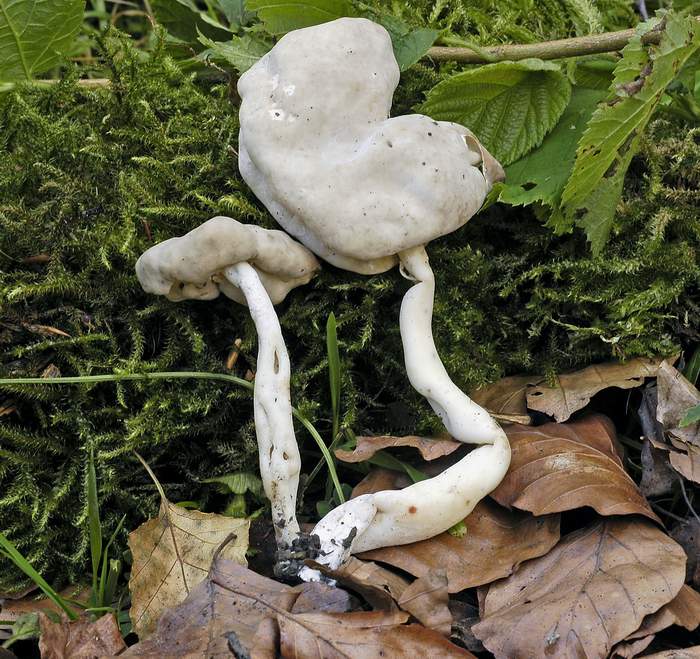
I'd like to know your opinion about this large Helvella species growing on Corylus avellana and Fagus sylvatica forest.
The ascomata are up to 13 cm high and 3.5 cm broad. Stipe and outside of pileus are smooth or only very slightly pubescent.
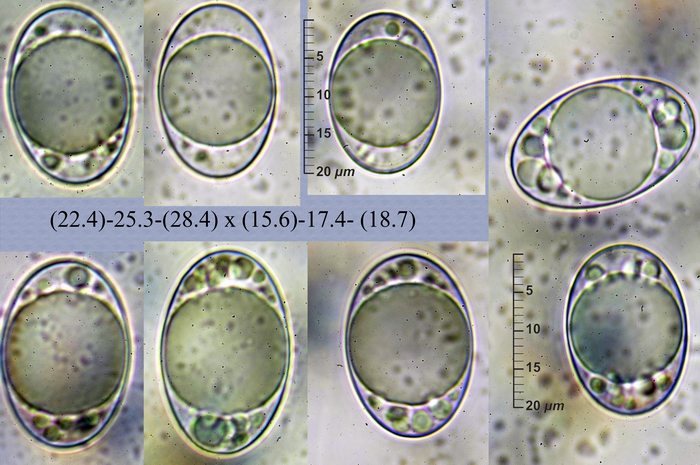
The spore mesurements are from the spore print of the ascomata.
Many thanks again for your kindly help.
Enrique
Enrique Rubio,
25-08-2009 14:15
Re:Helvella elastica vs. latispora
Spores
Enrique Rubio,
25-08-2009 14:16
Re:Helvella elastica vs. latispora
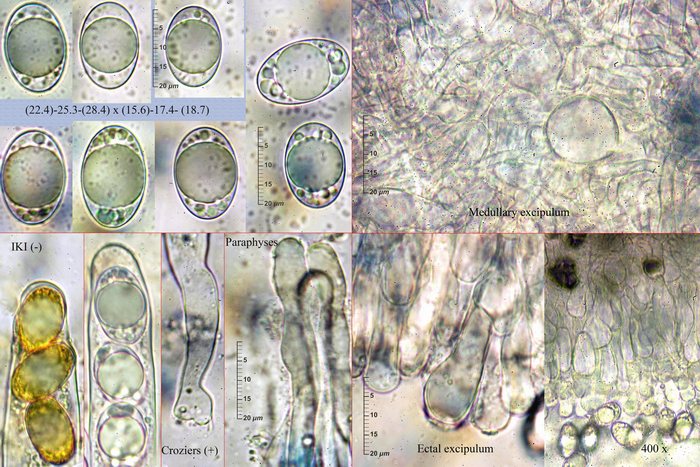
Micro. Ectal excipulum is made from a palissade of claviform hyphae
Alain BRISSARD,
25-08-2009 15:16
Re:Helvella elastica vs. latispora
La bibliographie indique toutefois une taille plus petite pour les spores (18-20,5 x11-12,5 µm).Mais ce n'est qu'une remarque car je ne suis pas à même d'en juger, à moins que la dite variété latispora possède d'aussi grosses spores.
Amitiés
Alain
Amitiés
Alain
Nicolas VAN VOOREN,
25-08-2009 18:23
Re:Helvella elastica vs. latispora
This shape represents (for me) typically Helvella elastica. H. latispora is often selliform and has a more brownish colour ("café au lait" in French). But I didn't find this species with such a spore size (max. 22 µm). Maybe a form macrospora !
Very interesting.
Very interesting.
Enrique Rubio,
25-08-2009 18:47
Re:Helvella elastica vs. latispora
Many thanks Alain and Nicolas.
Enrique
Enrique
Mario Filippa,
26-08-2009 10:05
Re:Helvella elastica vs. latispora
As Nicolas says, the shape is typical for Helvella elastica. If you have the possibility to return in the locality, you will see that the young ascomata have a deflexed apothecium from the beginning. In H. latispora (at least, sensu Häffner) the young specimens are somewhat cupulate.
Surely the spores are larger than normally seen. I remember only une collection, consisting in a single ascoma, from southern Italy (Calabria) in a similar habitat, with so large spores; I considered that the volume of the spores in that collection was almost double than normal. In your specimens, the same as in mine, the width of the spores is very large, but the spore's shape does not fit with Boudier's drawings for Helvella latispora.
If you will make more abundant collections, it will be very interesting an accurate study to search for some other differences from the typical H. elastica.
Surely the spores are larger than normally seen. I remember only une collection, consisting in a single ascoma, from southern Italy (Calabria) in a similar habitat, with so large spores; I considered that the volume of the spores in that collection was almost double than normal. In your specimens, the same as in mine, the width of the spores is very large, but the spore's shape does not fit with Boudier's drawings for Helvella latispora.
If you will make more abundant collections, it will be very interesting an accurate study to search for some other differences from the typical H. elastica.
Enrique Rubio,
26-08-2009 21:26
Re:Helvella elastica vs. latispora
Many thanks Mario.
Enrique
Enrique
Luc Bailly,
29-08-2009 11:39

Re:Helvella elastica vs. latispora
Just in case: How many spores in an ascus, in your specimens?
Enrique Rubio,
29-08-2009 19:05
Re:Helvella elastica vs. latispora
The asci are 8-spored, Luc
Enrique
Enrique
Mario Filippa,
29-08-2009 22:05
Re:Helvella elastica vs. latispora
8 spores in mine also.