
31-03-2026 21:18
 Miguel Ángel Ribes
Good evening. oes anyone have the original descrip
31-03-2026 20:57
Stefan BlaserHello everybody, I hope somebody can help me with
26-03-2026 15:31
 Åke Widgren
Hello,I found this one in October last year, on r
31-03-2026 16:20
 Mlcoch Patrik
Hello, Please about help with determination. On
31-03-2026 08:19
 Bernard CLESSE
Bonjour à toutes et tous,Pourriez-vous m'aider à
30-03-2026 12:03
 William Slosse
Hello all,On 27/03/26, in Kraaiveld in Wingene (Be
25-03-2026 10:35
Hulda Caroline HolteHello,I collected this species growing on a dead b
bitunicate discomycete
Gernot Friebes,
06-08-2009 21:14
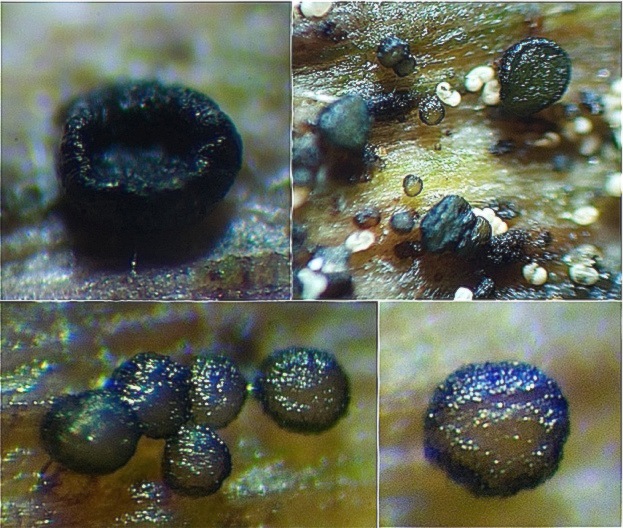
I could not determine this bitunicate discomycet. It grew on a branch of maybe Picea (but I am not sure about this), is <0,5mm ø, totally black when old and has a black margin with a slightly greenish middle when young.
For the description of the microscopical features please look at the next posting.
Best wishes and many thanks,
Gernot
Gernot Friebes,
06-08-2009 21:15
Re:bitunicate discomycete
s...spores (straight to curved, 8-celled, 28-37 x 5-6(8) µm)
a...asci (bitunicate, IKI-, 8-spored, 71-73 x 12-14 µm, croziers +)
p...paraphyses (straight to curved, 2 µm broad)
t...textura (consists of straight, brown hyphae, up to 4 µm broad)
a...asci (bitunicate, IKI-, 8-spored, 71-73 x 12-14 µm, croziers +)
p...paraphyses (straight to curved, 2 µm broad)
t...textura (consists of straight, brown hyphae, up to 4 µm broad)

Guy Marson,
07-08-2009 00:51
Re:bitunicate discomycete
Salut Gernot,
Je pense à Pragmopora amphibola qui n'est pas vraiment bituniqué mais il y a un dôme comme chez Claussenomyces et quelques Durellas s.l.
Ciao,
Guy
PS: clavier "fr" et tout va mieux;-).
Je pense à Pragmopora amphibola qui n'est pas vraiment bituniqué mais il y a un dôme comme chez Claussenomyces et quelques Durellas s.l.
Ciao,
Guy
PS: clavier "fr" et tout va mieux;-).
Gernot Friebes,
07-08-2009 01:14
Re:bitunicate discomycete
Hi Guy,
thanks a lot, this species seems to be my find. And with the asci you are right; I were not hundred per cent sure whether or not they were bitunicate because the looked a bit strange to me. I just thought "what else if not bitunicate".
Best wishes,
Gernot
thanks a lot, this species seems to be my find. And with the asci you are right; I were not hundred per cent sure whether or not they were bitunicate because the looked a bit strange to me. I just thought "what else if not bitunicate".
Best wishes,
Gernot
Guy Marson,
07-08-2009 07:27
Re:bitunicate discomycete
Hi Gernot,
You're right, they are very close to bitunicate. Functionally it is not the "jack in the box" type but such species might be a link to that group. Zotto is actually on a trip, I don't know his opinion about that kind of an ascus.
Cheers,
Guy
You're right, they are very close to bitunicate. Functionally it is not the "jack in the box" type but such species might be a link to that group. Zotto is actually on a trip, I don't know his opinion about that kind of an ascus.
Cheers,
Guy
Hans-Otto Baral,
07-08-2009 11:05

Re:bitunicate discomycete
Dear Gernot and Guy
we came yesterday evening back from our black forest trip (Feldberg), quite exhausted. There was not much to be found, but at least Propolis hillmanniana as a highlight.
Your fungus I think is not Pragmopora because that genus has not the parallel porrecta seeon on your photo which strongly reminds me of Durella. See my drawing Pragmopora amphibola, HB 4825.JPG. In Pragmopra the texture is quite steeply oriented.
Also the oily substance between the paraphyses is not there on your image. I suppose this is the common Durella connivens. You could easily try finding out whether the substrate is coniferous or not by looking on a cross break of the wood. I think D. connivens I never saw on conifers while Pragmopora is restricted to them.
Cheers
Zotto
we came yesterday evening back from our black forest trip (Feldberg), quite exhausted. There was not much to be found, but at least Propolis hillmanniana as a highlight.
Your fungus I think is not Pragmopora because that genus has not the parallel porrecta seeon on your photo which strongly reminds me of Durella. See my drawing Pragmopora amphibola, HB 4825.JPG. In Pragmopra the texture is quite steeply oriented.
Also the oily substance between the paraphyses is not there on your image. I suppose this is the common Durella connivens. You could easily try finding out whether the substrate is coniferous or not by looking on a cross break of the wood. I think D. connivens I never saw on conifers while Pragmopora is restricted to them.
Cheers
Zotto
Gernot Friebes,
07-08-2009 11:18
Re:bitunicate discomycete
Hi Guy and Zotto,
@Guy: It is interesting to learn something about about this kind of ascus, thanks!
@Zotto: True, Durella connivens seems to fit even better, especially because of the paraphyses and the porrecta. Even though D. connivens is quite common it is my first find of this species. ;) Many thanks!
Best wishes,
Gernot
@Guy: It is interesting to learn something about about this kind of ascus, thanks!
@Zotto: True, Durella connivens seems to fit even better, especially because of the paraphyses and the porrecta. Even though D. connivens is quite common it is my first find of this species. ;) Many thanks!
Best wishes,
Gernot
Guy Marson,
07-08-2009 11:43
Re:bitunicate discomycete
Hi Gernot, Zotto,
ok for Durella connivens, but Gernot please try to find out if the substrate is coniferous or not?
Cheers,
Guy
ok for Durella connivens, but Gernot please try to find out if the substrate is coniferous or not?
Cheers,
Guy
Gernot Friebes,
07-08-2009 11:51
Re:bitunicate discomycete
Hi again,
yeah, I will try to figure it out.
Best wishes,
Gernot
yeah, I will try to figure it out.
Best wishes,
Gernot