

30-05-2026 21:12
Philippe PELLICIERSur branche de mélèze (Larix) près de la neige,
31-05-2026 10:35
Hulda Caroline HolteHello,I collected this species growing on a rather
25-05-2026 16:35
 Bernard CLESSE
Bonjour à toutes et tous,J'ai trouvé récemment,
29-05-2026 15:35
daniel FERREBonjour à tous,Je voudrais votre aide pour cette
28-05-2026 16:15
James MitchellHello,Does anyone have the original publication of
28-05-2026 11:06
Thomas Læssøehttps://svampe.databasen.org/observations/10596750
23-05-2026 11:44
 Charles Grapinet
Hello, I am having trouble identifying this copro
25-05-2026 16:44
François BartholomeeusenHi forum members,During an excursion organised by
26-05-2026 21:25
Dirk GerstnerHello everyone, I'm completely stumped by this li
Hyaloscypha sur Betula alba
Luc Bailly,
22-04-2009 15:29
 Bonjour à tous,
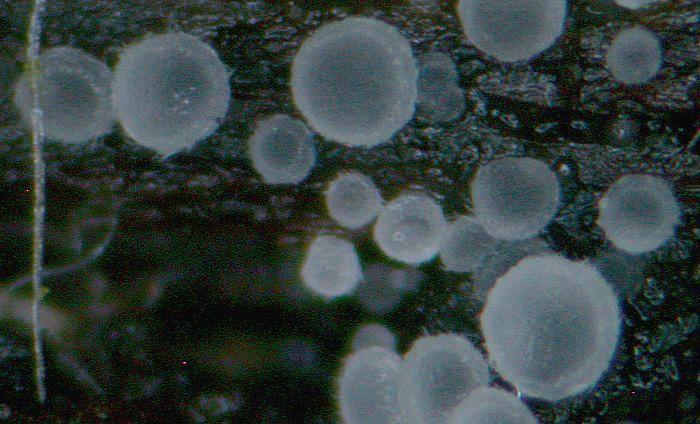
Une récolte faisant partie d'un inventaire d'une tourbière en réserve naturelle. (RND Fagne de la Crépale à Lierneux, Prov. LG, Belgique).
En colonies denses. Sur bois pourri de Betula alba ( "pubescens" ), dans la sphaigne d'une source forestière acide, 20.04.09
Apothécies poilues, sessiles, blanches, translucides, presque hyalines, de l'ordre de 0.1-0.2 mm.
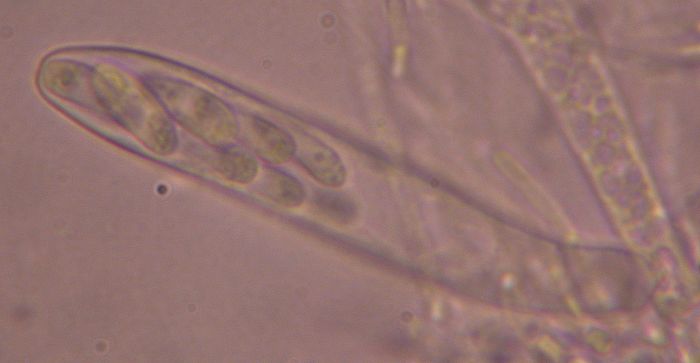
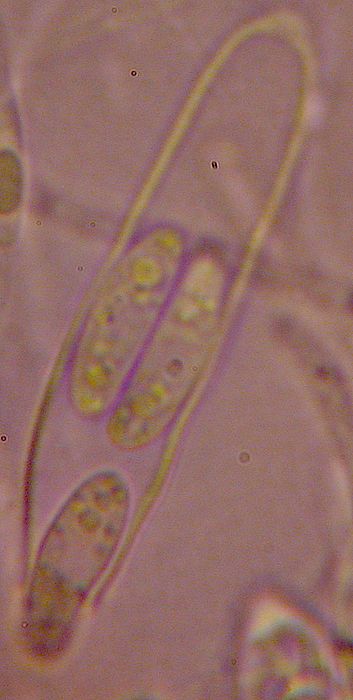
Obs. dans l'eau: Asques à spores bisériées, p.ex. 55X9 µ; spores 9.5-12 x 3-4 µ. Paraphyses cylindriques, lisses, x 2-3 µ. Poils peu visibles, lisses à première vue, hyalins, x 2µ à la base, x 1µ vers le sommet, peu nombreux.
Tout cela n'est pas loin de Hyaloscypha hyalina, qui pousse sur Quercus, mais les asques et les spores sont plus grandes.
Une idée?
Luc Bailly,
22-04-2009 15:30
Re:Hyaloscypha sur Betula alba
asque
Luc Bailly,
22-04-2009 15:30
Re:Hyaloscypha sur Betula alba
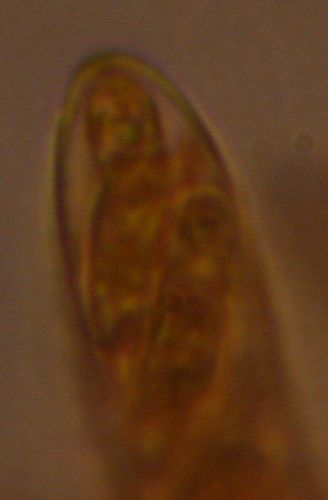
IKI +
Luc Bailly,
22-04-2009 15:32
Re:Hyaloscypha sur Betula alba
spores (très peu de spores mûres, la majeure partie de la récolte est immature).
Luc Bailly,
22-04-2009 15:34
Re:Hyaloscypha sur Betula alba
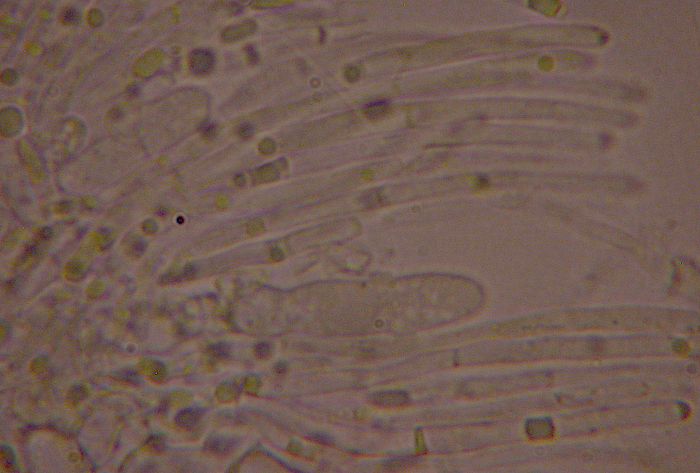
paraphyses
Luc Bailly,
22-04-2009 15:34
Re:Hyaloscypha sur Betula alba
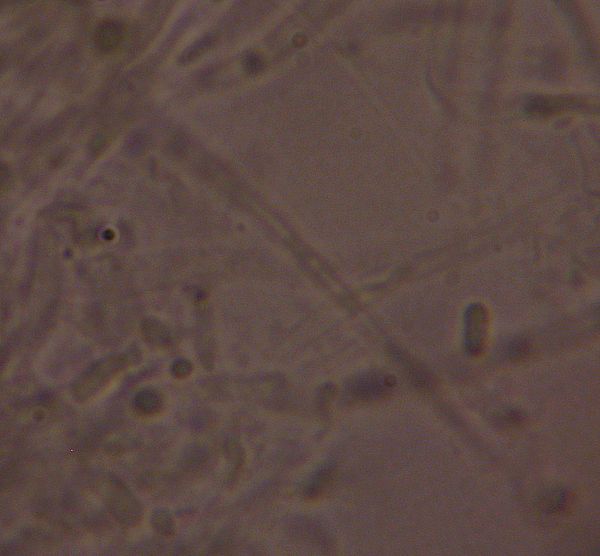
poil
Hans-Otto Baral,
22-04-2009 17:38

Re:Hyaloscypha sur Betula alba
Dear Luc
very good that you made photos in the living state, this makes it much easier.
Three questions: (1) I cannot see the iKI reaction of the ascus. It is better to view it in a dead ascus with expanded apical wall. (2) Please have a look at the ascus base (croziers). (3) The hair on your photo is too unsharp, I assume it attenuates towards the tip.
Wonderful are the refractive drops in the paraphyses. These are no vacuoles but SCBs, and they are very typical of Hyaloscypha albohyalina var. albohyalina but absent in var. spiralis. Hyaloscypha hyalina is a nomen dubium since no type material exists (see Huhtinen's 1990c monograph).
Zotto
very good that you made photos in the living state, this makes it much easier.
Three questions: (1) I cannot see the iKI reaction of the ascus. It is better to view it in a dead ascus with expanded apical wall. (2) Please have a look at the ascus base (croziers). (3) The hair on your photo is too unsharp, I assume it attenuates towards the tip.
Wonderful are the refractive drops in the paraphyses. These are no vacuoles but SCBs, and they are very typical of Hyaloscypha albohyalina var. albohyalina but absent in var. spiralis. Hyaloscypha hyalina is a nomen dubium since no type material exists (see Huhtinen's 1990c monograph).
Zotto
Luc Bailly,
22-04-2009 22:04
Re:Hyaloscypha sur Betula alba
Hi Zotto, many thanks for your reply and the label Hyaloscypha albohyalina var. albohyalina for my specimen.
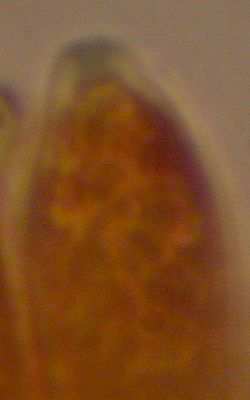
1- The IKI reaction is better in an immature ascus, see photo below. Clearer when directly observing than in photos (I must refine my photos techniques).
2- I don't remember seeing croziers, but I still have the specimen, it's not drying for the herbary yet. I'll check again.
3- Yes, the hairs dinstinctly attenuate toward the tip.
Regards - Luc.
1- The IKI reaction is better in an immature ascus, see photo below. Clearer when directly observing than in photos (I must refine my photos techniques).
2- I don't remember seeing croziers, but I still have the specimen, it's not drying for the herbary yet. I'll check again.
3- Yes, the hairs dinstinctly attenuate toward the tip.
Regards - Luc.
Hans-Otto Baral,
22-04-2009 22:19
Re:Hyaloscypha sur Betula alba
O.k., that's fine. To see the croziers it is best to make a section and to look in vital state in water. The n you usually see them immediately. Perhaps you see also the hairs better.
zotto
zotto
Luc Bailly,
23-04-2009 00:04
Re:Hyaloscypha sur Betula alba
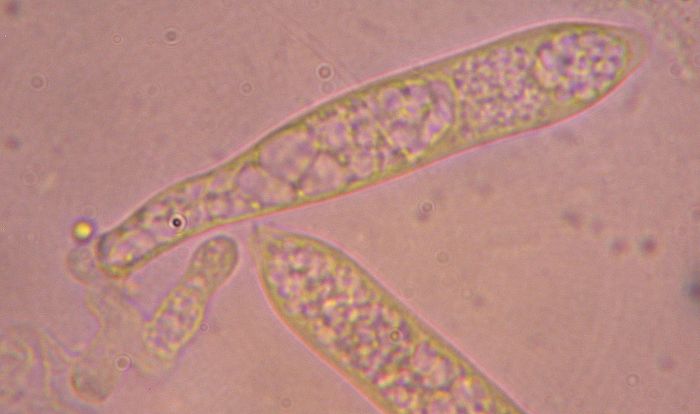
Hi Zotto, is that croziers?
Regards - LUC.
Regards - LUC.
Hans-Otto Baral,
23-04-2009 18:35
Re:Hyaloscypha sur Betula alba
yes, clearly a crozier. So H. var. albohyalina is sure. (var. spiralis is without croziers).
Zotto
Zotto