
05-04-2026 22:46
 Lothar Krieglsteiner
on wood of Ceratonia, Algarve, 3.4.2026.The color
15-05-2026 13:33
Sylvie Le GoffBonjour à tousJe serais très reconnaissante enve
16-03-2011 14:31
roman vargas albertoHi. I would like some opinion about this Peziza
14-05-2026 05:36
Ethan CrensonHi all, I haven't paid much attention to Lachnu
10-05-2026 23:17
 Andreas Gminder
Hello,today we found in a moist steep decidous for
11-05-2026 12:32
 Bernard CLESSE
Pourriez-vous m'aider à identifier cette héloti
13-05-2026 15:26
 François Freléchoux
Bonjour,Voici une récolte faite il y a quelques j
12-05-2026 15:41
 Nicolas VAN VOOREN
Dear Ascolovers, especially interested in Pezizale
13-05-2026 12:05
 Thierry Blondelle
Bonjour à tous,J'aimerais avoir confirmation de c
28-04-2026 20:07
Lothar Krieglsteiner
... on twig in the air at standing Ceratonia siliq
Pestalotiopis funerea
William de Jong,
14-02-2022 14:00
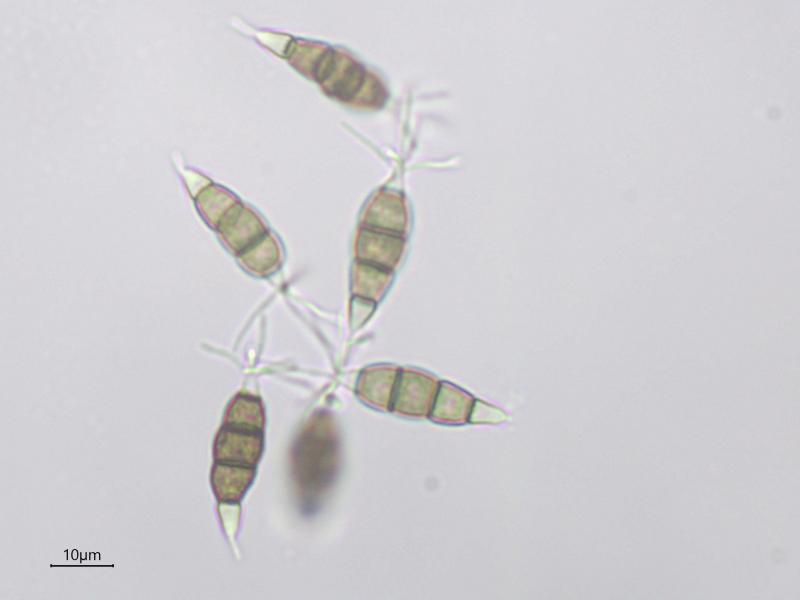
Two weeks ago I found a Pestalotiopsis species on dead, still attached, leaves of Thuja (in the Netherlands).
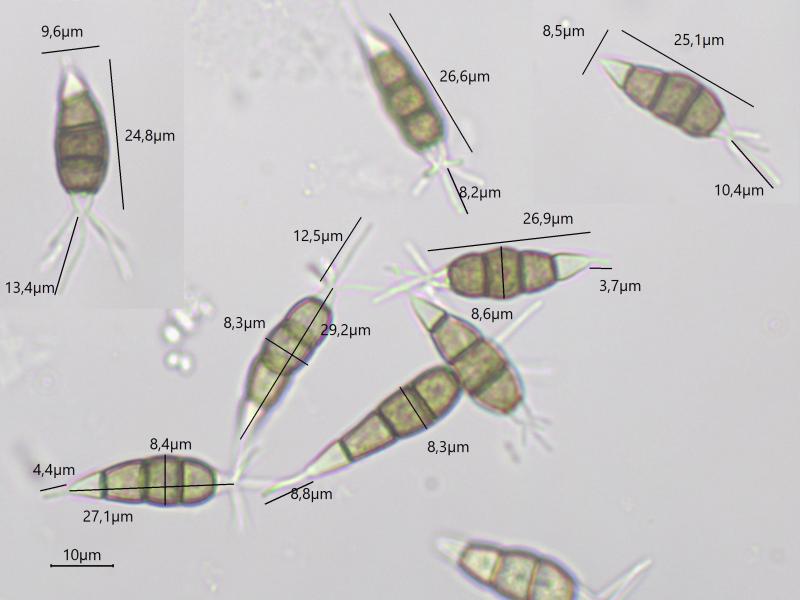
Conidia with 5 cells; outer cells hyaline, three median cells brown. basal appendage 3,7-8,8µm (n=4); 4 to 5 apical appendices (longest varying from 8,2 to 14,4 µm; n=8). Conidia without appendages: (24,6-)25,1-29,2(-29,9)x(7,9-)8,3-9,1(-9,6) µm; avg 27,2 x 8,7 µm; Q=3,12 (n=16). See also the attached pictures.
Host + details match the description of P. funerea in Steyaert (1949), Contribution à l'étude monographique de Pestalotia de Not. et Monochaetia Sacc. (Truncatella gen. nov. et Pestalotiopsis gen. nov.).
Is this indeed P. funerea?
Best regards, William de Jong
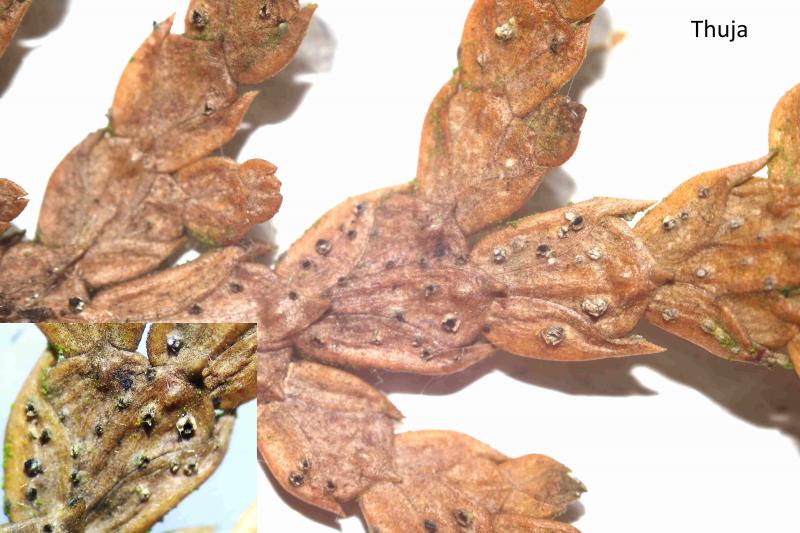
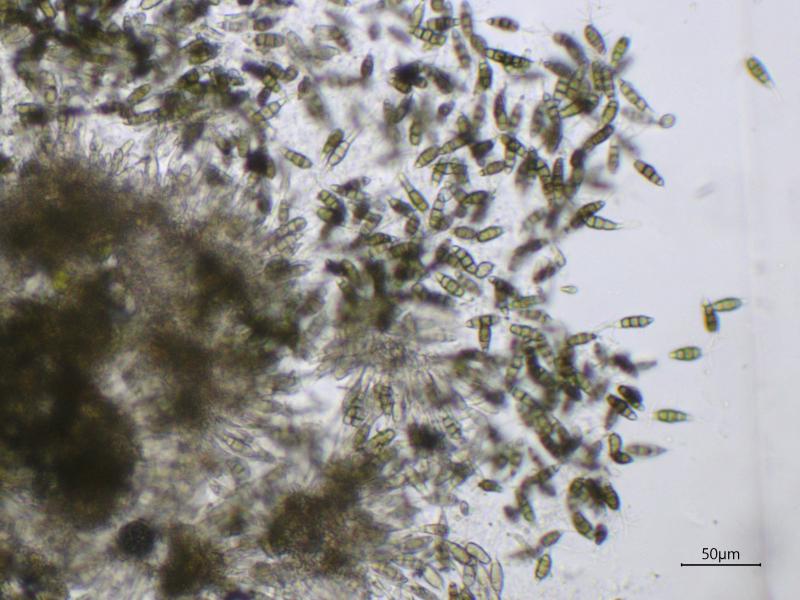
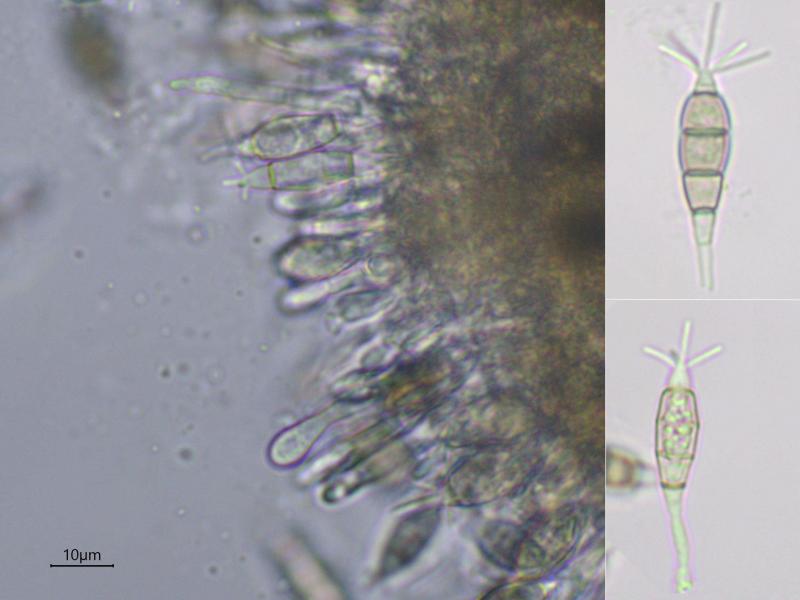
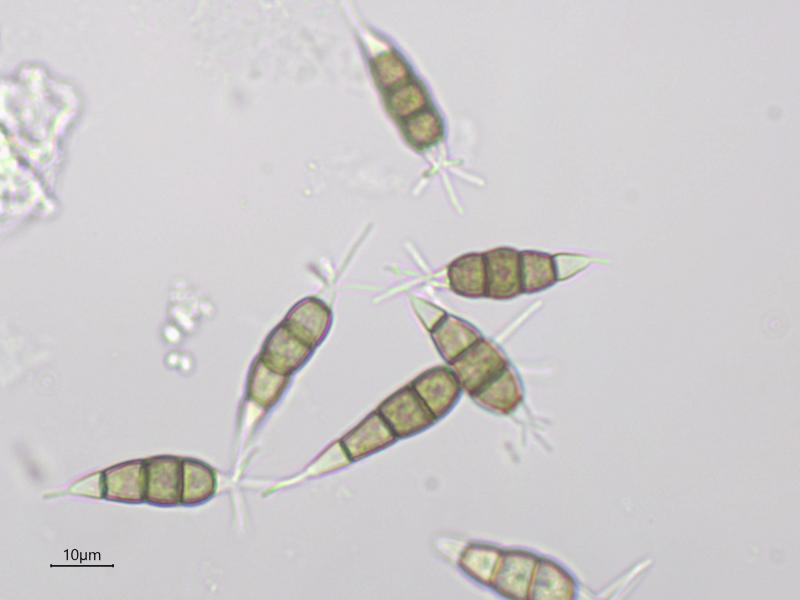
Bernard Declercq,
15-02-2022 10:38

Re : Pestalotiopis funerea
Dag Willem,
Ik denk dat je juist gedetermineerd hebt.
De apikale aanhangsels van deze soort kunnen evenwel tot 30 µm lang zijn. Indien deze apikale aanhangsels nooit langer dan 15 µm zijn komt P. hispanica ook in aanmerking.
Het genus Pestalotiopsis is niet erg substraat-specifiek, maar deze soort is het wel (op blad van coniferen).
Bernard
Ik denk dat je juist gedetermineerd hebt.
De apikale aanhangsels van deze soort kunnen evenwel tot 30 µm lang zijn. Indien deze apikale aanhangsels nooit langer dan 15 µm zijn komt P. hispanica ook in aanmerking.
Het genus Pestalotiopsis is niet erg substraat-specifiek, maar deze soort is het wel (op blad van coniferen).
Bernard
William de Jong,
15-02-2022 11:02
Re : Pestalotiopis funerea
Dag Bernard,
Bedankt voor je reactie.
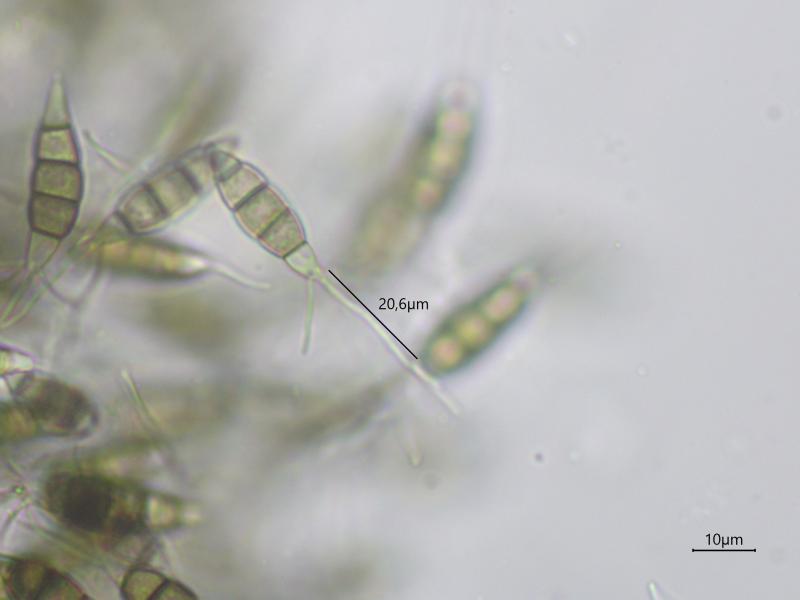
Ik heb even door de mic-foto's gebladerd en kom ook sporen tegen met apicale aanhangsels langer dan 20 µm (zie foto), dus dan valt P. hispanica af. Ik zal eens kijken of ik nog wat meer foto's kan maken daarvan.
Is er ook recentere literatuur van P. funerea? In Nag Raj 1993; Maharachchikumbura et al., Studies in Mycology 79: 121–186 (2014); en Liu et al., Studies in Mycology 92: 287–415 (2019) wordt deze soort namelijk niet genoemd.
Groeten, William
Bedankt voor je reactie.
Ik heb even door de mic-foto's gebladerd en kom ook sporen tegen met apicale aanhangsels langer dan 20 µm (zie foto), dus dan valt P. hispanica af. Ik zal eens kijken of ik nog wat meer foto's kan maken daarvan.
Is er ook recentere literatuur van P. funerea? In Nag Raj 1993; Maharachchikumbura et al., Studies in Mycology 79: 121–186 (2014); en Liu et al., Studies in Mycology 92: 287–415 (2019) wordt deze soort namelijk niet genoemd.
Groeten, William
Eduard Osieck,
15-02-2022 12:27
Re : Pestalotiopis funerea
Hi William
Did you consider also P. thujicola (described as Pestalotia by Maas 1971, Mycologia 63: 667)?
Eduard
Did you consider also P. thujicola (described as Pestalotia by Maas 1971, Mycologia 63: 667)?
Eduard
William de Jong,
15-02-2022 12:37
Re : Pestalotiopis funerea
Hi Eduard,
Thanks for your reply.
I couldn't find much about P. thujicola. And on the Verspreidingsatlas Bernard states in the feedback section that P. thujicola is a synonym of P. funerea: https://www.verspreidingsatlas.nl/1356010#
Maybe Bernard could go into this?
Thanks for the reference of Maas 1971, Mycologia 63. I'll have a look at it.
Groet! William
Thanks for your reply.
I couldn't find much about P. thujicola. And on the Verspreidingsatlas Bernard states in the feedback section that P. thujicola is a synonym of P. funerea: https://www.verspreidingsatlas.nl/1356010#
Maybe Bernard could go into this?
Thanks for the reference of Maas 1971, Mycologia 63. I'll have a look at it.
Groet! William
Eduard Osieck,
15-02-2022 13:27
Re : Pestalotiopis funerea
Thanx, I wasn’t aware of that feedback. It would be useful to know the reference for that conclusion.
Eduard
Eduard
Bernard Declercq,
16-02-2022 19:58
Re : Pestalotiopis funerea
Hi William and Eduard,
Indeed, I think that, based on Maas his description, Ps. thujicola is nothing more than a synonym of Ps. funerea.
Moroever, Ps. funerea is based on a French collection, while Ps. thujicola is based on a Japanese collection. So, even when we have to do with similar but different species, Ps. funerea would be the most probable one, a not so rare species collected in many Western European countries.
Bernard
Indeed, I think that, based on Maas his description, Ps. thujicola is nothing more than a synonym of Ps. funerea.
Moroever, Ps. funerea is based on a French collection, while Ps. thujicola is based on a Japanese collection. So, even when we have to do with similar but different species, Ps. funerea would be the most probable one, a not so rare species collected in many Western European countries.
Bernard