
12-06-2026 14:50
 François Freléchoux
Bonjour, Voici la brève description d'une Mollis
10-06-2026 21:16
François Freléchoux
Bonsoir,Le dernier du jour, en attendant votre avi
11-06-2026 19:01
 William Slosse
Hello all,In an attempt to make a culture of a sus
11-06-2026 19:03
 Nicolas VAN VOOREN
Chers membres d'Ascofrance,Le site sera placé en

09-06-2026 18:32
Camille MertensSur morceau de roseau immergé 0,5 - 0,7 mm de dia
10-06-2026 12:54
Steve ClementsBonjour encore, Pouvez-vous m'aider, s'il vous pl
10-06-2026 21:07
François Freléchoux
Toutes les tiges de gentianes jaunes de l'an passÃ
10-06-2026 13:41
François Freléchoux
Bonjour à nouveau, Voici une trouvaille d'hier.
Arachnopeziza aurata or perhaps something else?
Hardware Tony,
04-08-2020 15:52
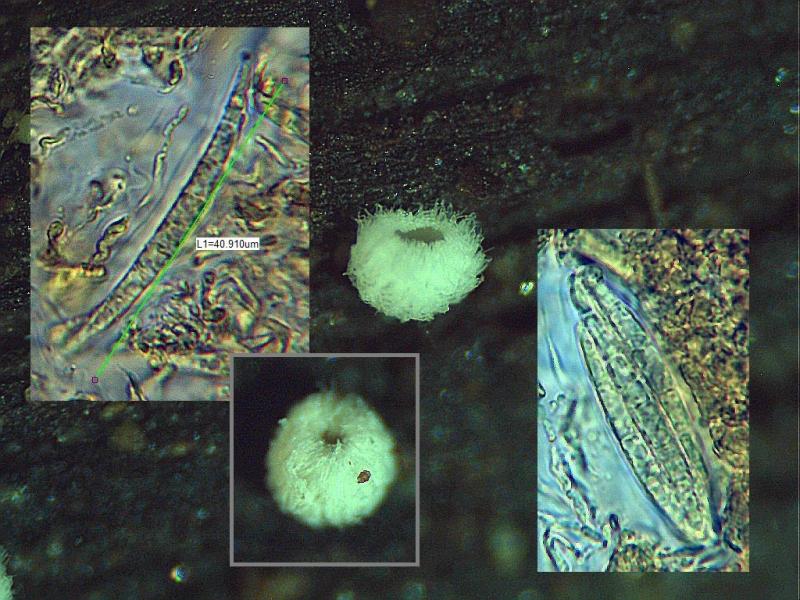
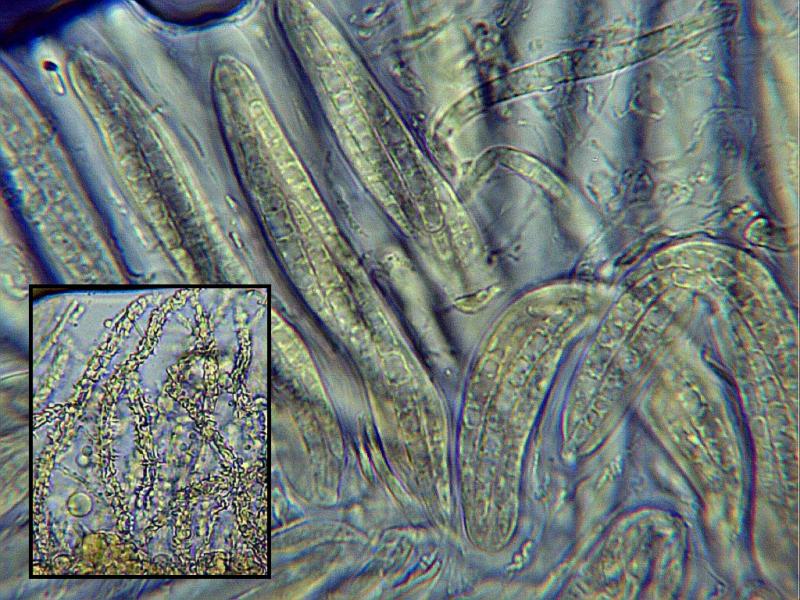
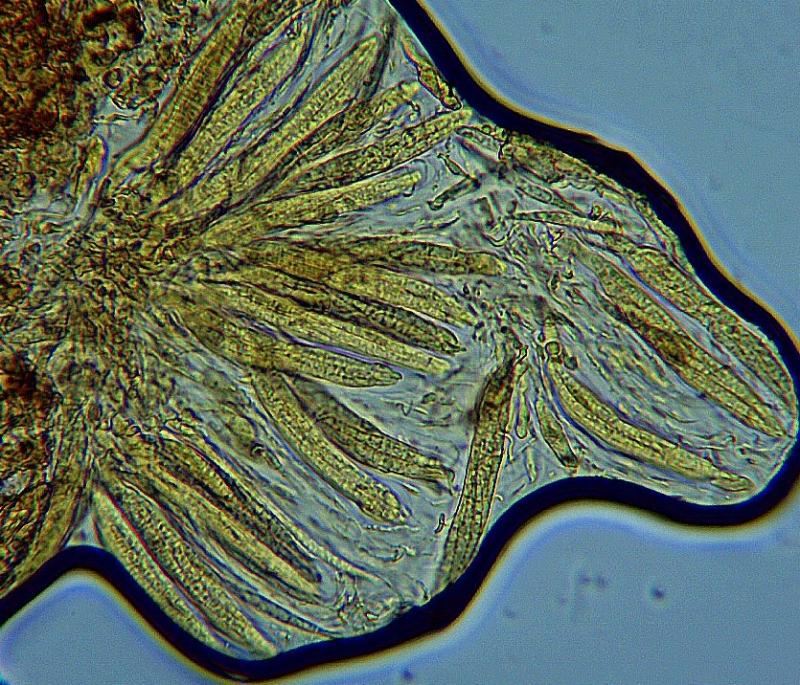
 Found a small group of inoperculate cup ascos under Corylus, with the following all pointing towards A. aurata.Sessile to substarte, hairs 110+ x 2.5µm but multicrystals than few, gregarious, only 0.3mm largest, ASCI 8.5 x 68µm, blue tipped.
On the negative side, no subiculum observed when found, spores 7/8 spetate plus but difficult to see, pointed both ends not just one and size smaller at around 45-50µm x 3. White form less common.
So few things not looking good, but can't identify anything closer, unless anyone knows of species with this type of spores and large white hairs.
With thanks Tony Hardware
Hans-Otto Baral,
04-08-2020 17:52

Re : Arachnopeziza aurata or perhaps something else?
Hi
I suppose your fungus grew on moist rotten wood.
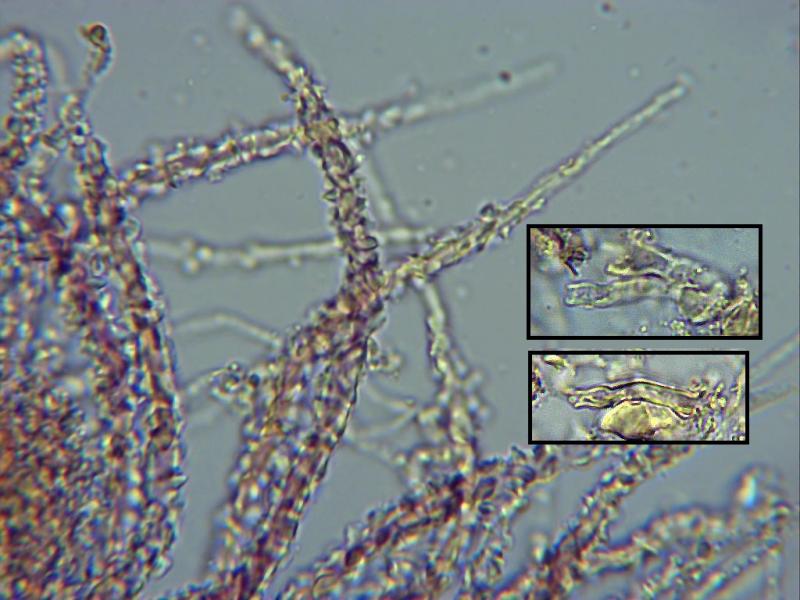
In the dead state it is not easy, but the hairs look very strange. Rather narrow and flexuous and densely covered with crystals. These hairs resemble a Flagelloscypha more than an Arachnopeziza.
From where is this sample?
Hardware Tony,
04-08-2020 18:21
Re : Arachnopeziza aurata or perhaps something else?
Found on Corylus avellana branch on ground. Only damp wood, not wet. I'm based around the Atlantic west side of Cornwall.
Thanks Otto
Looking at the possibility of Flagelloscypha, it seems to me that from a macro and hairs aspect they are almost identical to your ID for this Cyphelloid species. All new to me, but I looked hard for hyphae and basidia in case and think from a poor dried example found some evidence of this. I was wondering if a white hairy asco had found itself close to this species and when I dropped them from the wood to the slide both were placed and the spores we see are for the asco as the asci is clearly seen. Mystery is what the asco is still, but the hairs are so strongly Flagelloscypha minutissima, not sure how I can explain the asci and these hairs together. I could find no lemon shaped spores for the F. min. possibility. Hopefully, you will have the answer and I have gone a bit too far with my imagination!
Thanks again Tony
Thanks Otto
Looking at the possibility of Flagelloscypha, it seems to me that from a macro and hairs aspect they are almost identical to your ID for this Cyphelloid species. All new to me, but I looked hard for hyphae and basidia in case and think from a poor dried example found some evidence of this. I was wondering if a white hairy asco had found itself close to this species and when I dropped them from the wood to the slide both were placed and the spores we see are for the asco as the asci is clearly seen. Mystery is what the asco is still, but the hairs are so strongly Flagelloscypha minutissima, not sure how I can explain the asci and these hairs together. I could find no lemon shaped spores for the F. min. possibility. Hopefully, you will have the answer and I have gone a bit too far with my imagination!
Thanks again Tony

Peter Thompson,
04-08-2020 21:08
Re : Arachnopeziza aurata or perhaps something else?
Hello Tony,
Your find looks far too robust for Arachnopeziza aurata, which is a much more delicate species altogether. Also, as you say, no evidence of a subiculum on the host.
Your later photo shows the crystal lined hairs of Flagelloscypha species. The hairs should have slender, whiplike ends, which can break off during preparation for microscopy.
This one is more appropriate for 'Basidiofrance' than Ascofrance, though many of us will have knowledge of these cyphelloid basidiomycetes.
Presumably, there was an adjacent ascomycete on the host as well. Unless you can find its fruit bodies, we can't really help any further with that one.
With Best Wishes,
Peter.
Your find looks far too robust for Arachnopeziza aurata, which is a much more delicate species altogether. Also, as you say, no evidence of a subiculum on the host.
Your later photo shows the crystal lined hairs of Flagelloscypha species. The hairs should have slender, whiplike ends, which can break off during preparation for microscopy.
This one is more appropriate for 'Basidiofrance' than Ascofrance, though many of us will have knowledge of these cyphelloid basidiomycetes.
Presumably, there was an adjacent ascomycete on the host as well. Unless you can find its fruit bodies, we can't really help any further with that one.
With Best Wishes,
Peter.
Hans-Otto Baral,
04-08-2020 21:18
Re : Arachnopeziza aurata or perhaps something else?
I looked more close and think the asci are bitunicate (The apical wall thickening is several µm thich but only faintly visible). They should come from a pyrenomycete possibly.
Hardware Tony,
04-08-2020 23:18
Re : Arachnopeziza aurata or perhaps something else?
Many thanks Peter/Otto,
I think there must be some sort of corruption with the Cyphelloid, and thank you for helping me realise this position.
I inspected the host carefully but couldn't see anything at the time, but possibly missed a darker pyrenomycetes. One to look out for in future.
Tony
I think there must be some sort of corruption with the Cyphelloid, and thank you for helping me realise this position.
I inspected the host carefully but couldn't see anything at the time, but possibly missed a darker pyrenomycetes. One to look out for in future.
Tony