12-06-2026 14:50
 François Freléchoux
Bonjour, Voici la brève description d'une Mollis
10-06-2026 21:16
François Freléchoux
Bonsoir,Le dernier du jour, en attendant votre avi
11-06-2026 19:01
 William Slosse
Hello all,In an attempt to make a culture of a sus
11-06-2026 19:03
 Nicolas VAN VOOREN
Chers membres d'Ascofrance,Le site sera placé en

09-06-2026 18:32
Camille MertensSur morceau de roseau immergé 0,5 - 0,7 mm de dia
10-06-2026 12:54
Steve ClementsBonjour encore, Pouvez-vous m'aider, s'il vous pl
10-06-2026 21:07
François Freléchoux
Toutes les tiges de gentianes jaunes de l'an passÃ
10-06-2026 13:41
François Freléchoux
Bonjour à nouveau, Voici une trouvaille d'hier.
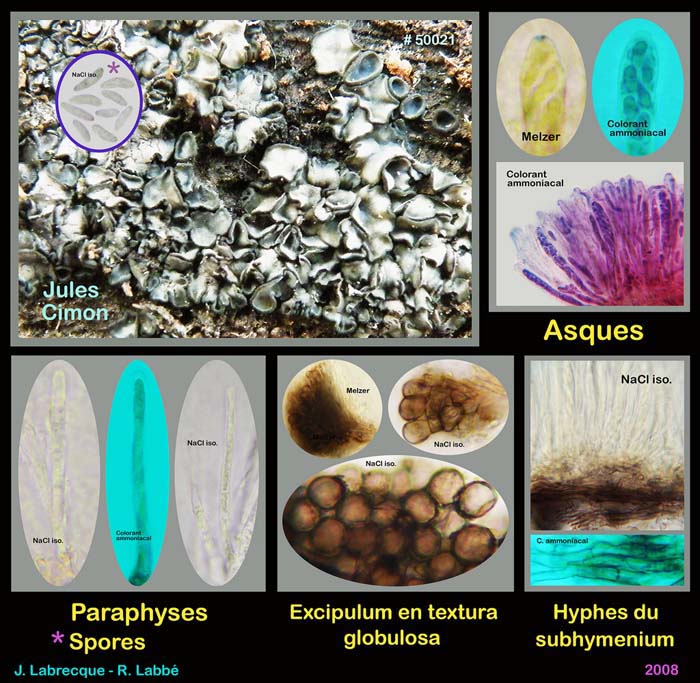
Mollisia lividofusca
Roland Labbé,
24-12-2008 03:17
Les hyphes du subicuculum sont en textura intricata et brunâtres.
J'arrive à cette espèce avec la clé d'Andreas Gminder, version mai 2006.
Qu'en dites-vous ?
Voici les détails :
Date de récolte: 3008.10.24
Habitat: à découvert, dans tas de bois coupé
Hôte: bois de pin blanc
Spores cylindriques-fusoïdes, bisériés dans l’asque, à contenu homogène réfringent en NaCl iso.,
9-13 x 2-3 µm, 10,3 x 2,5 µm en moyenne (15 spores), Q = 4,12
Asques octosporés, avec appareil apical amyloïde, 50-55 x 5-6,5 µm
Paraphyses cylindriques, parfois légèrement élargies à l’apex, non ramifiées, non septées ou à 1-2 septa au tiers inférieur, à contenu homogène ou finement guttulé ou granuleux en NaCl iso., 55-60 x 2,5-3 µm
Subhyménium en texture intricata, formé d’hyphes parallèles brunâtres.
Excipulum en textura globulosa formé de cellules clavées-caténulées, 10 x 10 µm à 20 x 25 µm
Sporée non disponible