
12-06-2026 14:50
 François Freléchoux
Bonjour, Voici la brève description d'une Mollis
10-06-2026 21:16
François Freléchoux
Bonsoir,Le dernier du jour, en attendant votre avi
11-06-2026 19:01
 William Slosse
Hello all,In an attempt to make a culture of a sus
11-06-2026 19:03
 Nicolas VAN VOOREN
Chers membres d'Ascofrance,Le site sera placé en

09-06-2026 18:32
Camille MertensSur morceau de roseau immergé 0,5 - 0,7 mm de dia
10-06-2026 12:54
Steve ClementsBonjour encore, Pouvez-vous m'aider, s'il vous pl
10-06-2026 21:07
François Freléchoux
Toutes les tiges de gentianes jaunes de l'an passÃ
10-06-2026 13:41
François Freléchoux
Bonjour à nouveau, Voici une trouvaille d'hier.
yesterday I found something Mollisia-like on a twig of Betula, hiding on inner bark. It was under a rupture in the outer bark caused by a now dead stroma of Diatrypella favacea or something alike.
The diameter of apos are up to 1.2 mm, greyish - yellowish, turning more brown on drying. Asci 35-42 x 4-7 µm, IKI-. Spores 5-6.5 x 1.5. Parahyses simple 35 x 2 µm.
With Gminder's key the closest I can get is Mollisia ceaspiticia. Any chance that I am somewhere close by?
Stefan
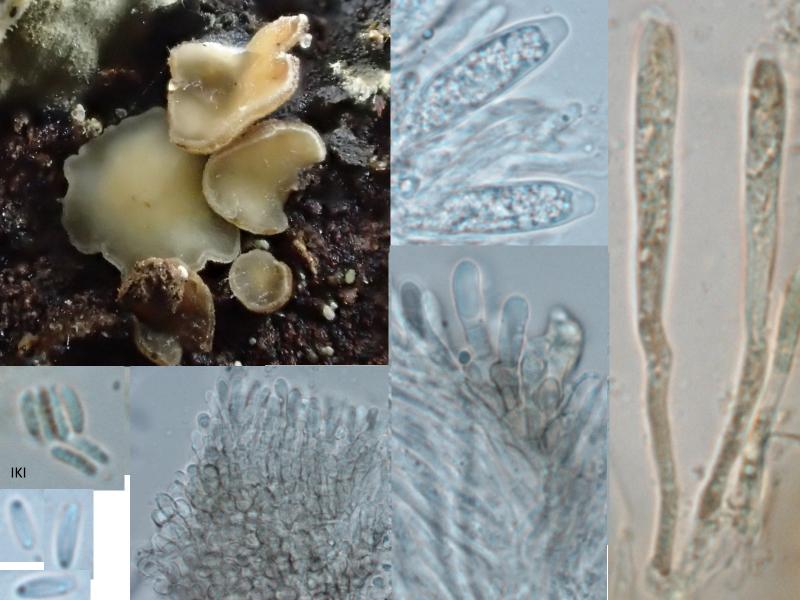

HI Stefan,
Your macro and micro match collections of M. caespiticia we regularly make on twigs of Quercus in Brittany, also on dead Diatrypaceae , but hithertoo rather in winter and spring, I.E. during very wet periods.
IKI négative is a striking character of this species
Amitiés
Michel

Another idea was that M. caespiticia is a Pyrenopeziza. I just moved it back to Mollisia because their is no evidence at present, and it could also be that my folder includes different species. For the sequenced sample only a macro exists which is in the C. vulgaris folder (6.I.2016).
Zotto
Gremmen 1958 examined the "type" in H on Sambucus, so this might have been interpreted as lecotypification. But he did not describe it.
I do not see that Huhtinen published on this, how can he have selected a lectotype?

as far as I remember there were two collections in the KARSTEN Herbarium in H, both of which were studied by Seppo as well as by me. I can verifiy tomorrow when I'm at home. And as far as I remember one of them was labelled as Lectotype. Both collections were on Ribes, as far as I remember, but I will check and verify.
best regards,
Andreas