
01-05-2026 22:45
 Thierry Blondelle
Bonjour à tous, Une récolte sur bouse séchée d
28-04-2026 20:07
 Lothar Krieglsteiner
... on twig in the air at standing Ceratonia siliq
14-04-2026 05:32
Ethan CrensonHi all, A few weeks back a friend pointed out som
28-04-2026 20:33
Vitus SchäfftleinHello, I found Trochila ilicina on Ilex aquifoliu

30-04-2026 10:28
Rot BojanHello, by appearance I would say that I am dealing
27-04-2026 18:48
Tony MoverleyCollected 23rd April 2026, Norfolk, EnglandSwarms
27-04-2026 20:52
Lothar Krieglsteiner
Found on hanging tiwg of Olea europaea in dried-ou
28-04-2026 22:51
 Bernard CLESSE
Bonsoir à toutes et tous,Pourriez-vous m'aider à
29-04-2026 08:01
Lothar Krieglsteiner
... on twig attached to small tree of Citrus auran
Sarcoscypha
Malcolm Greaves,
15-03-2017 17:44
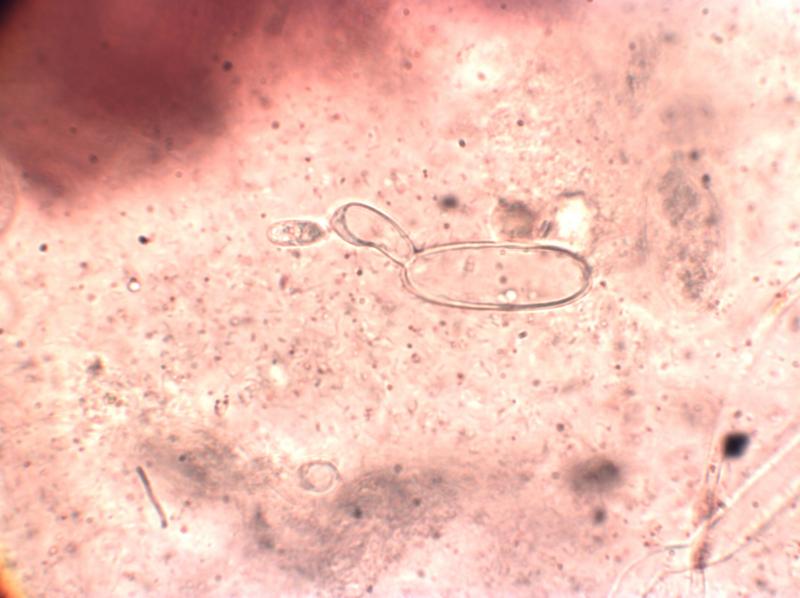
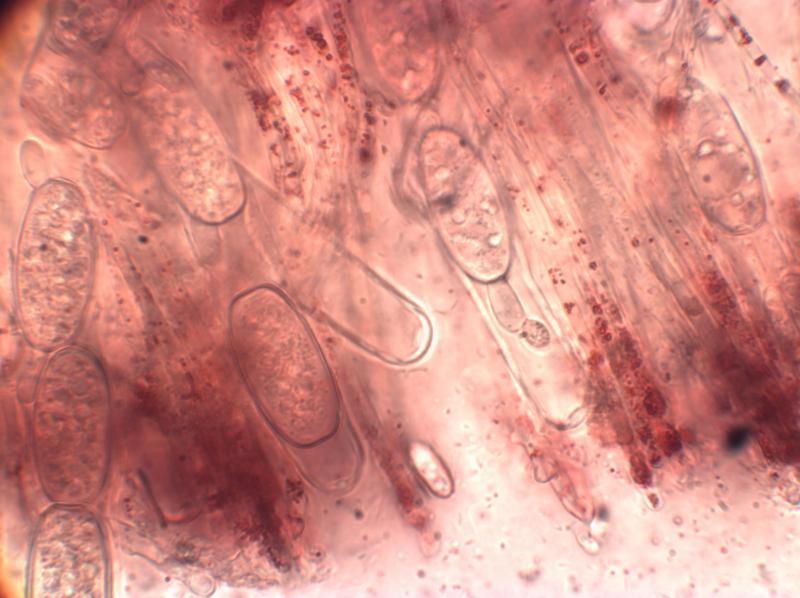
 Is it unusual for the spores of Sarcoscypha austriaca to germinate while still in the ascus? One particular find had lots of spores germinating both outside and inside the ascii.
Mal
Hans-Otto Baral,
15-03-2017 18:03

Re : Sarcoscypha
Germinable spores of all ascomycetes may germinate inside the asci, but only when the asci are dead. Why shouldn't a spore germinate in an ascus when the humidity allows?
But inside living asci only a few fungi do, by forming ascoconidia. Sarcoscypha does not belong to these.
Living asci are distinctly larger than dead asci, you can easily make the test with KOH or MLZ, shrinkage is enormous.
But inside living asci only a few fungi do, by forming ascoconidia. Sarcoscypha does not belong to these.
Living asci are distinctly larger than dead asci, you can easily make the test with KOH or MLZ, shrinkage is enormous.
Chris Yeates,
15-03-2017 18:19

Re : Sarcoscypha
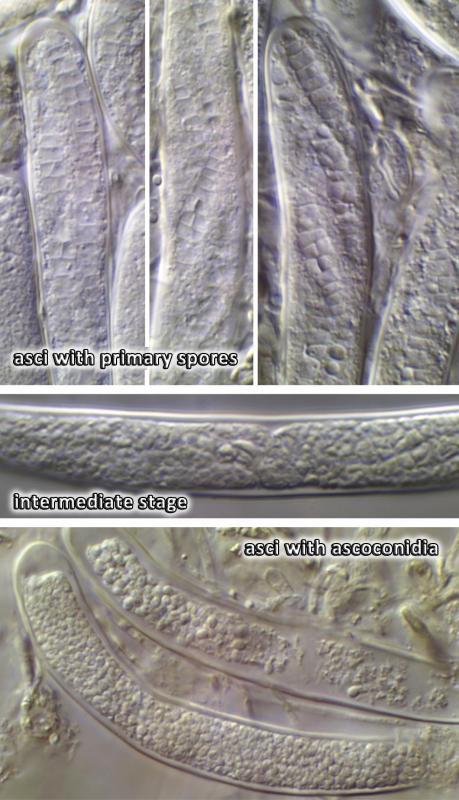
A classic example of forming ascoconidia can be found in Claussenomyces atrovirens.
Hans-Otto Baral,
15-03-2017 18:31
Re : Sarcoscypha
Thanks Chris, you are right for the spores and conidia but the asci are all dead on these pics.
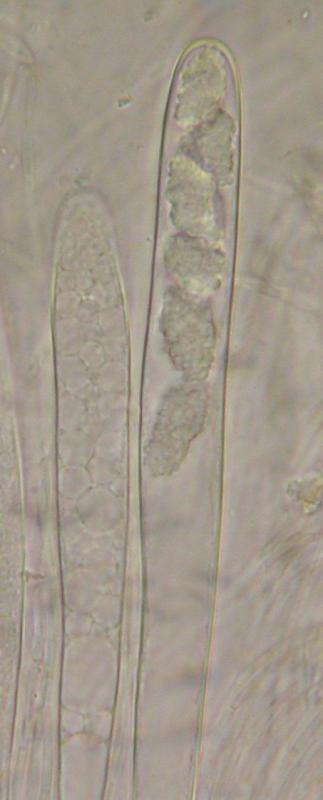
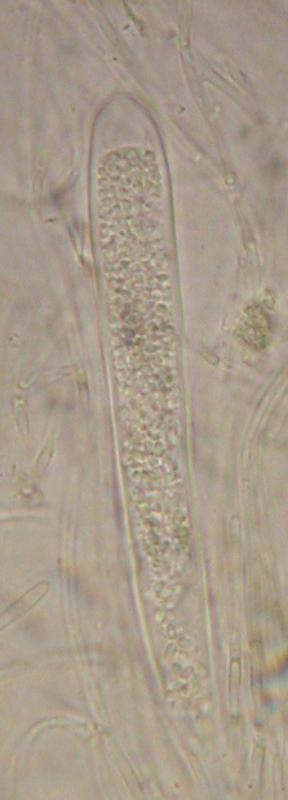
Attached a living and dead ascus of C. atrovirens. The conidia are held together in 8 balls which also contain the remnants of the collapsed ascospores (invisible).
Attached a living and dead ascus of C. atrovirens. The conidia are held together in 8 balls which also contain the remnants of the collapsed ascospores (invisible).
Chris Yeates,
15-03-2017 18:49
Re : Sarcoscypha
Thanks Zotto
I hadn't realised the asci were dead - the photo's were taken in 2013, so I was working backwards when I said that. What are the clues that these are dead? I have edited my former post accordingly.
LG
Chris
I hadn't realised the asci were dead - the photo's were taken in 2013, so I was working backwards when I said that. What are the clues that these are dead? I have edited my former post accordingly.
LG
Chris
Hans-Otto Baral,
15-03-2017 18:58
Re : Sarcoscypha
It is a classical example: apical thickening swollen, conidia distributed ácross the entire lumen. Compare my two pics. If you add KOH to the living ascus it will suddenly look light the dead one I posted. f you don't believe, I have a video :-)
Malcolm Greaves,
16-03-2017 10:48
Re : Sarcoscypha
Thanks for the information Zotto.
Mal
Mal