
28-04-2026 20:07
 Lothar Krieglsteiner
... on twig in the air at standing Ceratonia siliq
04-05-2026 18:13
 Stephen Martin Mifsud
ID request for what seems to be a true aquatic fun
04-05-2026 16:39
Stephen Martin Mifsud
ID request: This specimen was collected in Malta o
04-05-2026 09:50
 Castillo Joseba
Me mandan el material seco de Galicia,(España) re
02-05-2026 12:42
Alain BRISSARDBonjour à tousJeuidi 30 avril dernier on m'a remi
02-05-2026 13:06
Pauline. PennaBonjour Please can someone help me with this id
01-05-2026 22:45
 Thierry Blondelle
Bonjour à tous, Une récolte sur bouse séchée d
14-04-2026 05:32
Ethan CrensonHi all, A few weeks back a friend pointed out som
28-04-2026 20:33
Vitus SchäfftleinHello, I found Trochila ilicina on Ilex aquifoliu
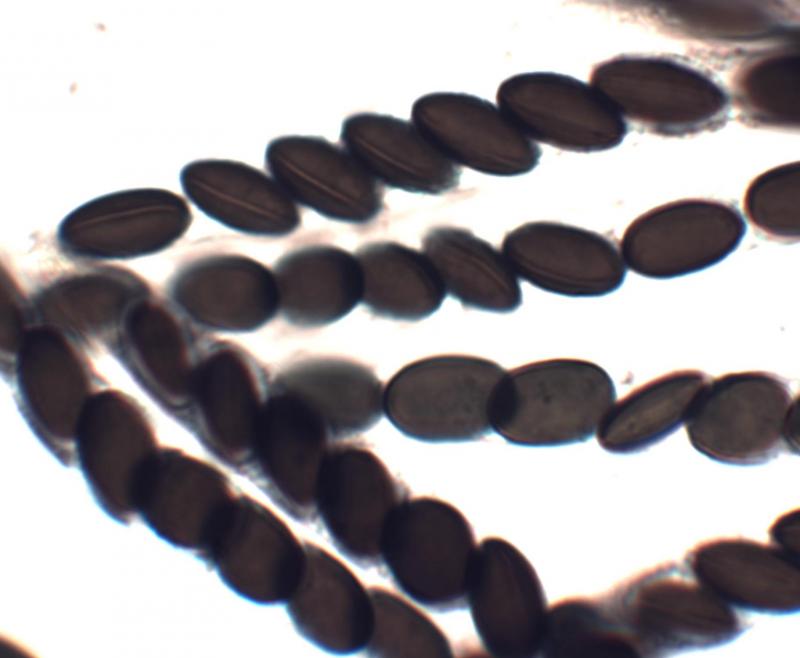
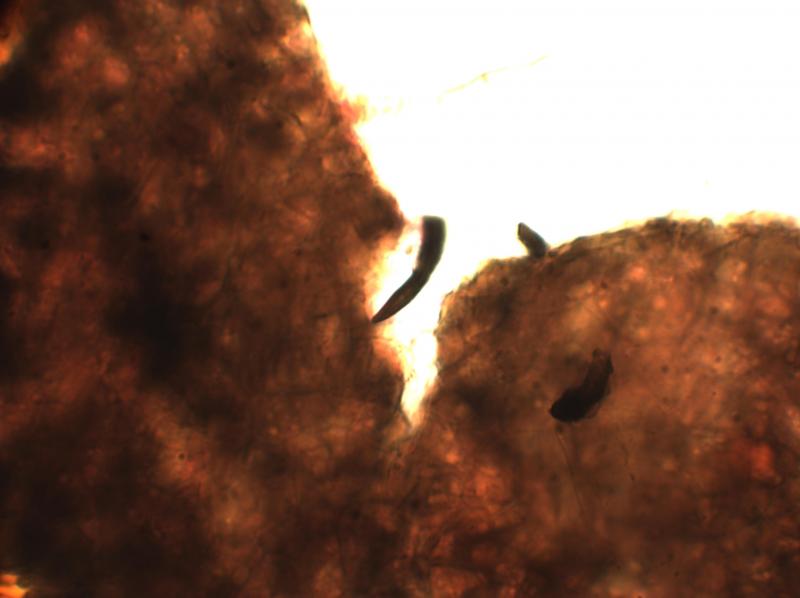
 Having found Ascobolus carletonii on the grouse dung a lot of Sporormiella australis developed but I then came across a third species. A small black almost spherical Perithecia with a short neck sparsely surrounded by short dark pointed hairs. The spores were either narrowly ellipsoid with a germ slit or more rounded without the slit. I think it could be a Coniochaeta but although it is close to C saccardoi it does not seem a perfect fit for any species in Ellis and Ellis. The spores are 10-11.8 x 4.9-5.3 or 6.2-7.1
Thanks
Mal


Good evening Malcolm.
Still a difficult genre where species are delicate to separate. On your picture of the spores one sees nevertheless that the latter are rather wide. One must be wary of the three dimensions and make numerous preparations and measure many spores. Try to see if the germ slit goes around the spore. You can also measure the asci. I do not know C.saccardoi, but Checa gives longer spore measurements.
Your mushroom could be within the size range of C.discospora.
Michel.
Mal
Michel.
Very similar to the first find with spores (10.3)11.21(12.25) x (5.2)5.68(6.5) x (6.44)7.27(7.61) 30 spores measured.
It does not fit perfectly with any in Ellis and Ellis, Keys to Dung Fungi, Dung Fungi of New Zealand or The Genus Conichaeta Checa (thanks Michel). The best fit seems to be C discospora currently synonomised with C ligniarea in the UK.
Thanks for all your help.
Mal