

30-05-2026 21:12
Philippe PELLICIERSur branche de mélèze (Larix) près de la neige,
31-05-2026 10:35
Hulda Caroline HolteHello,I collected this species growing on a rather
25-05-2026 16:35
 Bernard CLESSE
Bonjour à toutes et tous,J'ai trouvé récemment,
29-05-2026 15:35
daniel FERREBonjour à tous,Je voudrais votre aide pour cette
28-05-2026 16:15
James MitchellHello,Does anyone have the original publication of
28-05-2026 11:06
Thomas Læssøehttps://svampe.databasen.org/observations/10596750
23-05-2026 11:44
 Charles Grapinet
Hello, I am having trouble identifying this copro
25-05-2026 16:44
François BartholomeeusenHi forum members,During an excursion organised by
26-05-2026 21:25
Dirk GerstnerHello everyone, I'm completely stumped by this li
 Hello forum,
This ascomycete intrigues me. I found it on dead decorticated bleached twigs < 1cm diam of Buxus sempervirens, in a submediterranean environment, on a very dry and sun-exposed slope.
It appears as black erumpent hysterothecia, almost superficial at maturity, 1-1.2 mm long, with two thick black lips composed of wood cells and dark brown fungal tissue, opening over a dark grey elongated hymenium.
Hamathecium waxy, difficult to dissociate, composed of palisadic cellular pseudoparaphyses 1.8-2 µm diam, apically branched, with swollen tips coated with scattered greyish amorphous deposits, I-.
Asci few, likely bitunicate with a thin refractive ectoascus but lacking an ocular chamber and apparently not fissitunicate. They are clavate, subsessile, devoid of apical apparatus, 3-5-8-spored, I-.
Ascospores 16-21 x 8.5-10 µm, ellipsoid, hyaline, smooth, thin-walled, muriform, with 3-5 tranverse septa and 1-3 longitudinal or oblique septa in each cell, not constricted at septa, without slimy sheath.
I considered Patellarialles, especially because of the hamatecium anatomy but I failed to find a satisfactory genus in that order. This fungus is relatively conspicuous by its size and the contrast with the bleached wood, I hope someone will recognize it.
Thanks,
Jacques
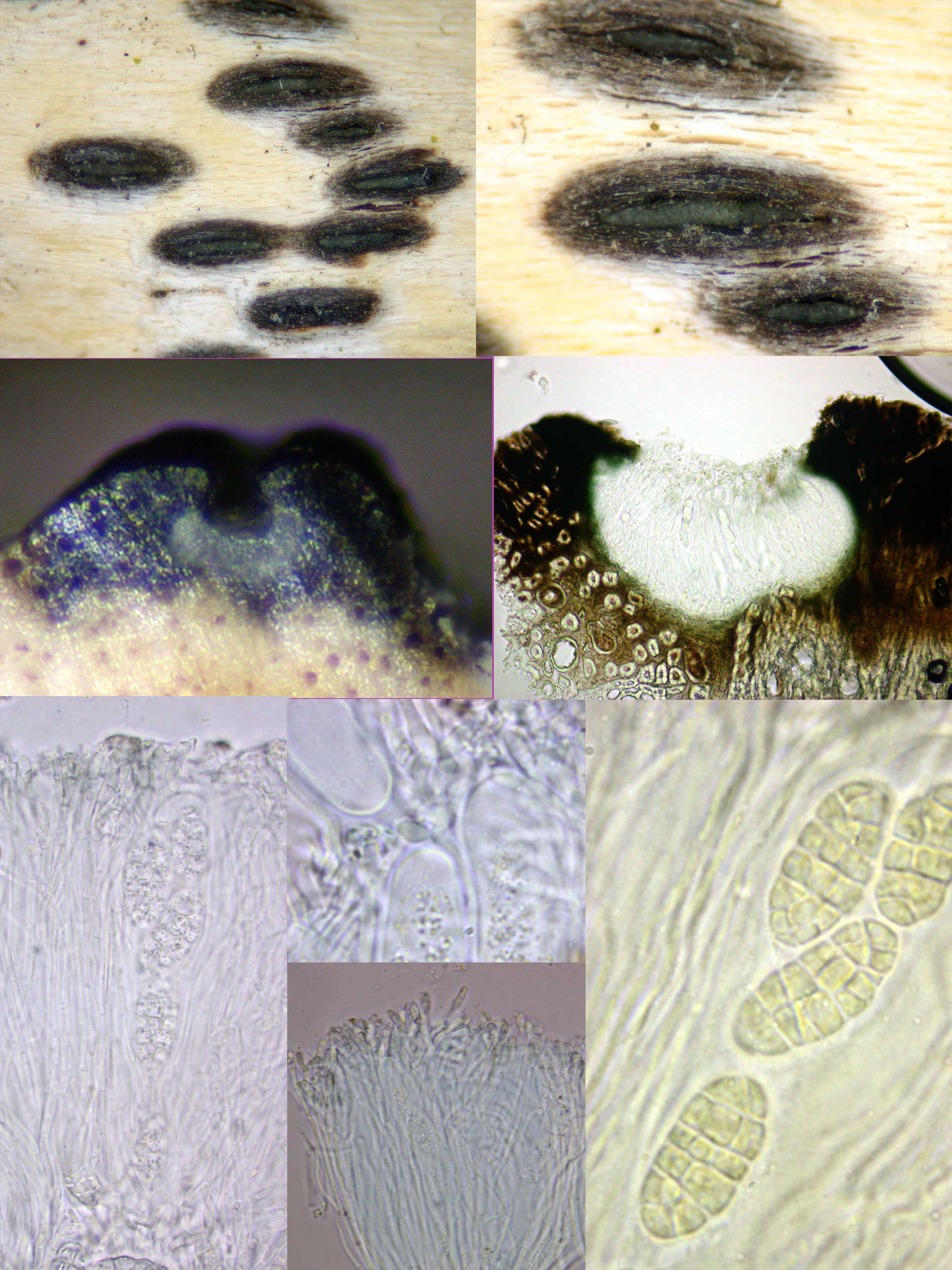 JF16038
it would probably be good to study immature dead asci for their possibly thick lateral and/or apical wall. In Patellariales I would expect bitunicate asci.
Zotto