
01-05-2026 22:45
 Thierry Blondelle
Bonjour à tous, Une récolte sur bouse séchée d
28-04-2026 20:07
 Lothar Krieglsteiner
... on twig in the air at standing Ceratonia siliq
14-04-2026 05:32
Ethan CrensonHi all, A few weeks back a friend pointed out som
28-04-2026 20:33
Vitus SchäfftleinHello, I found Trochila ilicina on Ilex aquifoliu

30-04-2026 10:28
Rot BojanHello, by appearance I would say that I am dealing
27-04-2026 18:48
Tony MoverleyCollected 23rd April 2026, Norfolk, EnglandSwarms
27-04-2026 20:52
Lothar Krieglsteiner
Found on hanging tiwg of Olea europaea in dried-ou
28-04-2026 22:51
 Bernard CLESSE
Bonsoir à toutes et tous,Pourriez-vous m'aider à
29-04-2026 08:01
Lothar Krieglsteiner
... on twig attached to small tree of Citrus auran
... found today in the Bavarian Forest near Frauenau, Germany, altitude about 1000 m NN, on bark of lying log of Abies.
Unfortunately I found no asci but only a lot of hyaline conidia - but with a quite special form, and about 11-14/2 µm large. The conidia have a lot of minute droplets (as long as alive ...).
Can somebody help - or is it hopeless?
Regards from Lothar
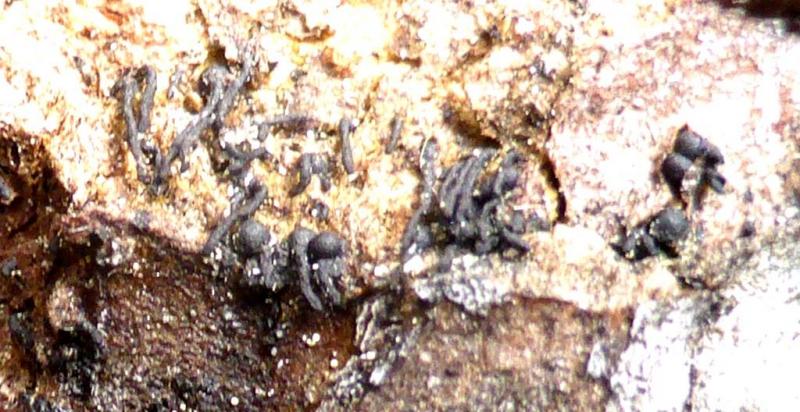
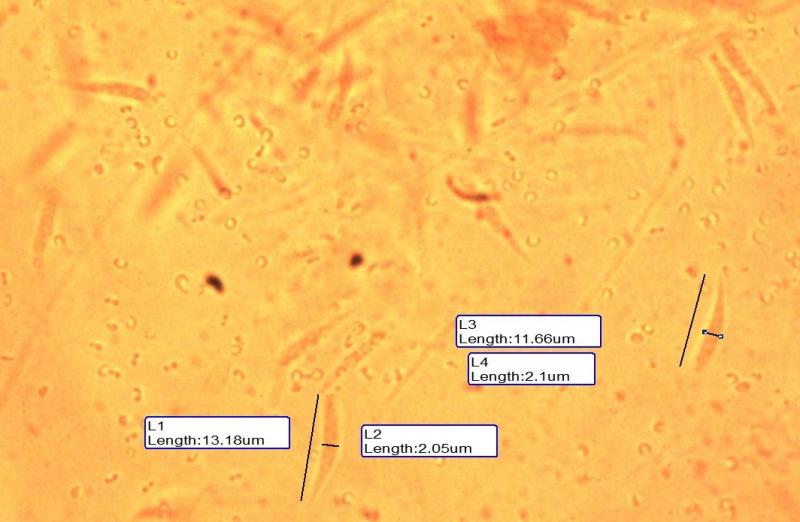


if one assumes that your conidia might be immature asci and the minute horseshoe-shaped things floating between them ascospores, and considers the long beaked gragarious ascomata, Calosphaeriales might be a lead.
Jacques
Hi Jacques,
thank you very much for your proposal of unripe asci!
But - I think this cannot be right.
First: there were a lot of (hundreds of) that "asci" floating, and not much more to see at all - like it is typical for anamorphs. And all looked more or less the same, this speaks claearly against unripe asci. None of the "asci" showed a second cell or what has ruptured from a second cell, all were more or less "sperma-shaped". The droplets inside the conidia were of perfect roundish form (as far as one could see this - they are minute) - what also speaks against unripe asci but for a ripe and healthy structure.
No - I really think it is an anamorph.
Best regards from Lothar
P.S. I try to find this fungus again - in the teleomorph :-)