
02-05-2026 12:42
Alain BRISSARDBonjour à tousJeuidi 30 avril dernier on m'a remi
02-05-2026 13:06
Pauline. PennaBonjour Please can someone help me with this id
01-05-2026 22:45
 Thierry Blondelle
Bonjour à tous, Une récolte sur bouse séchée d
28-04-2026 20:07
 Lothar Krieglsteiner
... on twig in the air at standing Ceratonia siliq
14-04-2026 05:32
Ethan CrensonHi all, A few weeks back a friend pointed out som
28-04-2026 20:33
Vitus SchäfftleinHello, I found Trochila ilicina on Ilex aquifoliu

30-04-2026 10:28
Rot BojanHello, by appearance I would say that I am dealing
27-04-2026 18:48
Tony MoverleyCollected 23rd April 2026, Norfolk, EnglandSwarms
27-04-2026 20:52
Lothar Krieglsteiner
Found on hanging tiwg of Olea europaea in dried-ou
... found yesterday in Stuttgart, Germany, at naked, nutrient-rich and base-rich soil at the side of a vineyard.
The spores (as measurable, few outside te ascus) are about 13,5-15 (16) µm in diameter.
The meshes are quite variable, mostly between 1,8 and 3 (4 or even 5) µm in diameter.
The host could be the moss Phascum cuspidatum - the phylloids have short peaks of the prolonged rib, the lamina cells are about square-shaped and distinctly papillose.
Am I right (with fungus and moss)?
Regards from Lothar


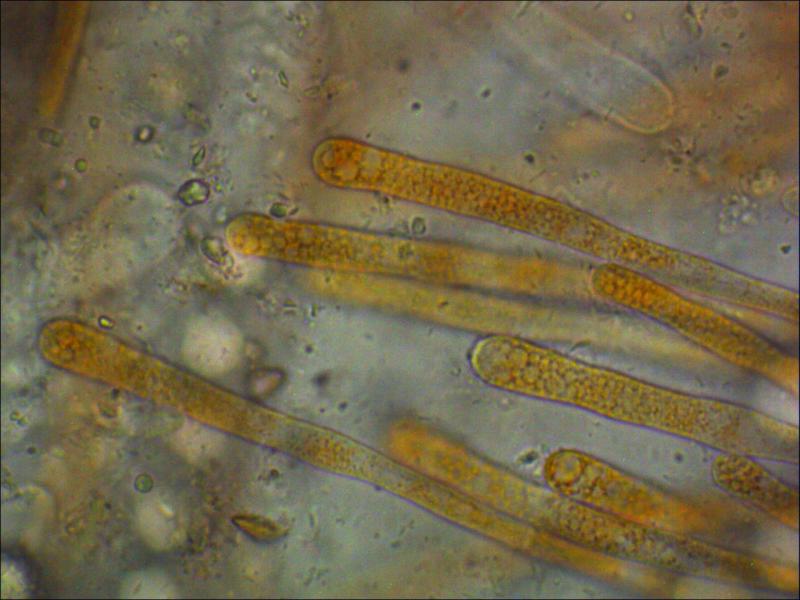


I don't remember collections of L. miniata with such thick nodes on the network...
Let our German specialists (Marcel and Jan) give their advice!

Hello,
Tanja and me have found the same about 10 days ago before the temperatures have gone down. I will look tomorrow if there are new fruitbodies now.
We found it also along a roadside on calcareous soil, between agriculture fields.
I was also thinking of L. miniata or feuchrichiana first, but hesittated because of the thickenings of the net work lines. Two weeks ago I had a real miniata/feucrichiana collection from sand stone which didn't had these thickenings.
best regards,
Andreas
Beaucoup de difficultés pour retrouver Ascofrance...
A mon avis, les spores représentent bien Lamprospora miniata malgré des noeuds asez épais à certains endroits. Je crois que l'ornementation évolue au cours de la maturation si bien qu'on rencontre souvent plusieurs types d'ornementation à l'intérieur d'un seul asque.
Si l'on compare avec les spores représentées par Benkert dans son article sur Lamprospora miniata (2000) en particulier celles relatives à la mousse Phascum cuspidatum, (p 60), je ne trouve rien de choquant.
Amitiés
Gilbert
Hello Nicolas, Andreas and Gilbert,
sorry for the late answer, but as I heard I was not the only one who had problems to write in ascofrance in the last days.
@Gilbert: thank you for your opinion especially - and for your confirmation of my suggestion of Lamprospora miniata. I knew this species only from Encalypta streptocarpa by now, and so I was not sure of the identity.
@Andreas: interesting that you found the same Lamprospora under the same conditions!
So - I will (if nobody else will contradict further) call my specimen Lamprospora miniata.
Best regards from Lothar