

10-06-2026 12:54
Steve ClementsBonjour encore, Pouvez-vous m'aider, s'il vous pl
09-06-2026 18:32
Camille MertensSur morceau de roseau immergé 0,5 - 0,7 mm de dia
10-06-2026 21:16
 François Freléchoux
Bonsoir,Le dernier du jour, en attendant votre avi
10-06-2026 21:07
François Freléchoux
Toutes les tiges de gentianes jaunes de l'an passÃ
10-06-2026 13:41
François Freléchoux
Bonjour à nouveau, Voici une trouvaille d'hier.
10-06-2026 11:53
Steve ClementsBonjour, This disco is abundant on dead stems of
10-06-2026 10:45
François Freléchoux
Bonjour à nouveau, Encore une détermination qui
08-06-2026 10:16
 Spooren Marco
I don`t have a clou about this fungus,it is not in
10-06-2026 09:24
François Freléchoux
Bonjour, J'imagine que cette détermination ne do
 Bonsoir tous
the 'foam-cakes' which can develop in fast flowing streams are a very interesting habitat for the so-called 'Ingoldian Fungi'.
Examples of some of the often distinctive conidia found can be seen here:
http://www.ascofrance.com/search_recolte/3964
http://www.ascofrance.com/search_recolte/3943
http://www.ascofrance.com/search_recolte/3010
Amongst these "aquatic hyphomycetes" one often sees diatoms and other algae, lepidopteran wing scales, pollen etc.; and also chance fungal spores from unknown fungi (which may or may not be aquatic in origin). Normally one ignores these, but occasionally one finds something so striking there may be a hope of getting an identification, even from a single spore. Here is an example of this and I am hoping that such a distinctive spore (which is surely an ascospore - Pleosporales or similar?) will be recognised by someone here. Notable are the large size of the spore and the very distinctive hyaline tips at each end (which are not formed within a single cell - the terminal cells are part-coloured). It may not be evident from the photograph, but the spore is 8-septate.
As ever any suggestions would be very welcome.
Chris
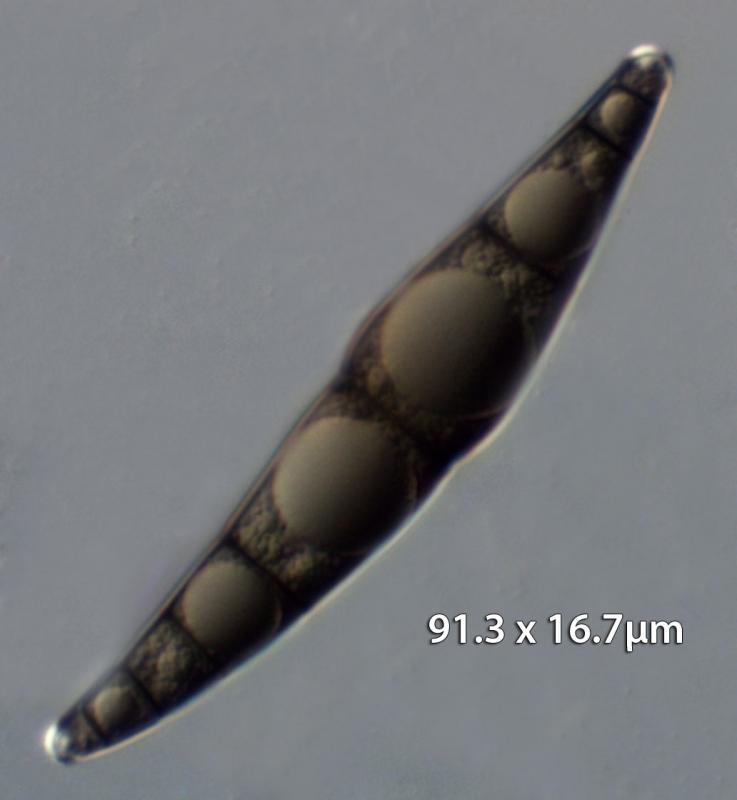
could be an ascospore of Trematosphaeria hydrela.
Best wishes,
Gernot

Exactly !
It's more common to find conidias of the anamorphic stages, ingoldian fungi, but sometimes there are ascospores of the sexual stage. One can also find non-aquatical spores.
Alain

Hi Chris and Gernot,
I fully agree with Gernot: this should be the spore of Trematosphaeria hydrela! I quite often found these species on deciduous wood in rivulets.
Regards from Lothar