

22-04-2026 20:54
 Enrique Rubio
Hi to everybody.This Pyrenopeziza grew in moist le
24-04-2026 03:16
 David Chapados
Found while looking at something else from wood in
22-04-2026 01:06
 Richard VALERI
Bonjour à tous.Je vous présente cette Nectria s.
22-04-2026 20:17
 Marian Jagers
Is anyone familiar with the Hyphomycetes genus Pse

Glaziella
Zuzana Sochorová (Egertová),
26-02-2015 18:59
 Good evening,
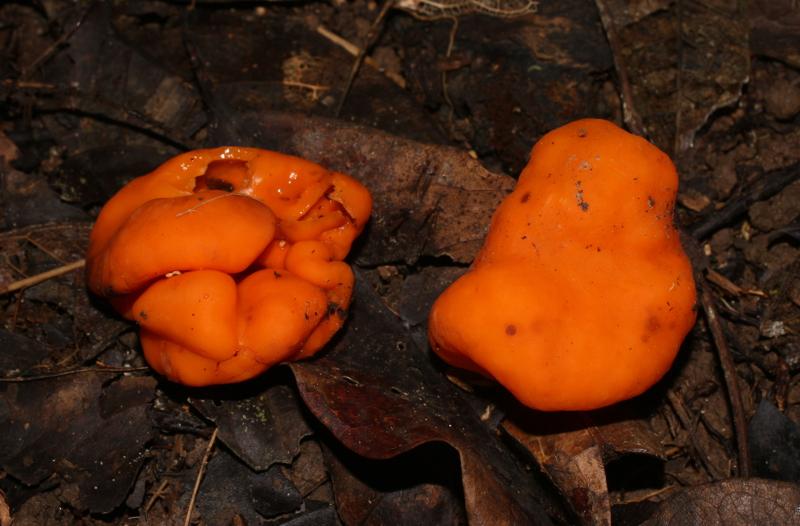
this bizarre fungus grew on many places in a karst region in East Kalimantan, sometimes directly on wood, sometimes on soil with a thin layer of litter.
It should be Glaziella. In many literature sources it is written the genus is monotypic, containing only Glaziella aurantiaca. However, there are more species listed as Glaziella at Index Fungorum - G. abnormis, G. bakeriana, G. berkeleyi, G. ceramichroa, G. cyttarioides, G. splendens, G. sulphurea, G. vesiculosa. G. vesiculosa should be a synonym of G. aurantiaca, according to the literature I have, but what about the other names?
I just want to know if my fungus could be someting else than Glaziella aurantiaca...
Zuzana
Hans-Otto Baral,
26-02-2015 19:47

Re : Glaziella
I had to do with the literature of this genus in my Syllabus survey, and my conclusion was that there is only one species.
There is no hymenium but scattered saccate asci, a very strange ascomycete. Could you verify this?
I paste her my text:
Fam. Glaziellaceae J.L.Gibson Ascomata cleistothecial, epigeous, up to 50 mm in diam., exterior smooth, irregularly spherical to lobed, hollow with basal opening, yellow to orange-red. Peridium 0.5–2 mm thick, gelatinous, of interwoven hyphae, externally and internally pseudoparenchymatic. Paraphyses absent. Asci scattered, embedded in peridial wall, clavate to subglobose, early deliquescent. Ascospores 1 per ascus, globose to subglobose, smooth, with thick inner and thin outer wall, orange. WBs globose. Epigeous in pantrop. lowlands, possibly ectomycorrhizal. 1 gen. (1).
Glaziella Berk. (1).
Previously placed in the Endogonaceae (Zygomycetes), Glaziella was later transferred by Gibson et al. (1986) to the Ascomycetes in a separate order Glaziellales. However, G. aurantiaca (Berk. & M.A.Curtis) Sacc. clusters within the Pezizales as a sister group to a clade containing Geopyxis and Ascodesmidaceae (Hansen et al. 2013). Little is known about the genus, and the previously included 9 species were all described about a hundred years ago or more, and are today believed to be either synonyms or unrelated. - References: Gibson et al. (1986), Hansen et al. (2005b, 2013), Laessøe & Hansen (2007), Perry et al. (2007).
There is no hymenium but scattered saccate asci, a very strange ascomycete. Could you verify this?
I paste her my text:
Fam. Glaziellaceae J.L.Gibson Ascomata cleistothecial, epigeous, up to 50 mm in diam., exterior smooth, irregularly spherical to lobed, hollow with basal opening, yellow to orange-red. Peridium 0.5–2 mm thick, gelatinous, of interwoven hyphae, externally and internally pseudoparenchymatic. Paraphyses absent. Asci scattered, embedded in peridial wall, clavate to subglobose, early deliquescent. Ascospores 1 per ascus, globose to subglobose, smooth, with thick inner and thin outer wall, orange. WBs globose. Epigeous in pantrop. lowlands, possibly ectomycorrhizal. 1 gen. (1).
Glaziella Berk. (1).
Previously placed in the Endogonaceae (Zygomycetes), Glaziella was later transferred by Gibson et al. (1986) to the Ascomycetes in a separate order Glaziellales. However, G. aurantiaca (Berk. & M.A.Curtis) Sacc. clusters within the Pezizales as a sister group to a clade containing Geopyxis and Ascodesmidaceae (Hansen et al. 2013). Little is known about the genus, and the previously included 9 species were all described about a hundred years ago or more, and are today believed to be either synonyms or unrelated. - References: Gibson et al. (1986), Hansen et al. (2005b, 2013), Laessøe & Hansen (2007), Perry et al. (2007).
Zuzana Sochorová (Egertová),
26-02-2015 20:50
Re : Glaziella
Thank you for an answer, Zotto.
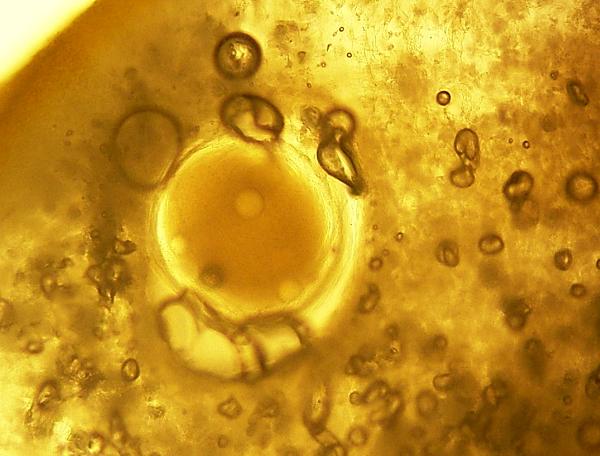
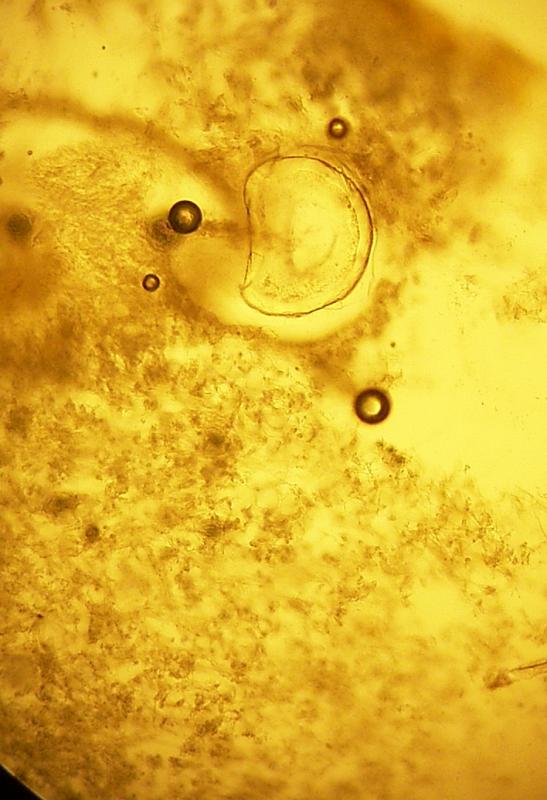
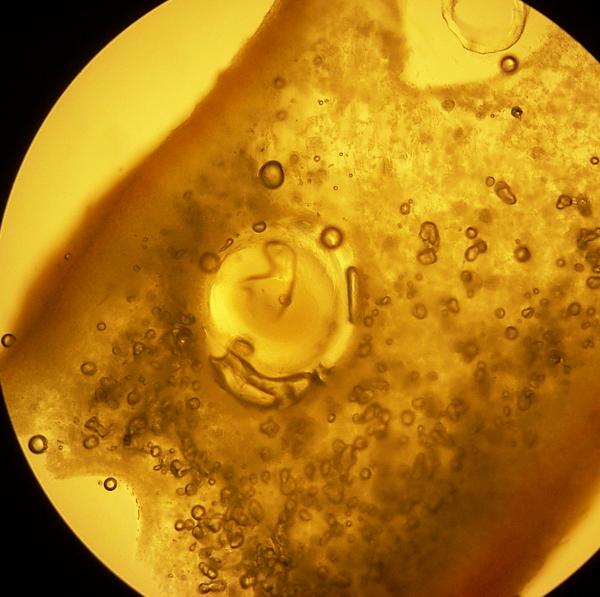
The structure of the fungus is really strange, very different from "classical" ascomycetes. What I can see fits well to the pictures in the article by Gibson. The size of the spores ranges from 230 to 330 micrometers.
The structure of the fungus is really strange, very different from "classical" ascomycetes. What I can see fits well to the pictures in the article by Gibson. The size of the spores ranges from 230 to 330 micrometers.
Hans-Otto Baral,
26-02-2015 21:38
Re : Glaziella
Yes, this is Glaziella....
Zuzana Sochorová (Egertová),
27-02-2015 07:25
Re : Glaziella
... aurantiaca :-)
Thanks for confirmation. It´s interesting it grew so much in the limestone area, but we saw no fruitbodies in the other regions. I don´t know if it is really calciphilous or it was just a coincidence...
Thanks for confirmation. It´s interesting it grew so much in the limestone area, but we saw no fruitbodies in the other regions. I don´t know if it is really calciphilous or it was just a coincidence...
Hans-Otto Baral,
27-02-2015 10:57
Re : Glaziella
This is of indeed interesting, regrettably I do not know.