
03-05-2026 10:57
 Castillo Joseba
Me mandan el material seco de Galicia (España) re
02-05-2026 12:42
Alain BRISSARDBonjour à tousJeuidi 30 avril dernier on m'a remi
02-05-2026 13:06
Pauline. PennaBonjour Please can someone help me with this id
01-05-2026 22:45
 Thierry Blondelle
Bonjour à tous, Une récolte sur bouse séchée d
28-04-2026 20:07
 Lothar Krieglsteiner
... on twig in the air at standing Ceratonia siliq
14-04-2026 05:32
Ethan CrensonHi all, A few weeks back a friend pointed out som
28-04-2026 20:33
Vitus SchäfftleinHello, I found Trochila ilicina on Ilex aquifoliu
30-04-2026 10:28
Rot BojanHello, by appearance I would say that I am dealing
Non Asco
Malcolm Greaves,
13-02-2015 21:38
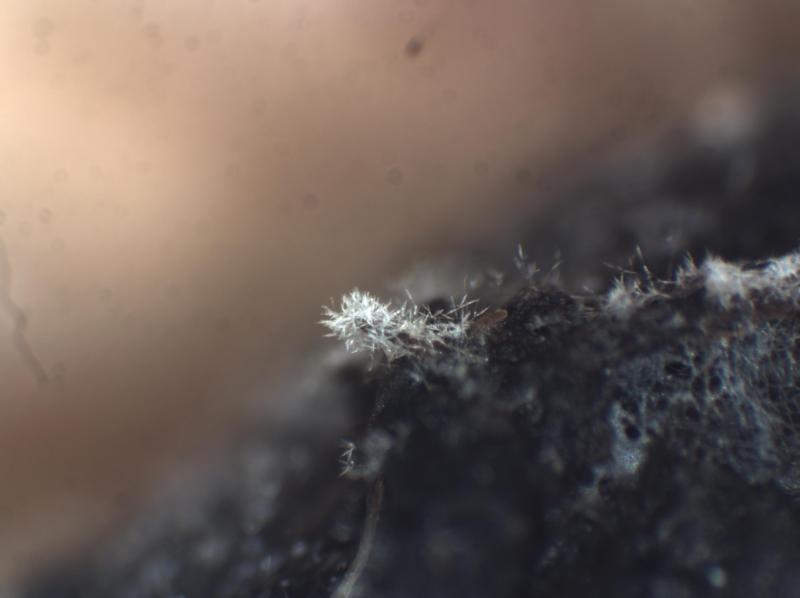
 I came across this growing on and around some Podospora on sheep dung and although I think it might be a Hyphomycete and I know that is not the purpose of this forum but has anyone come across anything similar.
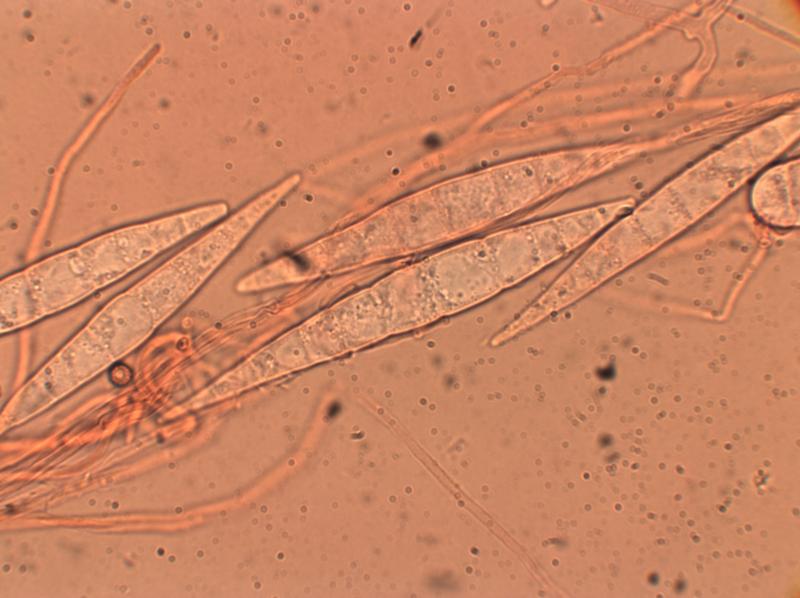
The distinctive multi septate spores are up to 90 x 10.5.
Thanks
Mal
Hans-Otto Baral,
13-02-2015 22:02

Re : Non Asco
This looks much like the anamorph of Orbilia fimicoloides, Dactylella oxyspora. Conidial size fits well.
Zotto
Zotto
Mateusz Wilk,
13-02-2015 22:03
Re : Non Asco
Dear Malcolm,
Could be some species of Dactylella, these are nematophagous fungi and occur often on plant litter or dung.
No idea about the species...
Best wishes,
Mateusz
Could be some species of Dactylella, these are nematophagous fungi and occur often on plant litter or dung.
No idea about the species...
Best wishes,
Mateusz
Mateusz Wilk,
13-02-2015 22:05
Re : Non Asco
Blast!
Zotto was faster and much more precise again!;)
Mateusz
Zotto was faster and much more precise again!;)
Mateusz
Hans-Otto Baral,
13-02-2015 22:14
Re : Non Asco
And I should add that Dactylella is in fact non-nematophagous, although very closely related to the nematophagous group. This is strange because this species was repeatedly found on dung, though more often on herbaceous stems.
Mateusz Wilk,
13-02-2015 22:32
Re : Non Asco
Ah, indeed, I see now that after the revision by Rubner (1996) all nematophagous species were excluded. I remember some older studies, by Drechsler from 1940', and by Cooke and Dickinson (1965), where all those Dactylella and Monacrosporium were treated together.
I have observed them more frequently on strongly decayed plant material with abundant infestation with nematodes and other fauna, and I thougth that was not a coincidence. But indeed I have never seen the very act of capturing the prey, nor I was able to see any adhesive hyphae.
Mateusz
I have observed them more frequently on strongly decayed plant material with abundant infestation with nematodes and other fauna, and I thougth that was not a coincidence. But indeed I have never seen the very act of capturing the prey, nor I was able to see any adhesive hyphae.
Mateusz
Hans-Otto Baral,
13-02-2015 22:46
Re : Non Asco
It is right that in earlier times the genera were separated by conidial septation and conidiophore types, bit since the genetic work of Hagedorn and Scholler the trapping organs play the major role. These organs are indeed not easily discovered. We have seen them occasionally on the natural substrate (constricting rings, adhesive knobs and pegs, but never adhesive nets).
Chris Yeates,
13-02-2015 23:17

Re : Non Asco
@Malcolm
It should also be said that 'hyphomycetes' and 'coelomycetes' - at least the vast majority of them - are anamorphic Ascomycota, and therefore very much included in "the purpose of this forum" ;-)
kind regards
Chris
It should also be said that 'hyphomycetes' and 'coelomycetes' - at least the vast majority of them - are anamorphic Ascomycota, and therefore very much included in "the purpose of this forum" ;-)
kind regards
Chris
Malcolm Greaves,
15-02-2015 15:03
Re : Non Asco
Thanks all for this information.
Mal
Mal