
11-05-2026 12:32
 Bernard CLESSE
Pourriez-vous m'aider à identifier cette héloti
13-05-2026 15:26
 François Freléchoux
Bonjour,Voici une récolte faite il y a quelques j
12-05-2026 15:41
 Nicolas VAN VOOREN
Dear Ascolovers, especially interested in Pezizale
13-05-2026 12:05
 Thierry Blondelle
Bonjour à tous,J'aimerais avoir confirmation de c
10-05-2026 23:17
 Andreas Gminder
Hello,today we found in a moist steep decidous for
28-04-2026 20:07
 Lothar Krieglsteiner
... on twig in the air at standing Ceratonia siliq
27-04-2026 20:52
Lothar Krieglsteiner
Found on hanging tiwg of Olea europaea in dried-ou
11-05-2026 20:22
Lothar Krieglsteiner
on attached twig of standing Ficus caricaquite uns
29-04-2026 10:44
Lothar Krieglsteiner
growing at moist, drying-out soil at the side of a
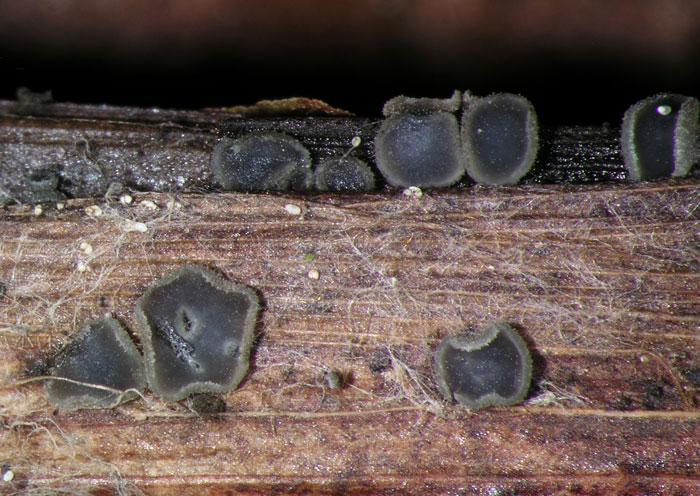
... d'une plante herbacée (peut-être une Poaceae).Apothécies 0.4-1 mm diam. Marge nettement villeuse.
Poils marginaux clavés dans l'article sommital, distinctement incrustés, 28-46 × 7-10 µm (partie la plus large). Asques sans crochet, 62-70 × 6-7 µm, pars spor. 29-33 µm, anneau apical IKI+ (bb). Paraphyses × 3–4.5 µm. Ascospores 11.5-16 (17) × 1.8-2.5 µm, fusiformes étroites, souvent courbées, contenant plusieurs guttules.
Je n'arrive à rien de concluant en utilisant les clés de A. Gminder ou de Zotto.
Une idée ?
===
Apothecia 0.4-1 mm diam. Margin distinctly villose.
Marginal hairs clavate in the top article, distinctly incrusted, 28-46 × 7-10 µm (wider part). Asci without crozier, 62-70 × 6-7 µm, pars spor. 29-33 µm, apical ring IKI+ (bb). Paraphyses × 3–4.5 µm. Ascospores 11.5-16 (17) × 1.8-2.5 µm, narrow fusoid, often curved, containing several oil-drops.
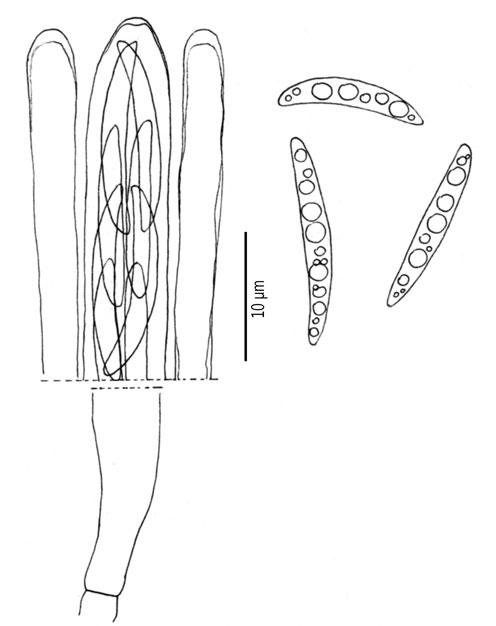

Did you test KOH?
Zotto

I've collected a similar-looking species from Aberystwyth, Wales, UK from Cortaderia (pampas grass), as part of my PhD thesis.
Based on the ITS DNA sequence my collection seems to be a close relative of what I consider to be Mollisia cf. poaeoides, which colonises turf-grass culms around Aberystwyth and possesses shorter ascospores with similar oil droplets. I suspect the ascospore size difference in the larger-spored species is associated with a host-jump to another larger grass species.
At the moment, it looks like there are many closely related species in this group that are endophytes of grass, orchid and other hosts (based on isolates and environmental sequences from plants). None of these have been collected and sequenced yet, so it is possible that there are other species on similar hosts with similar morphology.
Checking through my images I also can't see any distinct croziers, but I wasn't specifically looking for them when taking the images, and also wouldn't consider this a diagnostic feature at the moment. I didn't observe any KOH reaction.
I've attached a slide of some of my images so you can compare with your collection.
Cheers,
Brian
 Mollisia AB1
Be sure that the absence of croziers is an extremely important character, certainly constant within a species of Mollisia or Pyrenopeziza.
In Mollisia I recall M. rosae and M. asteroma as having always simple septate asci. M. prunicola and M. excelsior might be confused with their respective counterparts, but alsways have croziers.
On your photo I cannot see well an ascus base.
Nicolas, did you look for crystals? I have the suspicion that you fungus could be M. retincola, though I have noted a larger spore size in my files.
Zotto
I made a new mount to check some points:
1) KOH-reaction: faintly yellow
2) No crystal seen
3) Crozier present. I didn't see them first time because they seem to be placed very low in the ascogenous hyphae.
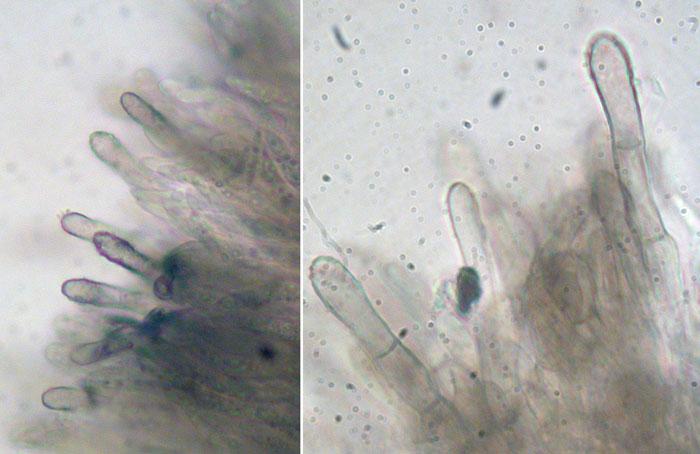
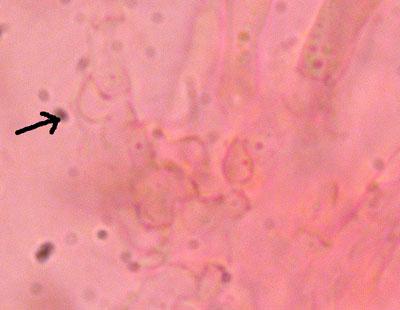
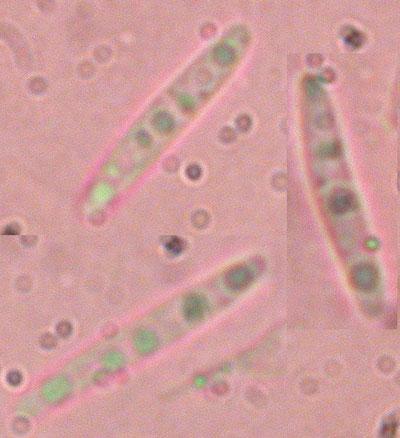
I now compare yours with M. luctuosa = humidicola. That species has 1-septate spores insider the living asci, however, though I am not sure about this in every of the specimens I have in my folder. The macroscopy is very similar at least.
Zotto
I suggest alternatively to make a Melzer mount in which septa are often rather striking. If you find enough asci with septate spores inside this would be a further confirmation for luctuosa.
Good tip :-)
Zotto - I've emailed you regarding my issues with the taxonomic value of croziers (at least in Mollisia and Pyrenopeziza). Hopefully I'm just being stupid and you can correct me!
Cheers,
Brian