
18-03-2026 13:09
 Khomenko Igor
I recently examined Celtis occidentalis branches
18-03-2026 11:52
Thomas Læssøehttps://svampe.databasen.org/observations/10493688
11-03-2026 17:36
 Michel Hairaud
Bonjour, Je cherche des indices pour cette réc
17-03-2026 10:40
 Martine Vandeplanque
Bonjour à tous.Chaque année en mars ou avril, il
17-03-2026 19:41
 Bernard CLESSE
Bonsoir à toutes et tous,Pourriez-vous m'aider à
12-03-2026 19:44
 Enrique Rubio
Hi to everybody.Can you give me any suggestions ab
17-03-2026 10:09
 François Freléchoux
Bonjour, Voici la description rapide d'un petit d
05-03-2026 10:07
Hulda Caroline HolteHello, I found and collected this species growing
12-03-2026 15:45
Åge OterhalsDear forum,I found this small discomycete on a ver
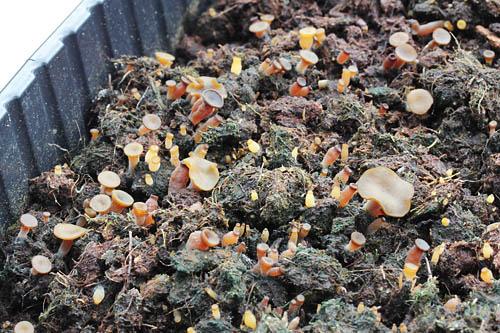
Recently I received some potting soil which showed a few brown fruit bodies suggestive of a Rutstroemia-like species. They were already drying out. At first only two more or less fresh specimens could be recovered. The dried specimens had a black cap and a greyish stipe.
Since I could not easily identify it, I have contacted a few local mycologists, but they had no idea either. A specific problem using the keys I have available is that the ascus tip is iodine-negative.
Later I was able to get information about the origin of the soil: it’s a broken and sifted preparation of 100% Baltic sphagnum (Sphagnum balticum) from Latvia, so it might well be a very specific species.
I have kept the soil in culture and to my surprise a massive number of new fruitbodies keep appearing. Only a few get fully developed.
Does anyone have an idea what this might be?
Details.
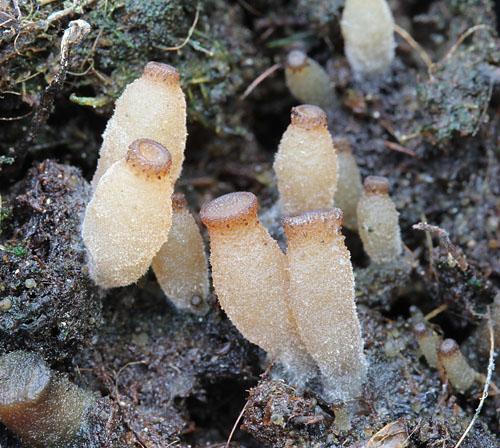
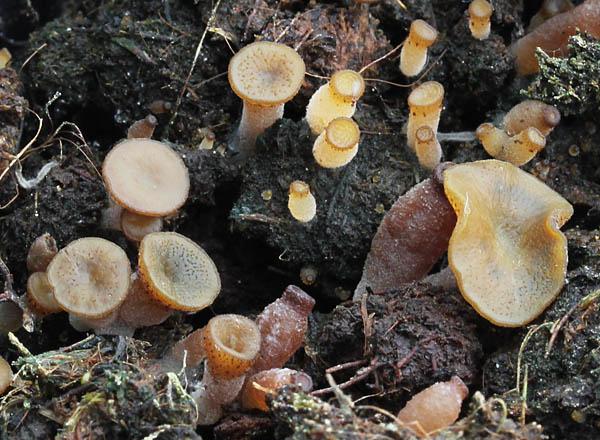
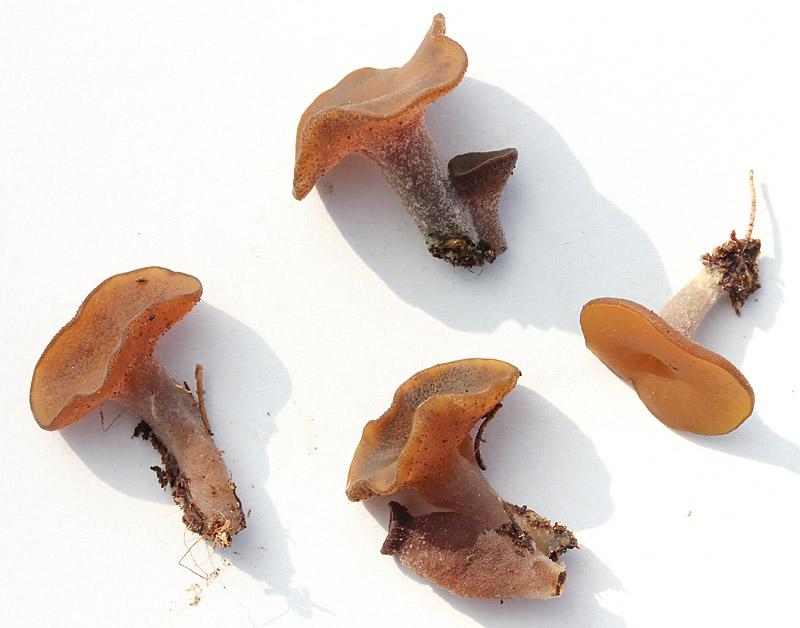
Ascomycete, initially with a small dull yellow to brown cup, soon developing into a disc, with diameter 1-1.5 cm, sometimes slightly depressed in the centre.
Stipe sometimes thickening upwards and flattened, slightly tomentous and whitish in fresh specimens, later becoming brown.
Becoming grey to black when drying.
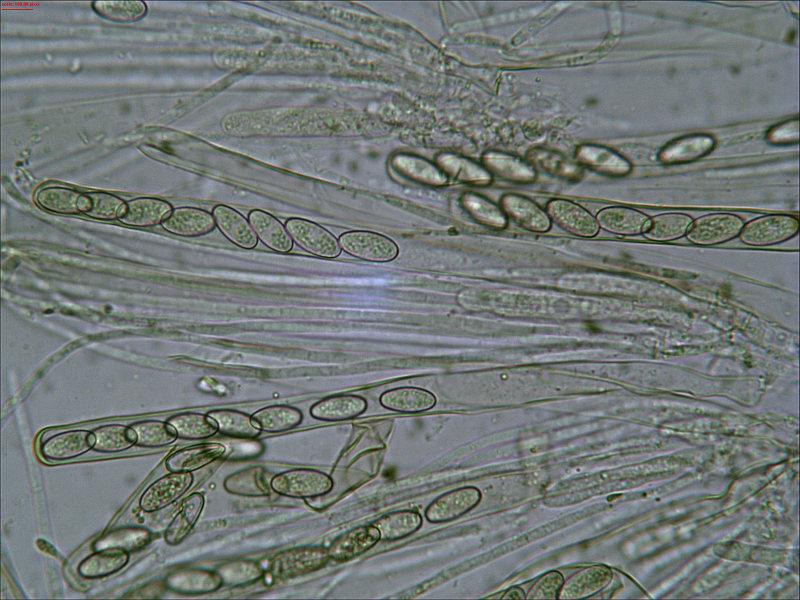
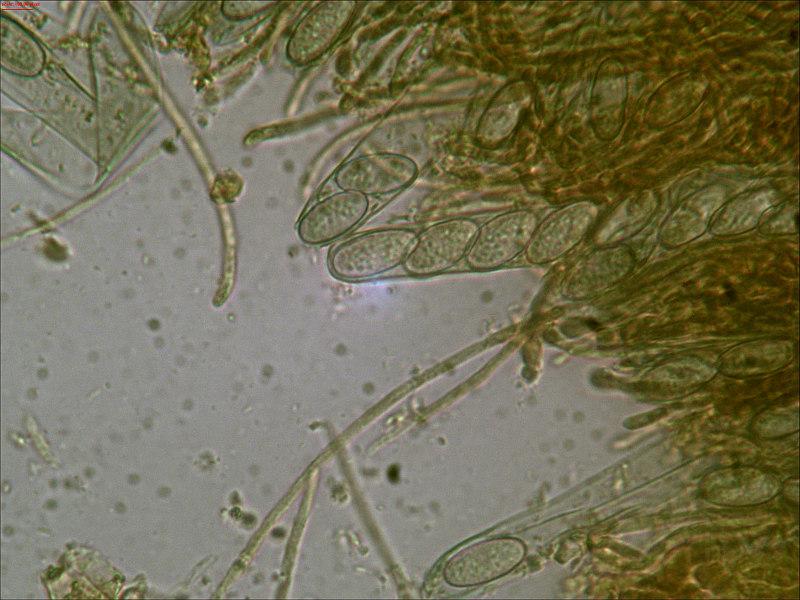
Asci ca 180 x 9 µm, J-negative (Lugol or Melzer), operculate
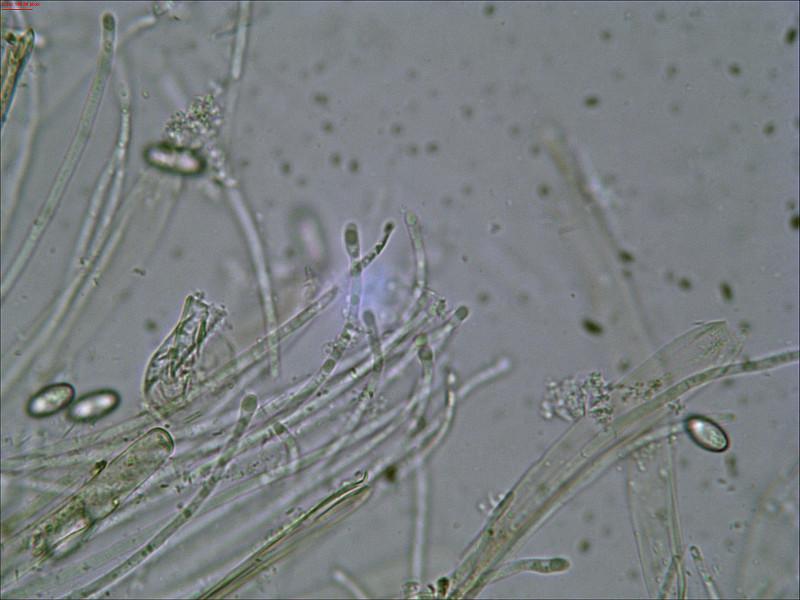
Paraphyses with slightly swollen top, mostly somewhat (widely) curved.
Subhymenium containing globose cells.
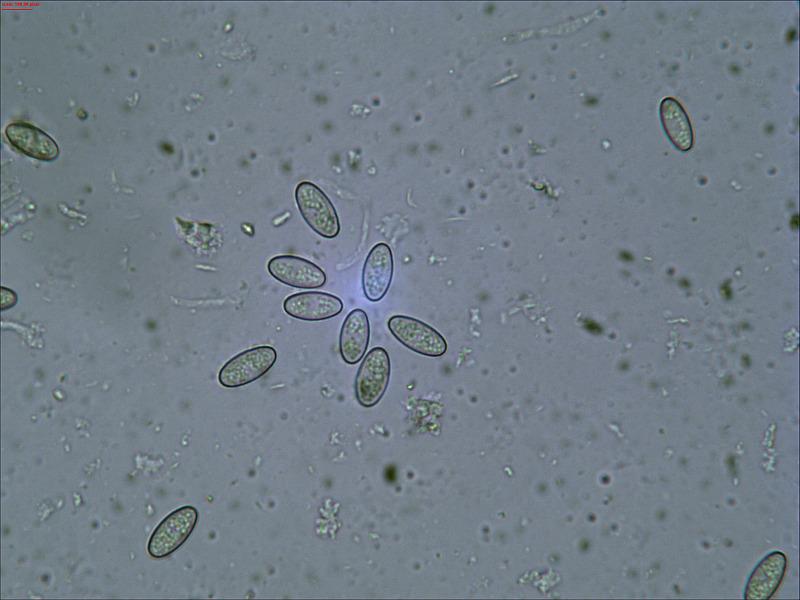
Spores ellipsoid, hyaline, smooth, 14.7-6.7 µm (n=10).
Regards,
Saar Hoenson
It is seems a rare species, for me, and interesting, since i am looking thoroughly at fungi in bogs and at sphagnum/peaty substrates and have never seen this (in West Siberia). I am not very knowledged in systematic of this group and can't make a jugement about its position. But if you will proceed with identification further, it will be a new one in the list of fungi of bog communities which we are preparing now. Could you let me know if a specialist will finally successfull with id?
Best wishes,
Nina.

Is the flesh gelatinized?
Your fungus looks a bit like Ascocoryne turficola, but it is a very gelatinized species, and the fact that there is no amyloid reaction on asci is a problem.
If you're sure that asci are operculate, you can take a look to the description of Peziza quelepidotia (syn. Lepidotia hispida), for example in:
Korf R.P. 1973. On Boudier's genus Lepidotia (Pezizaceae). Persoonia, 7: 205-212 + pl. 17-19.
Note that, also in this case, the asci should be amyloid and spores ornamented after Korf (only visible in 1000x).
Hello Nina,
I would be glad to support your investigations, but at the moment there is little I can do. If this species will somehow be identified, I will surely let you know! We should keep in mind, however, that the species might not be native, but might somehow have been introduced during preparation, transport, etc. of this soil (I live in The Netherlands). I don’t know how likely this is.
Best wishes,
Saar.
Hello Nicolas,
Thank you for your reaction. I have checked a few characteristics again. As far as I can judge the flesh is not gelatinized, the asci are definitely operculate, and at 1000x I cannot find any ornamentation. I will nevertheless try to get hold of a copy of Korf’s paper.
Saar.

My mind also thought in P. quelepidotia... Did you check again IKI or Melzer?
I attach Boudier´s drawing of Aleuria asterigma.
Korf in Persoonia 7:
http://www.cybertruffle.org.uk/cyberliber/61056/0007/002/0205.htm
Plates here:
http://www.cybertruffle.org.uk/cyberliber/61056/0007/002/p017.htm
Raúl
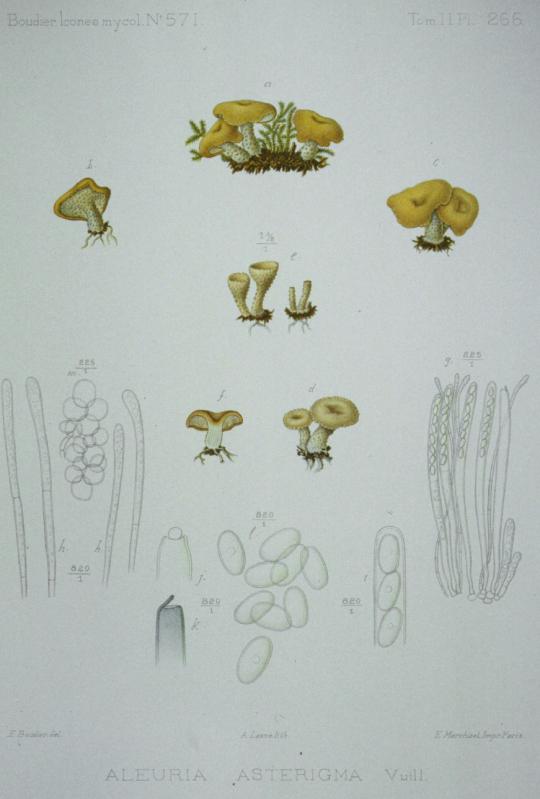
Dear Raúl,
Thanks for the literature links. Both you and Nicolas seem to be on the right track. I think the species looks quite like what is described in the Korf paper. But a major problem remains: I have again checked the ascus amyloidy, but I am still not able to get a distinct staining of the operculum area. Sometimes I see a very faint blue colour in the ascus wall extending down to about one spore length (like the bold lines in the ascus on the right on Plate 2C), but to me this looks like some diffraction artifact. Within Peziza some species seem to have asci that do not stain (I don't know an example). Maybe this is one of these anomalies.
Interestingly, the paper mentions a cyanophilic perispore and cytoplasm in very young spores. This I could reproduce with cotton blue. I had not tested it before. However, I have not yet found the tiny cyanophilic ornamentations developing on the spore wall in fully matured spore.
The fact that in this paper the species appeared in culture on Jiffy-7 tablets, consisting of dried peat-moss, is also very suggestive of a close link between these collections.
So far, so good. Thanks again for your help.
Saar.
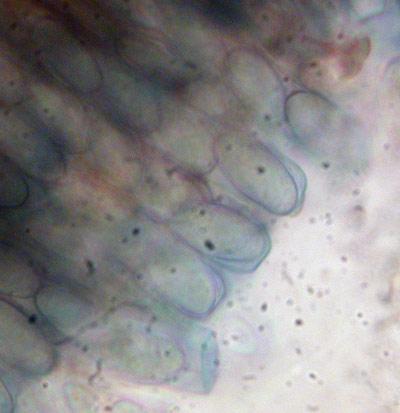
- asci react in blue in Lugol's solution (see attached picture)
- asci don't have crozier (aporhynchous type)
If someone has experience on this species, his opinion is welcome!

Here is Kerry O'Donnell's answer:
The discomycete he found growing on Sphagnum appears to be Peziza quelipodotia. In 1972, someone brought it to me when I was a graduate student at Michigan State University. It was growing on a commercial sphagnum product called Jiffy 7 pellets that people use to start plants from seeds. This species is homothallic, so it should go through a sexual cycle from a uninucleate ascospore. An earlier post indicated that it doesn't produce croziers, but this is incorrect. It does. If anyone would like some SEM images of this species please contact me and I'll be happy to send them to you.
Thanks,
Kerry O'Donnell