
28-04-2026 20:07
 Lothar Krieglsteiner
... on twig in the air at standing Ceratonia siliq
04-05-2026 18:13
 Stephen Martin Mifsud
ID request for what seems to be a true aquatic fun
04-05-2026 16:39
Stephen Martin Mifsud
ID request: This specimen was collected in Malta o
04-05-2026 09:50
 Castillo Joseba
Me mandan el material seco de Galicia,(España) re
02-05-2026 12:42
Alain BRISSARDBonjour à tousJeuidi 30 avril dernier on m'a remi
02-05-2026 13:06
Pauline. PennaBonjour Please can someone help me with this id
01-05-2026 22:45
 Thierry Blondelle
Bonjour à tous, Une récolte sur bouse séchée d
14-04-2026 05:32
Ethan CrensonHi all, A few weeks back a friend pointed out som
28-04-2026 20:33
Vitus SchäfftleinHello, I found Trochila ilicina on Ilex aquifoliu
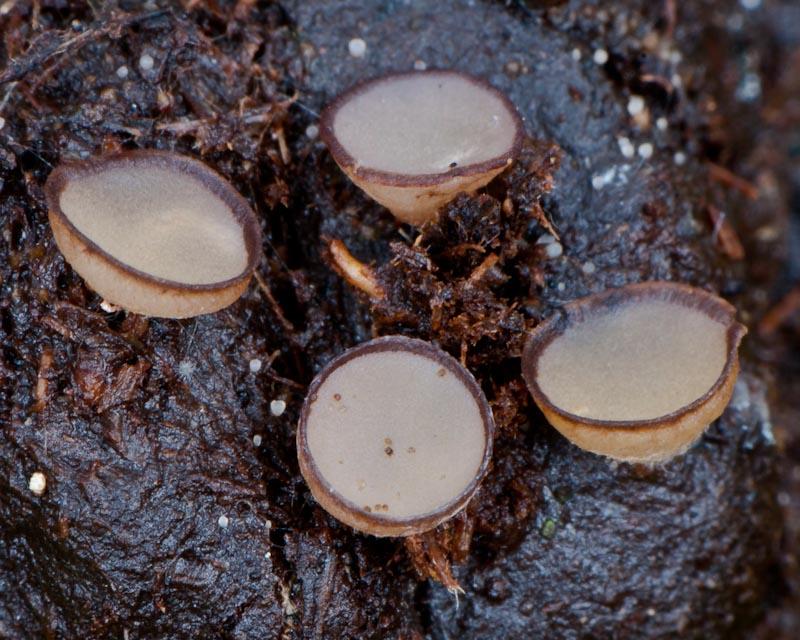
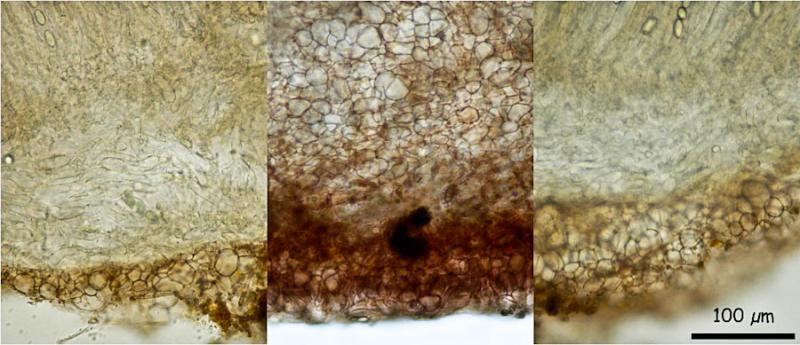
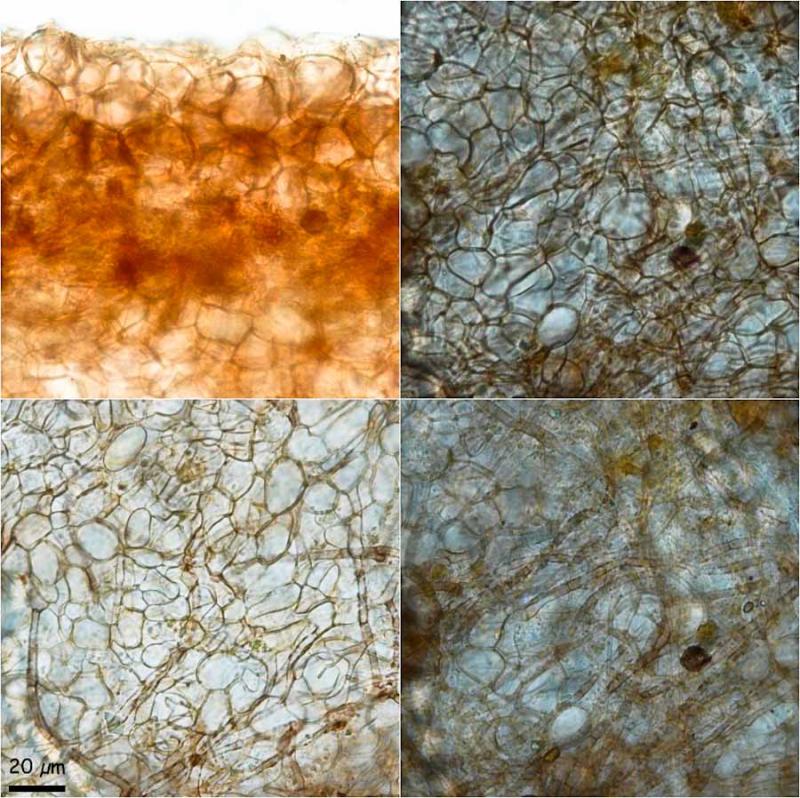
 Apos < 5 mm, with a big "collarium" at the margin, on deer dungs, 24/11/2012.
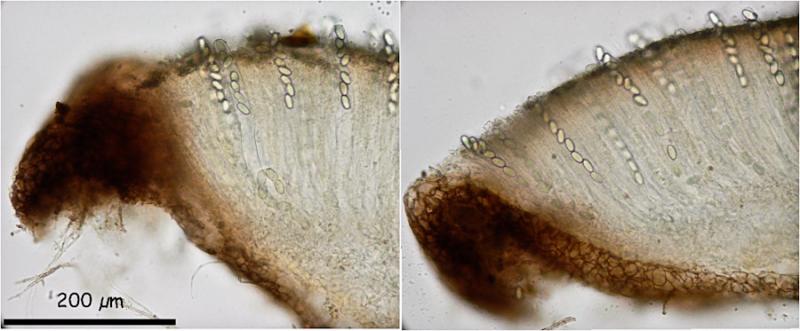
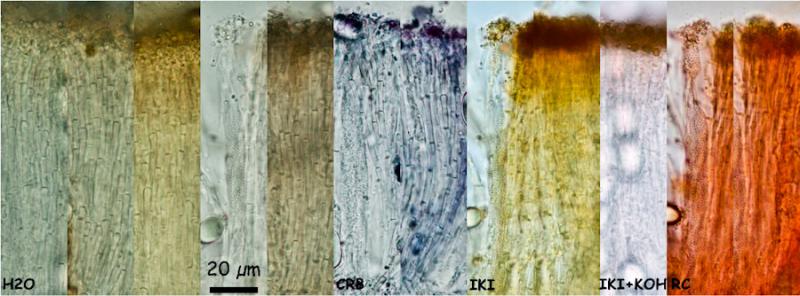
Asci inamiloid, 8-spores, operculate, croziers ¿? I am not sure.
Thanks.

ça manque de précision sur les dimensions des éléments micros et l'ornementation des spores
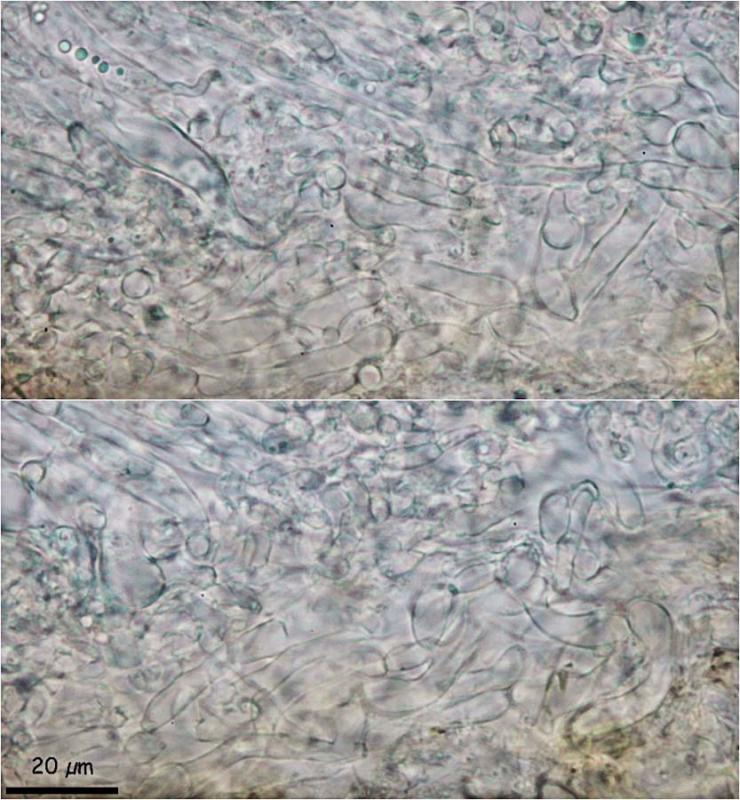
Paraphysis with many slightly strangulated septa and mixed with a "gloeocystidia-like" structure with many dots inside ¿?, with a red epithecium in IKI.
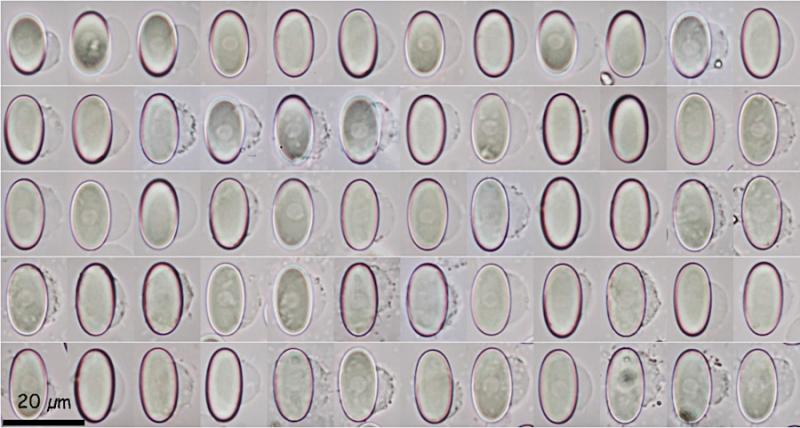
Spores (1000x, water)
(16.4) 17.0 - 18.2 (19.0) x (8.7) 9.2 - 10.0 (10.3) µm
Q = (1.7) 1.75 - 2.0 (2.1) ; N = 57
Me = 17.6 x 9.6 µm ; Qe = 1.8
Asci (400x, water)
(220.4) 221.7 - 237.0 (240.3) x (13.7) 14.5 - 18.7 (18.8) µm
N = 14; Me = 230.7 x 16.5 µm

Je suppose que tu as essayé de le comparer à P. cervaria
Amitiés et au plaisir de te revoir à Somiedo
Michel
I thought about P. cervaria, macro is more or less similar, but I did not see lateral and base hairs, it is completly smooth. This is the reason I doubt about the genus Pseudombrophila. But I suppose you are right, I have never seen it before.
Thanks.
http://www.asturnatura.com/fotografia/setas-hongos/pseudombrophila-theioleuca-rolland-1/3032.html
At Van Brummelen key, P. cervaria has reddish brown or brown disc and P. theioleuca hyaline or white. Mine is not white, but not reddish brown. And my asci have more than 200 µm long. ¿?
De par la présence de pigments bruns entre le sommet des paraphyses, je pense qu'il peut en effet s'agir de P. cervaria (Phill.) Brumm. Je ne suis cependant pas sûr que les ascospores présentées (et mesurées ?) soient matures. A cela deux raisons: la présence de granulations à l'intérieur (je ne parle pas du noyau qui est au centre) et le gélin qui entoure les ascospores, encore que certaines ascospores matures peuvent encore avoir encore du gélin. je remarque aussi que les ascospores sont plus larges que normalement chez cette espèce. Selon Brummelen 14,4-18,7 x 7, 9,9 µm (moyenne 16,6 x 8,8 µm). Je vous conseille de laisser encore maturer cette espèce et de refaire les mesures, sur sporée.
Proche de cette espèce il y a aussi P. theioleuca Rolland, qui croit aussi excréments de chevreuil, mais cette espèce ne présente pas de pigments bruns entre les paraphyses.
Cordialement
René
I can not say that the spores were fully mature, but I can assure that are measured outside the asci and expelled them without any pressure. They were obtained from the cross sections of the apothecia, in water and mounted without any pressure, only the coverslip. During the observation of the cuts to make the pictures I remember seeing the expulsion of many spores.
Unfortunately the collection is November 2012 and the apothecia are already dry. Next time I collect it, I will wait more time to mature.
Thank you very much for your help.
Cordialement.
Miguel Á. Ribes