
03-05-2026 10:57
 Castillo Joseba
Me mandan el material seco de Galicia (España) re
02-05-2026 12:42
Alain BRISSARDBonjour à tousJeuidi 30 avril dernier on m'a remi
02-05-2026 13:06
Pauline. PennaBonjour Please can someone help me with this id
01-05-2026 22:45
 Thierry Blondelle
Bonjour à tous, Une récolte sur bouse séchée d
28-04-2026 20:07
 Lothar Krieglsteiner
... on twig in the air at standing Ceratonia siliq
14-04-2026 05:32
Ethan CrensonHi all, A few weeks back a friend pointed out som
28-04-2026 20:33
Vitus SchäfftleinHello, I found Trochila ilicina on Ilex aquifoliu
30-04-2026 10:28
Rot BojanHello, by appearance I would say that I am dealing
Bark of Pinus sylvestris, N60,893086° E68,677082°, 09.09.2012.
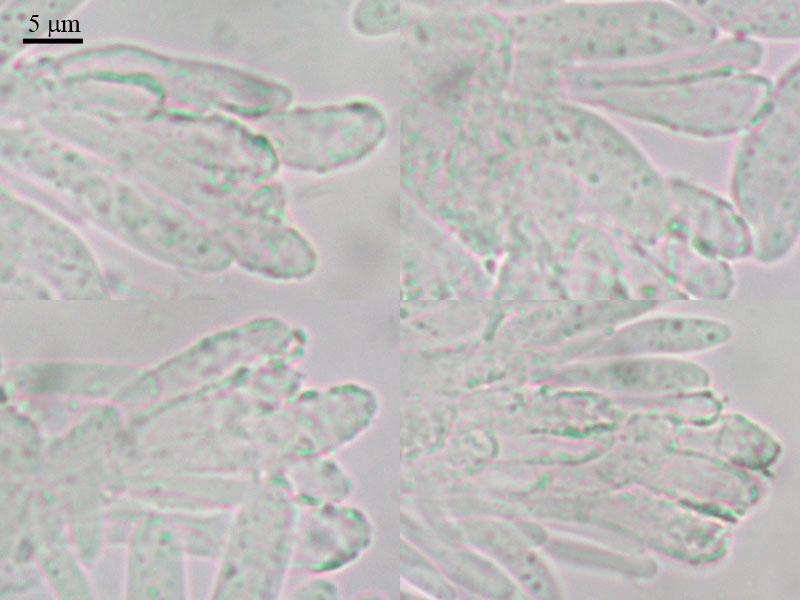
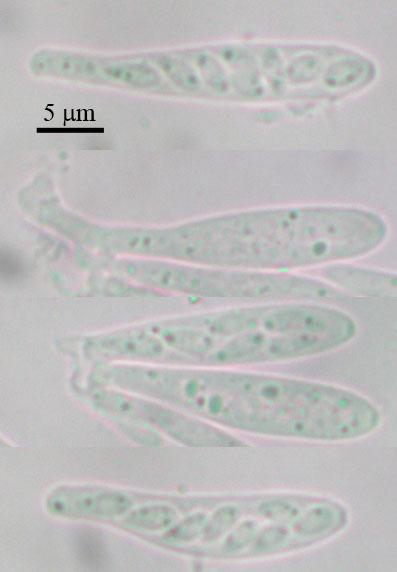
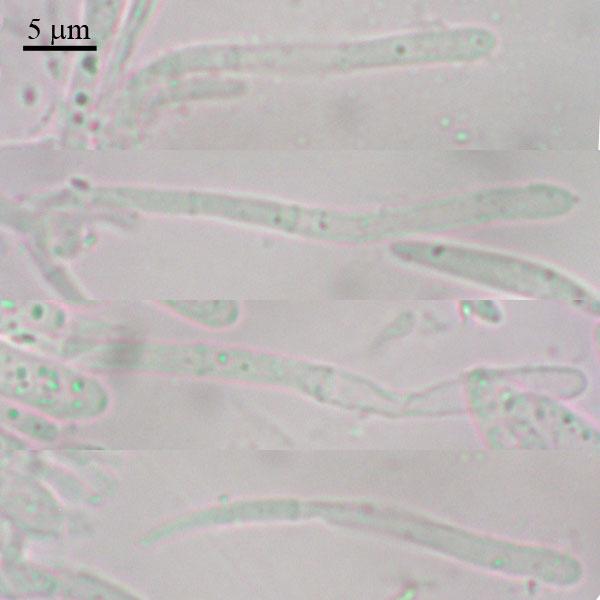
Apthecia cupulate - stipitate, disc concave to flat, stem length near equal the disc diametre, thin, outer surface powdery from short hairs, disc smooth, whitish, translucent, 180 x 170 mk.
Excipulum textura prismatica, cells cylindrical in stem and enlarged ellipsoid at disc; hairs cylindrical to clavate, 2-3 celled, end cell rough (covered by warts), 20 x 4; asci cylindrical, clamped, with amyloid pore, 23 x 4,3; paraphyses scarce, the same length as asci, with 1-2 septa at base, gradually enlarged to obtuse tip, 34 x 2,4 x 1,5, some branched at base; spores pip-shaped, 5,2 (4,7-6) x 1,8 (1,6-2,1) (Q=2,94; N=12).




possibly a stupid question - but definitely a Cistella? so not something like Fuscolachnum dumorum which can occur in the swarms you describe?
regards
Chris

you should consider Ciliolarina neglecta also, check if the granulation dissolves in MLZ or heated CB in lactic acid, I prefer the latter. For me the granulation is not convincing for Cistella acuum, but that could depend on the KOH.
best wishes,
Stip
really, roughness was lost in MLZ mount after it was tapped. I did not know about this genus before. I think C. neglecta will be the species then (from spore size and ascus pore +J).
May i ask you advise in CB solution preparing? - i've read instructions in "Methods of working with macrofungi", Clemencon, 2009, but for ascomycetes may be difference. Yet i have not Cotton Blue right now, but have Toluidine blue and Indigocarminum; i gues they not the same in effect.
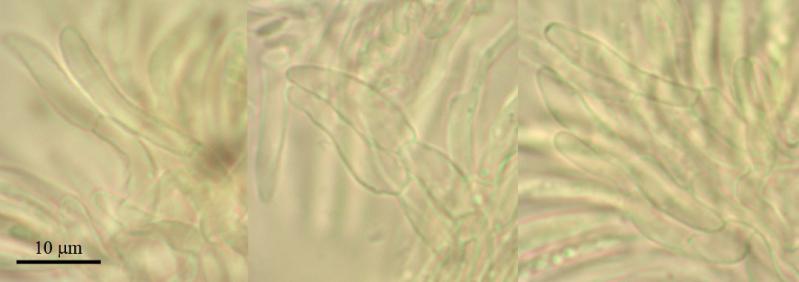
making a preparation in CB is easy, just put the fruitbody or a slice in a drop of CB, cover with a slide (and heat the mount with a gas flame eventually) It shows the plasmatic origin of some parts, for example in Cistella subgenus verrucotricha the spines on the hairs are coloured. the dissolving of the warts in Ciliolarina has probably more to do with the Lactic Acid.
Indigocarminum I don't know, Toluidine Blue has the same effect as Brilliant Cresyl Blue I think, it stains plasma also blue, but the violet stain ( the so called metachromatic reaction) points to some moleculair level, it has something to do with Iones and proteines(but I had no education on this matter) dissolved in water it stains in vital tissue refractive Vacuolebodies Turquoise.
To decide wether or not the parts are still vital is seen from the cell turgor in excipulair tissues and asci (living constricted at the septum which is straight, dead wrinkeled septum, living asci often show vacuoles and with full turgor the spores are pushed in the upper part, dead asci mostly show the wall more or less constricted around the spores like shrink-film)
the living spores show a distinct oildrop-pattern, in dead the oil is lumped together in one or two guttules
Next year try vital taxonomy ;-)
cheers,
Stip?
I will experiment with my dies ), that looks like play, though i seem lacking biochemical rools now. Very interesting about differences in vital \ dead material!