
28-04-2026 20:07
 Lothar Krieglsteiner
... on twig in the air at standing Ceratonia siliq
04-05-2026 18:13
 Stephen Martin Mifsud
ID request for what seems to be a true aquatic fun
04-05-2026 16:39
Stephen Martin Mifsud
ID request: This specimen was collected in Malta o
04-05-2026 09:50
 Castillo Joseba
Me mandan el material seco de Galicia,(España) re
02-05-2026 12:42
Alain BRISSARDBonjour à tousJeuidi 30 avril dernier on m'a remi
02-05-2026 13:06
Pauline. PennaBonjour Please can someone help me with this id
01-05-2026 22:45
 Thierry Blondelle
Bonjour à tous, Une récolte sur bouse séchée d
14-04-2026 05:32
Ethan CrensonHi all, A few weeks back a friend pointed out som
28-04-2026 20:33
Vitus SchäfftleinHello, I found Trochila ilicina on Ilex aquifoliu
Xylocoremium flabelliforme and Xylaria cubensis
John Plischke,
25-06-2012 08:49
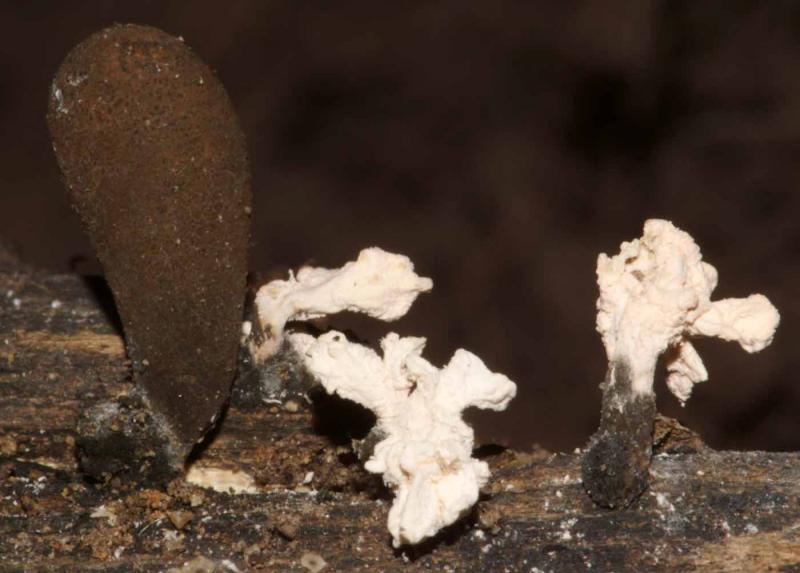
 Today I found Xylocoremium flabelliforme comfirmed microscopically, I have seen it several times before but always by itself. Today I found it with a Xylaria. Looking at the Xylaria under the microscope all I could find was a single spore 6 X 3.5 um. It looked just like a Xylaria spore but it did not have a germ slit. I am not certain where it came from. Looked for over an hour and I could not find any other spores. I do not want to make a false assumption on the single spore because I do not know where it came from since that is all I found. By doing a little reading it leads me to believe it may be Xylaria cubensis. There were a number of Xylaria longipes about 100 feet away. I have found X. longipes many times before but I never found X. cubensis. Does anyone know if there is a way to macroscopically tell them apart? From checking herbarim records it appears that Xylaria cubensis has not been collected in Pennsylvania before and I am very intrested in this. Thank you,
John
Thomas Læssøe,
26-06-2012 14:05
Re : Xylocoremium flabelliforme and Xylaria cubensis
even a mature X. cubensis will have brownish tinges on the surface and no real squamulose stuff unlike the grey to black, ± squamulose (and much bigger) X. longipes. Your thing looks like X. cubensis but the spore must be alien else you would fine many. A young X. longipes will be grey powdered from conidia - there is no conidial production on the surface of a cubensis stroma.
cheerss
cheerss
John Plischke,
27-06-2012 06:54
Re : Xylocoremium flabelliforme and Xylaria cubensis
Thank you Thomas
John
John
Jacques Fournier,
29-06-2012 21:04

Re : Xylocoremium flabelliforme and Xylaria cubensis
Hi John,
I have already seen one stroma of typical X. cubensis collected by Marc Stadler in Germany.
The associated anamorph leaves little doubt about the identity of the fungus. Xylaria cubensis, unlike all known European taxa, features a thick carbonaceous crust above the perithecial layer, nearly 200 µm thick, which is easy to evaluate on a split up stroma.
The spores of X. cubensis are dark brown and indeed the germ slit is very difficult to make out, if not absent. Maybe your stroma is hardly mature, check perithecia near the base, they get mature first. You can't base your observations on only one spore, try to find mature asci!
Cheers,
Jacques
I have already seen one stroma of typical X. cubensis collected by Marc Stadler in Germany.
The associated anamorph leaves little doubt about the identity of the fungus. Xylaria cubensis, unlike all known European taxa, features a thick carbonaceous crust above the perithecial layer, nearly 200 µm thick, which is easy to evaluate on a split up stroma.
The spores of X. cubensis are dark brown and indeed the germ slit is very difficult to make out, if not absent. Maybe your stroma is hardly mature, check perithecia near the base, they get mature first. You can't base your observations on only one spore, try to find mature asci!
Cheers,
Jacques
John Plischke,
01-07-2012 09:41
Re : Xylocoremium flabelliforme and Xylaria cubensis
Thank you Jacques
John
John