04-06-2026 10:50
 François Freléchoux
Bonjour, J'ai trouvé hier un petit asco observé
04-06-2026 07:02
François Freléchoux
Bonjour, Voici la description d'une espèce qui p
04-06-2026 13:34
Gernot FriebesHi,I am interested to hear your opinion on this Le
04-06-2026 11:36
Gernot FriebesHi,found on Vaccinium myrtillus.Asci: IKI –, 8-s
22-05-2026 13:29
Gernot FriebesHi,I am curious to hear your opinion on this mater
18-10-2022 00:12
Valencia Lopez Francisco JavierHola amigos/asRecientemente encontré esta colecci
03-06-2026 19:45
 Miguel Ángel Ribes
Good afternoonI'm completely baffled by this suppo
03-06-2026 14:39
Thomas FlammerApothecia yellow, glassy-transparent, 80 - 120 ymS
Coprotus? Need help
Björn Wergen,
15-11-2010 13:11
 Salut,
in the last days I have collected some dung from various animals (cow, horse...) to culture some coprophilous ascomycota. I have 10 different species now, but with the 11. one I have some problems with determination. Perhaps you can help me ;)
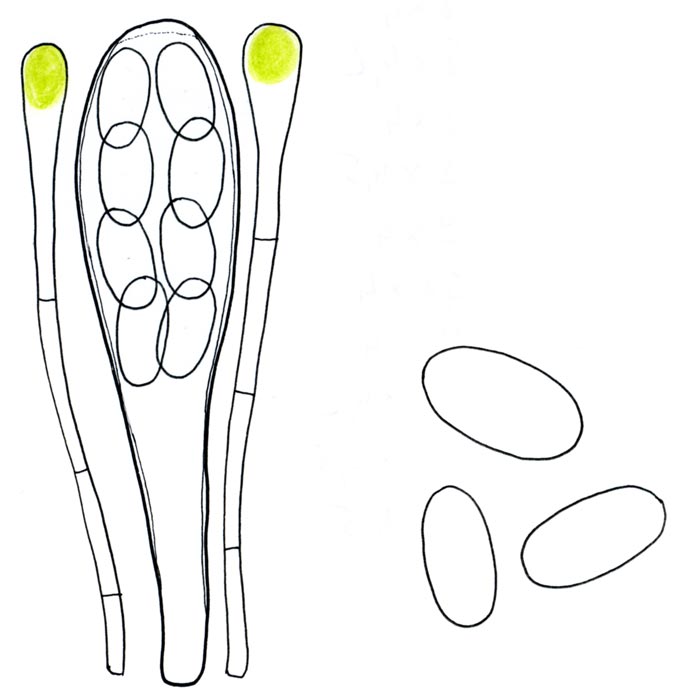
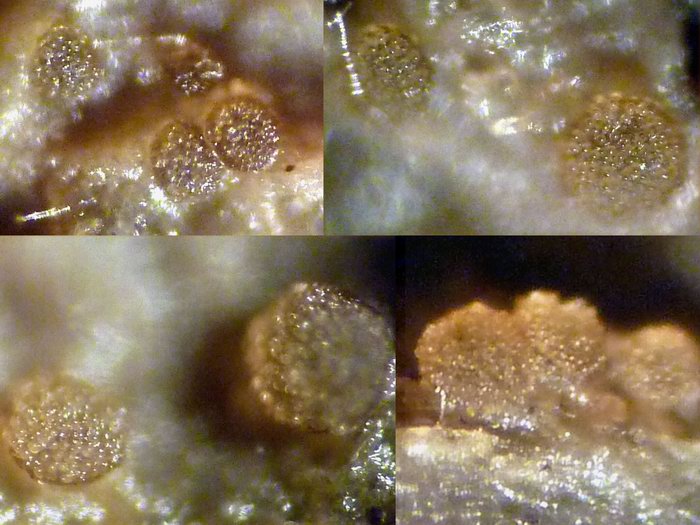
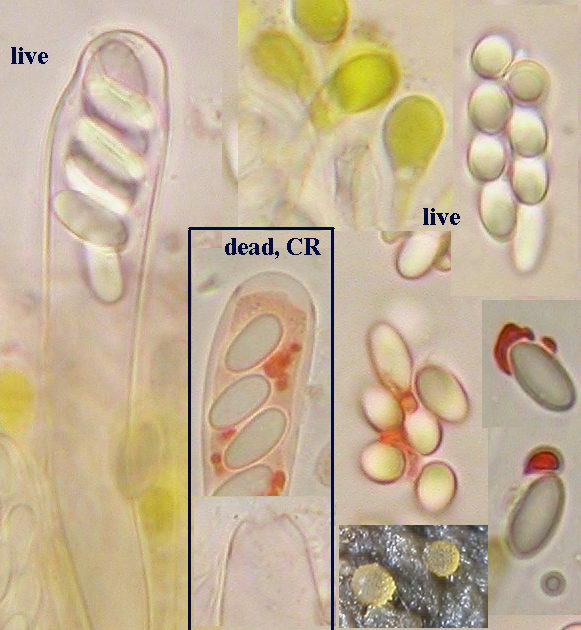
Fruitbody 0,08-0,2 mm, discoidal with protuding asci, first pale ochraceous-yellow, later darker, ochraceous to pale brown.
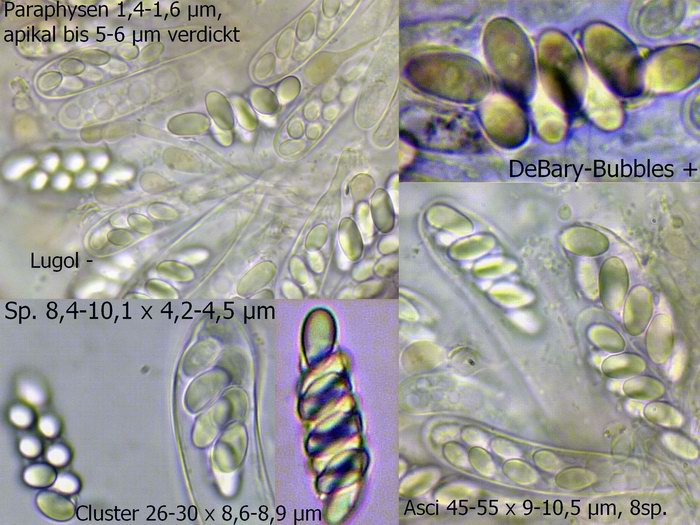
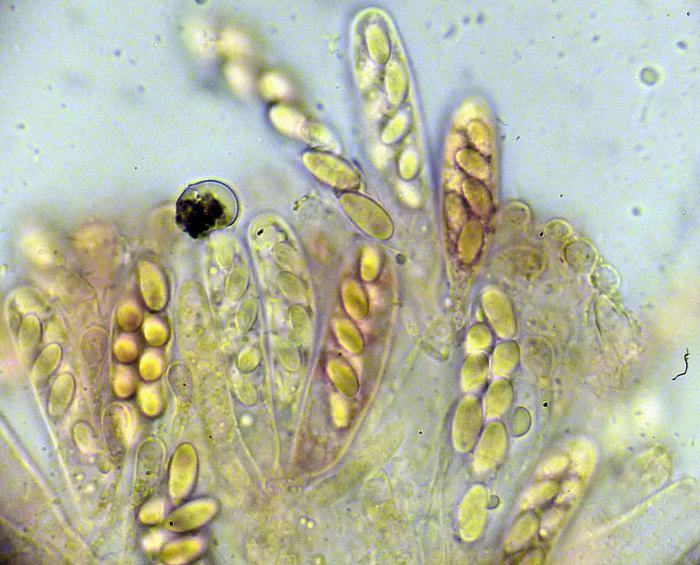
Spores 8,4-10,1 x 4,2-4,5 µm, ellipsoid with rounded ends, smooth, hyaline, with a DeBary-Bubble (only seen under x1000 with immersion and very good eyes :D ), glued to a cluster, also after leaving ascus, Cluster 26-30 x 8,6 - 8,9 µm.
Asci claviforme, very short stalked, hyalin, with 8 spores and an irregular biseriat arrangement (glued together).
Paraphyses 1,4-1,6 µm, apical strongly swollen up to 5-6 µm, with paly yellowish pigment, smooth.
Found on cow-dung together with Cheilymenia granulata.
It seems as if there is a Coprotus with hyalin, saccoboloid spores...can that be?? Anyway, hope you can give me some hints ;)
Thanks a lot and cheers,
Kazuya
Björn Wergen,
15-11-2010 13:12
Re:Coprotus? Need help
mikro1
Björn Wergen,
15-11-2010 13:12
Re:Coprotus? Need help
mikro2
Hans-Otto Baral,
15-11-2010 13:36

Re:Coprotus? Need help
Dear Kazuya
I imagine that your fungus s Thelebolus microsporus. Typical is that the spores glue together after discharge. Also there is no operculum, and the species is more close to the Helotiales (Thelebolaceae). There is a gluing substance which stains bright red in Congo (CR).
I had a fresh collection on sheep dung, with ssci *60-80 x 11-12.5 µm, with croziers, IKI-, +H2O mostly with apical thickening with apical chamber, opening by a split, no operculum. Sp. 8-9.5 x 4.5-4.8 µm.
There are no DBS. What you saw is the nucleus. Did you mount it fresh in water? Then maybe you see the greenish-yellow VBs in the paraphyses.
Good luck!
Zotto
I imagine that your fungus s Thelebolus microsporus. Typical is that the spores glue together after discharge. Also there is no operculum, and the species is more close to the Helotiales (Thelebolaceae). There is a gluing substance which stains bright red in Congo (CR).
I had a fresh collection on sheep dung, with ssci *60-80 x 11-12.5 µm, with croziers, IKI-, +H2O mostly with apical thickening with apical chamber, opening by a split, no operculum. Sp. 8-9.5 x 4.5-4.8 µm.
There are no DBS. What you saw is the nucleus. Did you mount it fresh in water? Then maybe you see the greenish-yellow VBs in the paraphyses.
Good luck!
Zotto
Björn Wergen,
15-11-2010 14:08
Re:Coprotus? Need help
Hi Zotto,
many thanks for help, I've also thought about T. microsporus, but I had never seen this one with that glued spores ;)
I will try it with CR next time. I have also seen paraphyses with this yellow pigment, fresh in water of course.
I will take a second look on this species. It's very very interesting for me ;)
Cheers,
Kazuya
many thanks for help, I've also thought about T. microsporus, but I had never seen this one with that glued spores ;)
I will try it with CR next time. I have also seen paraphyses with this yellow pigment, fresh in water of course.
I will take a second look on this species. It's very very interesting for me ;)
Cheers,
Kazuya
Nicolas VAN VOOREN,
16-11-2010 08:44

Re:Coprotus? Need help
Yes, this a very interesting species, also found this year on sheep dung.