
31-03-2026 21:18
 Miguel Ángel Ribes
Good evening. oes anyone have the original descrip
31-03-2026 20:57
Stefan BlaserHello everybody, I hope somebody can help me with
26-03-2026 15:31
 Åke Widgren
Hello,I found this one in October last year, on r
31-03-2026 16:20
 Mlcoch Patrik
Hello, Please about help with determination. On
31-03-2026 08:19
 Bernard CLESSE
Bonjour à toutes et tous,Pourriez-vous m'aider à
30-03-2026 12:03
 William Slosse
Hello all,On 27/03/26, in Kraaiveld in Wingene (Be
25-03-2026 10:35
Hulda Caroline HolteHello,I collected this species growing on a dead b
30-03-2026 09:53
Yanick BOULANGERBonjourVoici des petites fructifications poilues s
Annulohypoxylon
Dartanha Soares,
31-07-2015 15:20
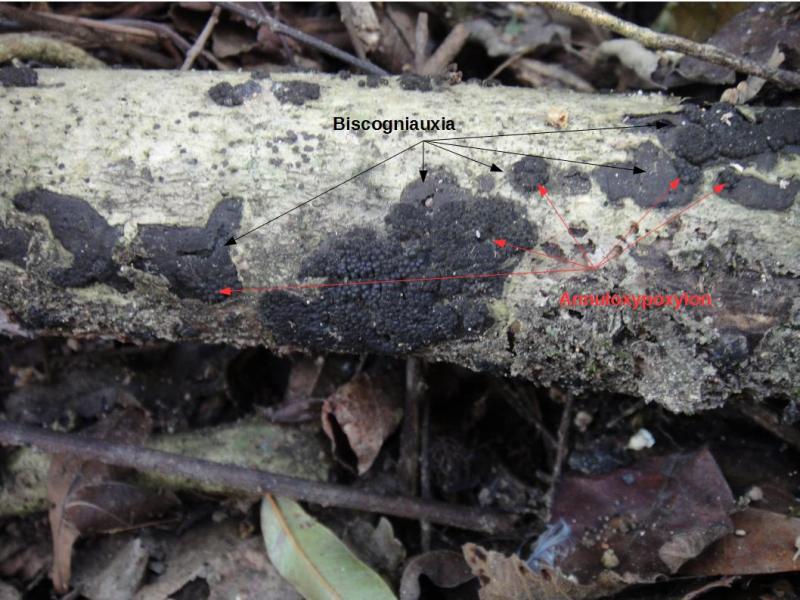
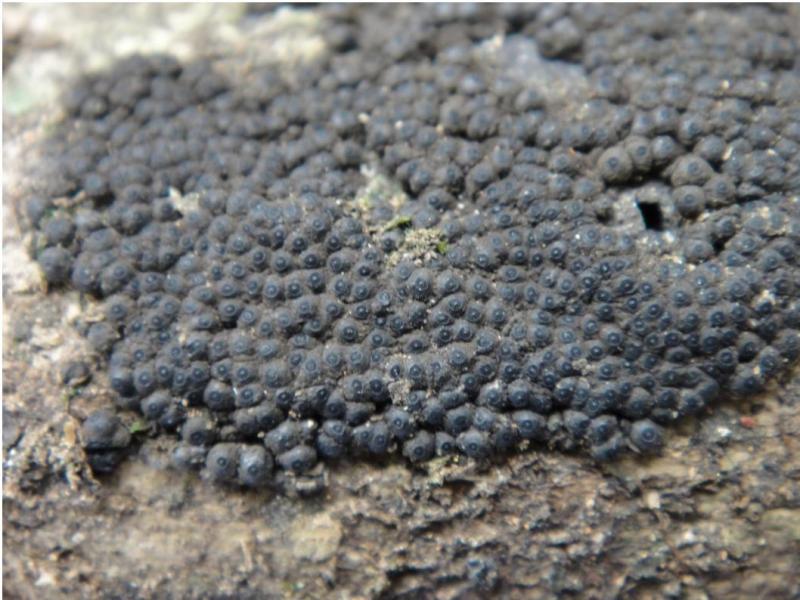
 Found this Annulohypoxylon on wood (unknown) in southeast Brazil (São Paulo state), in the same log that I found the Biscogniauxia capnodes (http://www.ascofrance.fr/search_forum/36990) and Pseudocosmospora joca (http://www.ascofrance.fr/search_forum/37055).
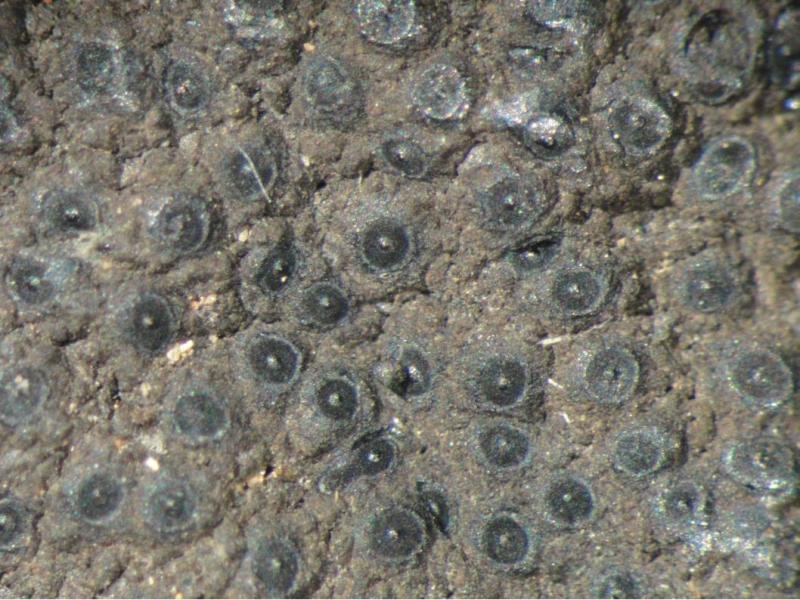
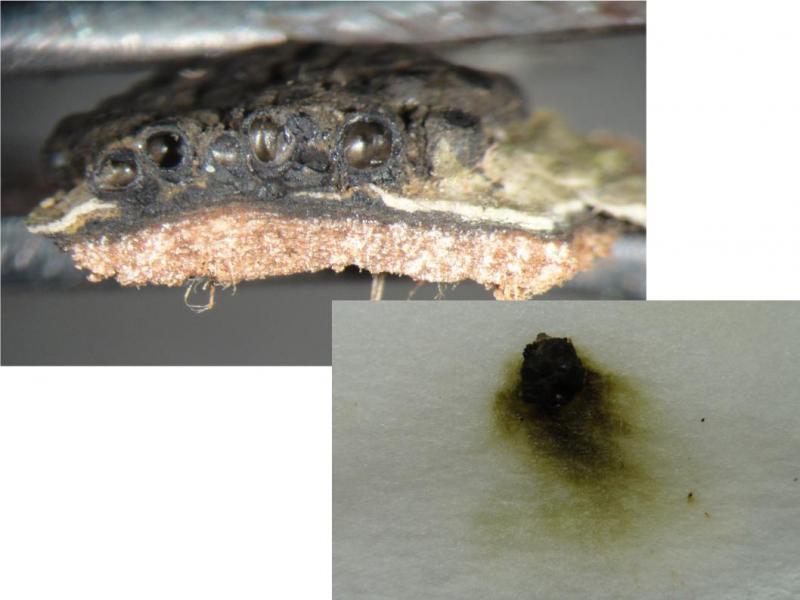
Clearly it is an Annulohypoxylon species, since it as a carbonaceous layer surrounding the perithecia, green KOH extractable pigments, ostioles are encircled by an annulate disk, ascospores has a thickened area (shoulder) at of ca. 1/3 spore lenght (from the perispore?).
It has asci with 100-130 x 4.5-5.5 µm and ascospores 6.5-8.0 x 3.2-4 µm.
The closer I was able to go was to A. annulatum, however I would like to hear your opinion about this fungus because I can't go further in the identification since I don't have the necessary literature.
A note that worth be mentioned about this fungus, is that it was found growing both, directly from the bark, but also over Biscogniauxia capnodes (Fig.1).
I would like to take this opportunity to ask if someone has the Ju and Rogers' monograph in pdf
(Ju Y-M, Rogers JD. 1996. A revision of the genus Hypoxylon. Mycologia Mem 20:1–365), and kindly could send it to me.
Thank you very much.
Update: I forgot to mention that the ostiole disk has 0.3-0.4 mm diam.
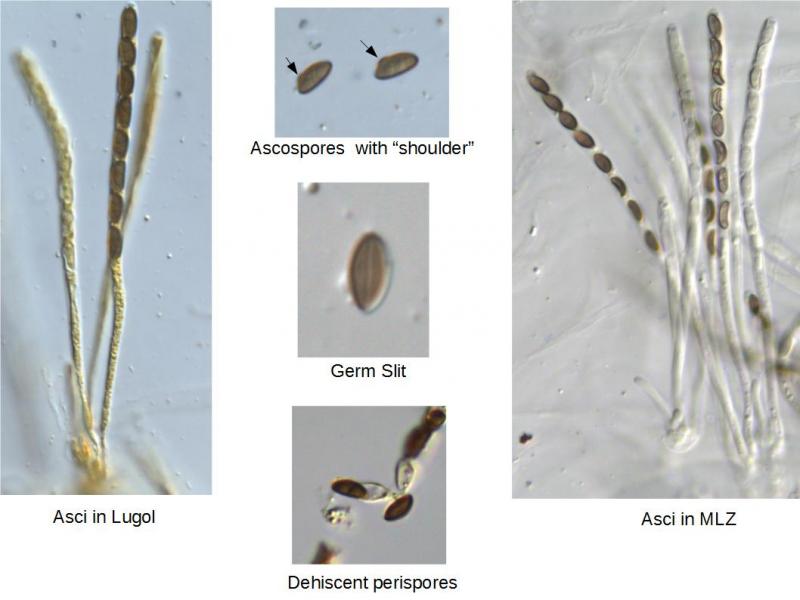
Thomas Læssøe,
31-07-2015 15:23
Re : Annulohypoxylon
You are aware of this website: http://mycology.sinica.edu.tw/Xylariaceae/ ?
Dartanha Soares,
31-07-2015 15:50
Re : Annulohypoxylon
Hi Thomas,
Yeah, I know it, but as I'm not familiar with this genus I'm not confident with my identification, I'm pretty sure it is wrong. Additionally, I would like to enrich my personal library, if you know what I mean. :0)
Thanks anyway.
Dartanha
Yeah, I know it, but as I'm not familiar with this genus I'm not confident with my identification, I'm pretty sure it is wrong. Additionally, I would like to enrich my personal library, if you know what I mean. :0)
Thanks anyway.
Dartanha
Dartanha Soares,
31-07-2015 16:25
Re : Annulohypoxylon
Checking again the key of section Annulata (http://mycology.sinica.edu.tw/Xylariaceae/) I missed the fact that A. annulatum has stromatal thickness greater than 2.5 mm, so I was right, my first identification was wrong! :0(
Still need help from experts.
Still need help from experts.
Jacques Fournier,
31-07-2015 20:18

Re : Annulohypoxylon
Hi Dartanha,
you are right on two points: it is an Annulohypoxylon and it is not A. annulatum.
I am afraid we cannot go further. It keys out to A. moriforme but the concept of this species is very wide and the name can be applied to morphologically very different collections.
It differs from "typical" A. moriforme in lacking small glomerate stromata, but this character is fairly variable.
I suggest you try to make additional collections of this species in the same area to record its natural variations and to evaluate which is not variable and may become discriminant.
You could also ask help from Jadergudson Pereira (Mycologia 102, 2010) who knows well this genus in Brazil and perhaps also encountered this species.
Cheers,
Jacques
you are right on two points: it is an Annulohypoxylon and it is not A. annulatum.
I am afraid we cannot go further. It keys out to A. moriforme but the concept of this species is very wide and the name can be applied to morphologically very different collections.
It differs from "typical" A. moriforme in lacking small glomerate stromata, but this character is fairly variable.
I suggest you try to make additional collections of this species in the same area to record its natural variations and to evaluate which is not variable and may become discriminant.
You could also ask help from Jadergudson Pereira (Mycologia 102, 2010) who knows well this genus in Brazil and perhaps also encountered this species.
Cheers,
Jacques
Dartanha Soares,
01-08-2015 14:13
Re : Annulohypoxylon
Hi Jacques,
Thank you for your comments, I will try to make additional collection, and also isolate the fungus, maybe I can obtain its DNA for a molecular study.
It seems that you and I will chat more and more in a near future (I still have additional collections of Xylariales).
Thank you for your comments, I will try to make additional collection, and also isolate the fungus, maybe I can obtain its DNA for a molecular study.
It seems that you and I will chat more and more in a near future (I still have additional collections of Xylariales).