
12-06-2026 14:50
 François Freléchoux
Bonjour, Voici la brève description d'une Mollis
10-06-2026 21:16
François Freléchoux
Bonsoir,Le dernier du jour, en attendant votre avi
11-06-2026 19:01
 William Slosse
Hello all,In an attempt to make a culture of a sus
11-06-2026 19:03
 Nicolas VAN VOOREN
Chers membres d'Ascofrance,Le site sera placé en

09-06-2026 18:32
Camille MertensSur morceau de roseau immergé 0,5 - 0,7 mm de dia
10-06-2026 12:54
Steve ClementsBonjour encore, Pouvez-vous m'aider, s'il vous pl
10-06-2026 21:07
François Freléchoux
Toutes les tiges de gentianes jaunes de l'an passÃ
10-06-2026 13:41
François Freléchoux
Bonjour à nouveau, Voici une trouvaille d'hier.
Calycina sp. 1 : C. subparilis ?
Nicolas VAN VOOREN,
31-10-2009 18:36
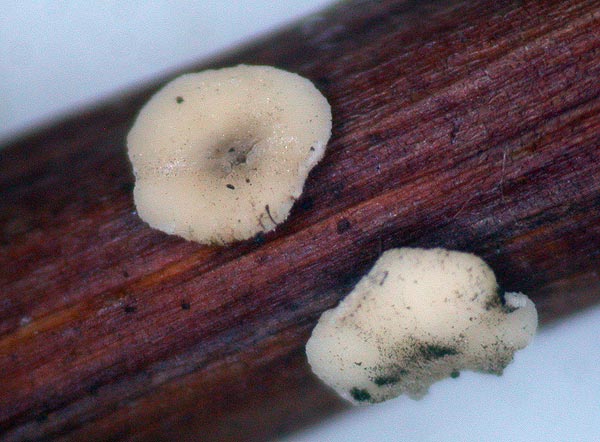
Bonjour.Voici les données d'une récolte d'un Calycina que je pense être C. subparilis d'après la clé de Zotto. Je suis intéressé par une confirmation.
Apothécies substipitées, discoïdes avec un petit ombilic, hyménium blanchâtre ou ivoire ; surface externe concolore, très finement furfuracée. Ø 0.9-1.2 mm
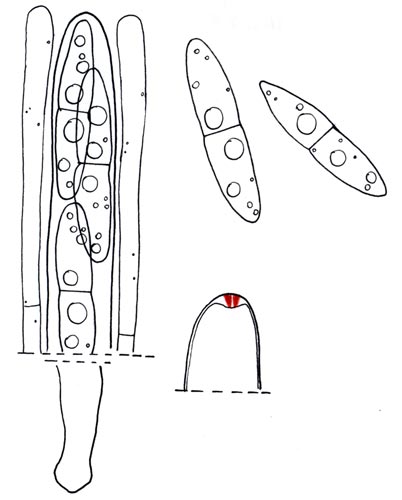
Excipulum de textura globulosa/subangularis, à hyphes Ø -> 12 µm, mais avec des cellules plus allongées et émergentes sur la partie extérieure. Asques avec crochet, 8 sp. ± bisériées, pars sporifera pratiquement sur toute la longueur, 65-70 x 4.8-6 µm, anneau apical IKI rb. Paraphyses sans vacuoles. Spores fusoïdes, avec 1 cloison (y compris dans l'asque), avec généralement 2-3 grosses gouttes réfringentes et d'autres plus petites, (11) 12-15 x (16) x (2) 2.5-3 µm
Nicolas VAN VOOREN,
31-10-2009 18:36
Re:Calycina sp. 1 : C. subparilis ?
Dessin micro...
Hans-Otto Baral,
31-10-2009 21:15

Re:Calycina sp. 1 : C. subparilis ?
Hi Nicolas
do you mean subparilis or subherbarum? :-)
subparilis has no croziesr and much wider spores. Your drawing looks like wide spores but 12-15 2.5-3 means quite narrow spores. Also subparilis grows on thicker wood and has asci without croziers. What is the substrate here?
Zotto
do you mean subparilis or subherbarum? :-)
subparilis has no croziesr and much wider spores. Your drawing looks like wide spores but 12-15 2.5-3 means quite narrow spores. Also subparilis grows on thicker wood and has asci without croziers. What is the substrate here?
Zotto
Nicolas VAN VOOREN,
01-11-2009 10:00
Re:Calycina sp. 1 : C. subparilis ?
Thank you Zotto.
OK, for C. subherbarum. The paraphyses I saw on this collection were probably dead.
The substrat is a dead herbaceous stem (I cannot identify the plant).
OK, for C. subherbarum. The paraphyses I saw on this collection were probably dead.
The substrat is a dead herbaceous stem (I cannot identify the plant).